
Power flushing
Power Flush Cost: What You Should Expect
A power flush is not a spa day for radiators. It is chemicals, hoses, magnets, black water and a fair bit of graft.
Insight by Vector Heat
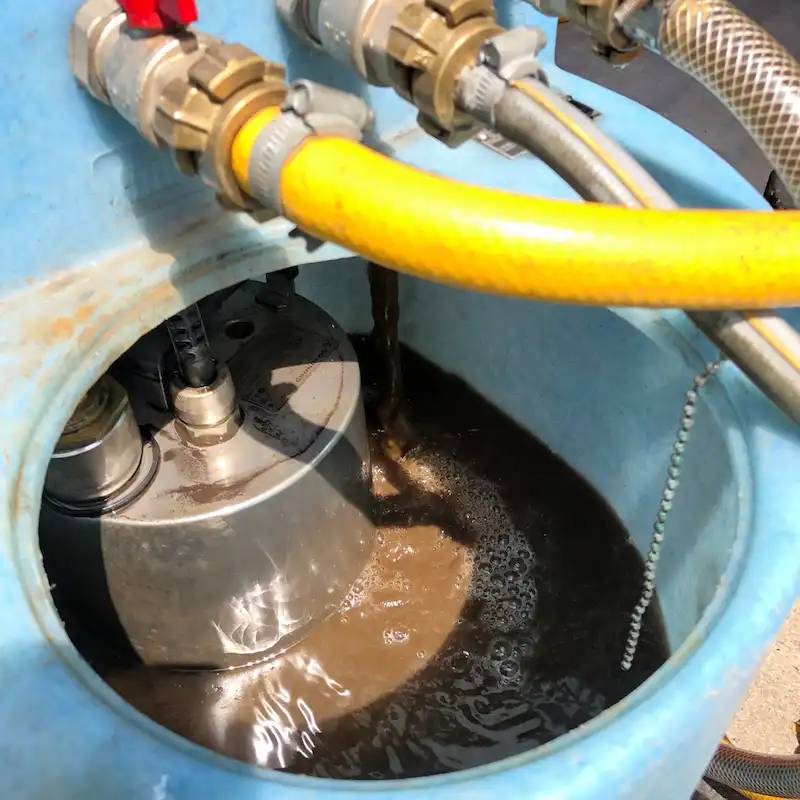
The short answer is this: power flush cost normally starts around £800 with Vector Heat. Larger heating systems, badly sludged systems, blocked pipework, failed pumps or extra repair work can cost more.
The more useful answer is this: not every dirty heating system needs a full power flush.
That bit matters. Some systems need the full all-day clean. Some need a lighter clean, a mains-pressure flush, a chemical clean, a water change, a filter clean or a proper repair. Selling a full power flush to every dirty system is like using a sledgehammer to crack a biscuit. Effective, possibly, but not a sign of a balanced morning.
Key points
Starting point
Vector Heat power flushes normally start around £800.
Usually a full day
A proper flush is labour-intensive, not a five-minute miracle.
Diagnose first
The system condition should decide the cleaning method.
Not always needed
Some systems only need a lighter clean or targeted repair.
Quick answer: how much does a power flush cost?
At Vector Heat, a power flush normally starts from around £800.
The final price depends on:
| Cost factor | Why it matters |
|---|---|
| Number of radiators | More radiators means more time flushing each one properly. |
| System size | Bigger systems hold more water and take longer to clean. |
| Sludge level | Heavy magnetite and sludge need more time and chemical work. |
| Blocked pipework | A full blockage can turn a clean into a repair job. |
| Pump, valve or cold feed faults | Faulty parts, stuck TRV pins or blocked cold feeds may need sorting before the system works properly. |
| Access | Loft boilers, tight airing cupboards and awkward pipework slow the job down. |
| System history | Old open-vent systems are more likely to carry corrosion debris. |
If the system is straightforward, the starting price may cover it. If the system is badly blocked, has a weak pump, or needs pipework altered, the price goes up because the job has stopped being just a clean.
It has become plumbing archaeology. Nobody cheers when archaeology happens in an airing cupboard.
Quick version
Power flush cost: our power flushing service usually starts around £800.
Typical time: often a full day.
Best for: badly sludged heating systems, cold radiator bottoms across multiple radiators, poor circulation, black water, filters repeatedly found full of magnetite, and systems with old open-vent or header-tank history.
Not always needed: some systems only need a mains-pressure flush, chemical clean, water change, filter clean or targeted repair.
Biggest mistake: paying for a full power flush before anyone has properly diagnosed the problem.
That last point is the one I care about most. A power flush should be recommended because the evidence points that way, not because someone likes writing it on quotes.
What is a power flush?
A power flush is a way of cleaning a central heating system by circulating water and cleaning chemicals through the boiler, radiators, pipework, pump, valves and other components.
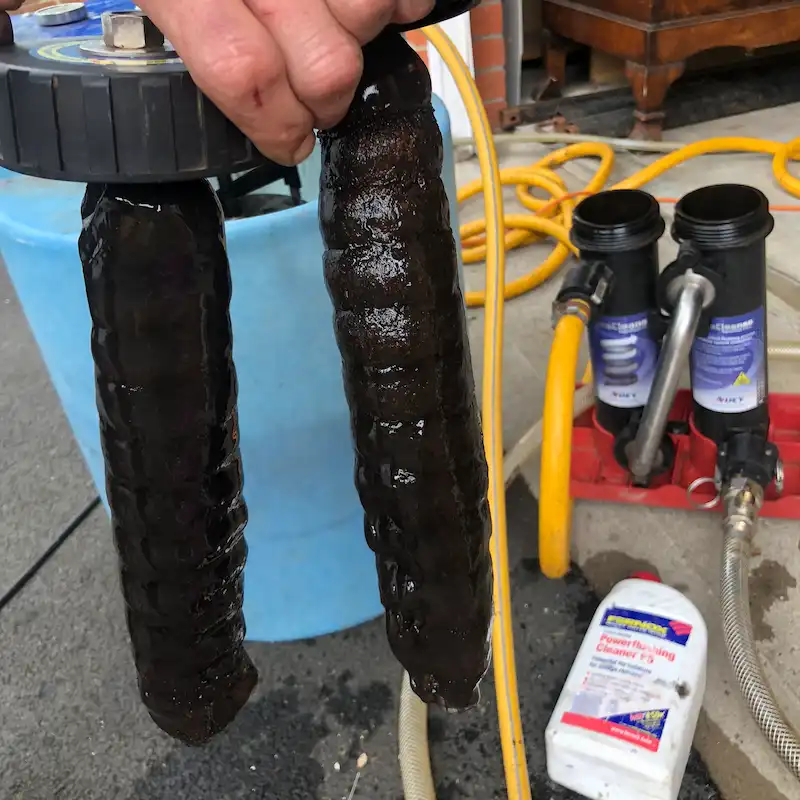
The target is usually magnetite. That is the black magnetic debris that forms when steel radiators and other ferrous parts corrode. It is the stuff that makes heating water look like it has lost a fight with a photocopier.
Magnetite can collect in:
- radiator bottoms
- pipework
- pumps
- boiler heat exchangers
- motorised valves
- magnetic filters
- narrow waterways inside modern boilers
When there is only a small amount of dirt, a lighter clean can be enough. When the system is badly sludged, normal draining can leave too much behind. That is when chemicals, flow, magnetic capture and time become important.
Why does power flushing cost so much?
Because a proper power flush is usually an all-day job, and it is hard work.
It can involve:
- connecting flushing equipment
- adding cleaning chemicals
- circulating the system
- changing the flow direction
- flushing radiators one at a time
- using magnetic capture to remove magnetite
- checking radiator performance
- removing dirty water
- refilling the system
- adding inhibitor
- checking the system afterwards
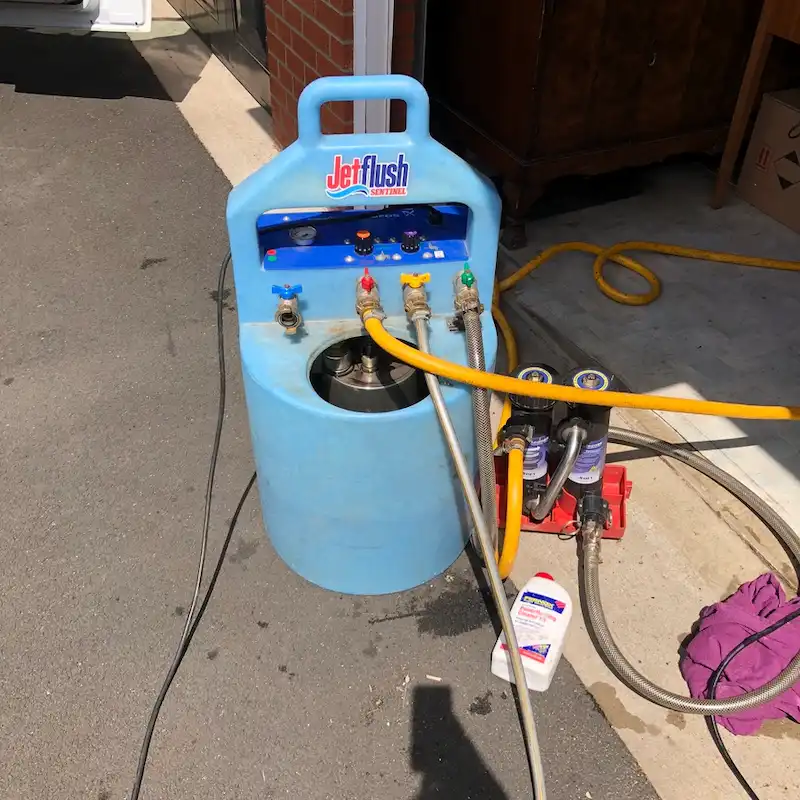
Vector Heat uses a MagnaCleanse-style setup with strong magnets connected to the flushing equipment. As dirty heating water passes through, magnetite sticks to the magnets instead of carrying on around the system causing trouble.
That is the satisfying bit. Engineers pretend to be mature, but every heating engineer secretly enjoys seeing black sludge come out of a system. It is disgusting, useful and oddly rewarding. Like cleaning a barbecue, but with more plumbing qualifications.
Sometimes radiators need careful tapping with a rubber mallet to help loosen sludge from the bottom. The word "careful" is doing work there. This is not a Chuckle Brothers demolition scene. The aim is to persuade the sludge to move, not teach the radiator a lesson it will remember.
What affects power flush cost?
Number of radiators
The more radiators a property has, the longer the job takes. A good flush is not just connecting a machine and hoping the whole system sorts itself out while everyone has a biscuit.
Radiators often need to be worked through one at a time. That means closing others down, moving flow through one radiator, checking what comes out, then moving to the next.
This is why the cost of power flushing radiators rises with system size. More radiators means more time, more checks and more opportunities for one valve to look older than it claims.
Sludge level
A lightly dirty system is different from a heavily sludged system.
If the water is a bit discoloured, a lighter clean might be enough. If several radiators are cold at the bottom, the magnetic filter is repeatedly found full of magnetite and the water is thick black soup, the system needs more serious attention.
The more sludge there is, the more time the chemicals need to circulate and the more work it takes to get the dirt moving.
Blocked pipework
Sometimes a flush reveals a complete blockage. This is especially common around older airing-cupboard pipework, pumps, valves or areas where old system debris has had years to settle down and get comfortable.
If pipework is completely blocked, flushing alone may not fix it. Pipework may need replacing or repiping.
That is not a hidden power flush charge. That is a separate fault showing itself halfway through the job.
Pump, valve, cold feed or filter findings
A system with sludge can also have a weak pump, a stuck TRV pin, a stuck valve, a blocked cold feed on an open-vented system, a filter full of magnetite or another poor circulation fault.
This is why diagnosis matters. If the system does not circulate properly, a power flush may be harder to carry out and the heating may still not work properly afterwards until the faulty part is sorted.
A boiler making a noise is not proof that the system needs flushing. The timing and source of the sound need checking first.
If another company has diagnosed sludge but the explanation is vague, we may want to inspect the system first. That is not being awkward. It is trying to stop the job turning into "while we are here, we have also found..." which is nobody's favourite sentence.
Access and layout
Access matters. A boiler in a nice open utility room is one thing. A boiler in a loft, a tight cupboard or an airing cupboard with pipes arranged like a game of KerPlunk is another.
The more awkward the access and layout, the more time the job can take.
Does every dirty heating system need a power flush?
No.
This is the bit some power flush pages glide past quite happily. They probably should not.
A power flush is normally for the worst sludged-up systems. Many heating systems can be improved with something lighter, such as a mains-pressure flush, a chemical clean, a water change, a filter clean, a targeted pipework or pump repair, or cleaner added and circulated before a later drain and refill.
The right method depends on the evidence.
If the system water is dirty but the radiators heat well, the magnetic filter is not repeatedly found full of magnetite and the system has always been sealed, a full power flush may be overkill. If the system has been open vented for years, has cold radiator bottoms across multiple radiators and produces black water that looks like it has made some poor decisions, a full flush becomes much more sensible.
Heating is full of "it depends", which is annoying, but cheaper than pretending every house is the same.
Power flush vs chemical flush vs mains-pressure flush
Here is the plain-English version.
| Cleaning method | What it is | Best for |
|---|---|---|
| Power flush | Machine-led clean using flow, chemicals and magnetic capture. | Badly sludged systems with poor circulation. |
| Chemical clean | Cleaner added to help break down debris, usually less aggressive. | Mild to moderate dirt where circulation is still reasonable. |
| Mains-pressure flush | Thorough flushing using mains water pressure. | Systems that need a good clean but not the full power flush setup. |
| Water change or filter clean | Drain/refill or filter maintenance. | Light dirt, routine protection or after specific works. |
The mistake is thinking these are all the same thing with different names. They are not.
A chemical clean is not automatically a power flush. A filter clean is not a system clean. A power flush is not automatically the best choice just because it sounds more serious.
A filter clean, chemical clean and power flush are not the same job with different names.
Signs a power flush might be needed
A power flush may be worth considering if:
- several radiators are cold at the bottom
- some radiators barely heat at all
- the heating takes a long time to warm up
- the boiler is noisy
- pumps or valves keep failing
- the magnetic filter is repeatedly found full of magnetite
- heating water is black
- the system has poor circulation
- a dirty old system is getting a new boiler
- there is known open-vent or header-tank history
But symptoms alone are not enough.
Cold radiators can be caused by sludge, but a stuck TRV pin is probably the most common cause, especially if it is just one radiator. They can also be caused by balancing, stuck valves, pump faults, air, poor pipework, undersized pipework or design issues. Heating systems are very good at making three faults look like one fault. It keeps engineers humble.
Why system history matters
Open-vent systems and header tanks
Older open-vent systems, especially those with a small header tank in the loft, are more likely to have sludge and magnetite.
The reason is oxygen. In an open-vent system, oxygen can keep getting into the heating water through the tank. Oxygen reacts with steel radiators and other ferrous parts, and that corrosion produces magnetite.
If oxygen keeps being replenished, corrosion can keep happening.
That is why an old open-vent history matters even if the system has since been sealed. The boiler on the wall today does not tell the whole story. The old pipework usually has receipts.
Sealed systems
A sealed system is different.
In a sealed system, the available oxygen in the water is limited. Once it has reacted, it is not easily replenished unless the system keeps being topped up because of leaks or pressure loss.
That does not mean sealed systems never get dirty. They can. But a clean sealed system should not automatically be treated as a full power flush job.
If a sealed system keeps needing topping up, the first question is not "shall we fit another filter?" The first question is "where is the water going?"
What happens during a Vector Heat power flush?
Every system is different, but a full power flush can look something like this:
- We assess the heating system and symptoms.
- We connect flushing equipment to the system.
- We add suitable cleaning chemicals.
- We circulate the system and start collecting magnetite.
- We work around the radiators one at a time.
- We reverse flow where useful.
- We tap radiators carefully where sludge is settled.
- We keep flushing until the water condition improves.
- We refill the system and add inhibitor.
- We check operation afterwards.
The aim is not just to make the water look nicer for five minutes. The aim is to restore flow through the parts that matter and protect the boiler and system.
This is where magnetic capture helps. Seeing magnetite build up on the magnets tells you the system is giving up the rubbish it has been storing. It is oddly satisfying, in the same way peeling protective film off a new appliance is satisfying. Do not pretend you do not enjoy that.
Should you get a power flush before a new boiler?
Sometimes, yes. Not always.
A new boiler should be fitted onto system water that is clean enough for the boiler and warranty requirements. The cleaning method should be decided by the system condition, not by a blanket rule.
A full flush is more likely where the system has been open vented, has header-tank history, has old radiators and pipework, shows black water or magnetite, has cold radiator bottoms across multiple radiators, has filters repeatedly found full of magnetite, has a blocked cold feed on an open-vented system, or has poor circulation.
If the heating has always been a clean sealed system and the water condition is good, it may only need a water change, rinse or lighter clean.
At Vector Heat, we fit a magnetic filter on boiler installations for Building Regulations compliance and manufacturer guarantee reasons. A filter is also technically useful where there is open-vent history, old radiators or evidence of magnetite.
But a filter is protection. It is not a time machine. If the system is already full of sludge, fitting a filter and hoping for the best is not a strategy.
Can a power flush damage pipes?
A properly carried out power flush should not damage sound pipework.
The caveat is old or weakened systems. If a pipe, radiator, valve or fitting is already badly corroded or close to failing, cleaning and circulation can reveal that weakness.
That does not mean the flush "caused" the problem in the simple sense. It means the system was already in poor condition and the job exposed it. Still not fun, obviously. Nobody wants to find the weakest fitting in the house halfway through a clean.
This is another reason diagnosis matters. If a system is ancient, heavily corroded or showing signs of fragile pipework, the engineer should use judgement before choosing the cleaning method.
Before you pay for one, get the diagnosis right
The best power flush advice is not "book a power flush".
It is "work out whether the system needs a power flush".
That means looking at radiator performance, TRV pins, water colour, magnetic debris, filter condition, cold feed condition on open-vented systems, system layout, pump performance, valve operation, boiler symptoms, system history and whether the issue is sludge or something else.
After 23 years in plumbing and heating, and 14 years surveying boiler and heating work, you see the same pattern again and again: the obvious answer is not always the right answer.
Sometimes a system needs a full flush. Sometimes it needs a pump. Sometimes it needs balancing. Sometimes it needs a bit of pipework replacing. Sometimes it needs someone to stop blaming the boiler and look at the heating system properly.
The boiler gets blamed for everything. It is the family printer of the heating world.
FAQ
How much does a power flush cost?
Vector Heat power flush cost normally starts from around £800. Bigger systems, badly blocked systems, awkward layouts or extra repair work can cost more.
Why is power flushing so expensive?
Because a proper power flush is usually an all-day, labour-intensive job. It can involve chemicals, flushing equipment, magnetic capture, radiator-by-radiator work, refilling, inhibitor and post-flush checks.
How long does a power flush take?
A proper power flush often takes a full day. Very large systems, badly blocked systems or systems with faults can take longer or need extra repair work.
Is a power flush worth it?
It is worth it when the system is badly sludged and poor circulation is causing real problems. It is not worth paying for a full power flush if a lighter clean or repair would solve the issue.
What is the difference between a power flush and a chemical flush?
A chemical clean uses cleaner to help break down debris. A power flush uses specialist flushing equipment, flow and often magnetic capture to move and remove debris more aggressively.
Can a power flush damage pipes?
A properly carried out power flush should not damage sound pipework, but it can reveal weaknesses in old, corroded or fragile systems. That is why judgement matters before starting.
Do you need access to all radiators?
Yes, a proper power flush usually needs access to the radiators so they can be checked and worked through properly. If half the radiators are behind furniture, the job starts with moving furniture, not flushing radiators.
Can a magnetic filter replace a power flush?
No. A magnetic filter helps capture circulating magnetite and protect the boiler, but it does not properly clean a badly sludged system by itself.
Think your system needs flushing?
If several radiators are cold at the bottom, your magnetic filter is repeatedly full of black sludge, or someone has told you that you need a power flush without much explanation, Vector Heat can inspect the system first.
If it needs a full power flush, we will say so. If a lighter clean or repair makes more sense, we will say that too.
Nobody should be sold a full-day power flush if the heating only needed a smaller fix.
Ask Vector Heat about flushing