
Boilers
Boiler Leaking Water: What to Check First
A boiler leaking water is one of those lovely household moments where you suddenly become a detective, plumber, risk assessor and towel manager all at once.
Insight by Vector Heat
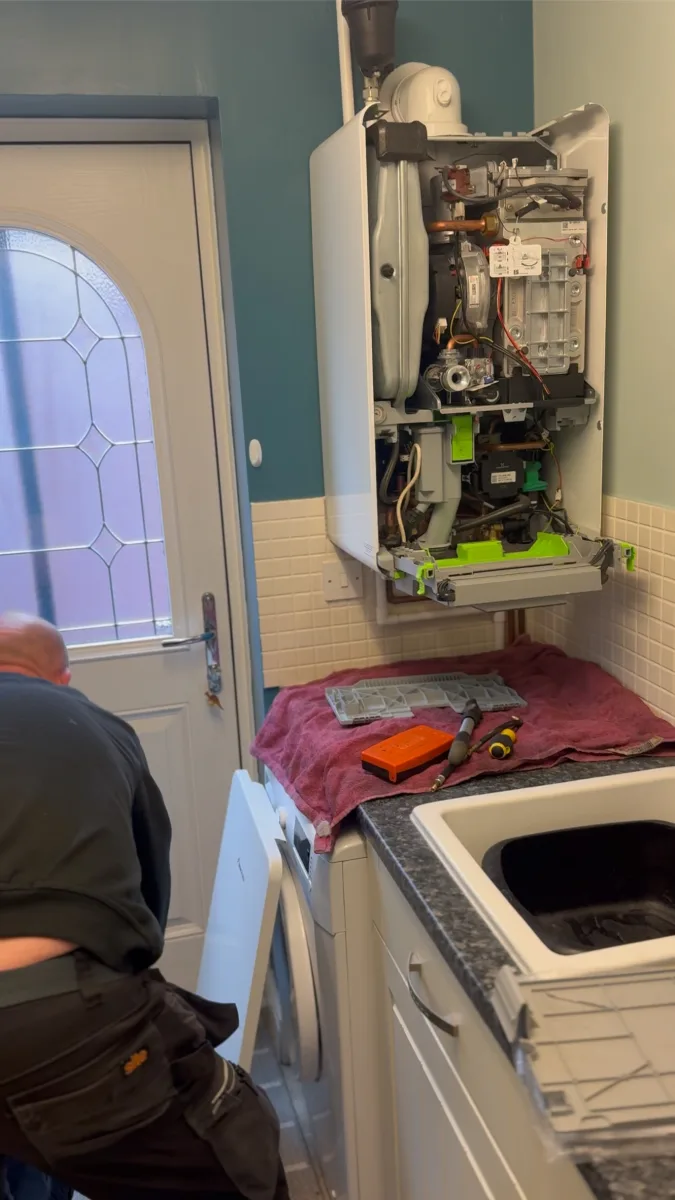
The short answer is this: make it safe, do not remove the boiler case, check whether the pressure is changing, and call a heating engineer if the leak appears to be inside the boiler. Some leaks are simple pipework or washer faults. Some need proper diagnosis by a heating engineer.
This guide is for safe observations around the boiler, not work inside the appliance.
Key points
Make it safe
Keep water away from electrics and turn the boiler off if the leak is heavy.
Leave the case on
Look around the boiler, but do not remove the casing to hunt for the leak.
Check pressure
The gauge can tell you whether water is leaving the heating system.
Take photos
Clear photos help an engineer understand the leak before it starts acting innocent.
Quick Answer: What Should You Do First?
If your boiler is leaking water, start with the safe checks:
- Put a tray, towel or bucket under the drip if it is safe.
- Keep water away from electrics.
- Check the pressure gauge.
- Check whether water is coming from above the boiler.
- Turn the boiler off if the leak is heavy, near electrics or getting worse.
- Do not remove the boiler casing.
- Call a Gas Safe registered engineer if the leak is inside the boiler or you are unsure.
A gas boiler contains combustion, seals, electrics and safety components. Leave internal inspection and repair to a suitably qualified engineer.
First, Make It Safe
If there is a lot of water, turn the boiler off at the controls and isolate the electrical supply if you can do so safely. If the leak is small and away from electrics, contain it while arranging help.
Before touching any external pipe or valve, know where the stop tap is. A tiny drip can become a larger leak quickly if a failed washer or connection is disturbed.
If you smell gas, do not treat it as a water leak problem. Open doors and windows, avoid flames and electrical switches, and call the National Gas Emergency Service on 0800 111 999. If you suspect carbon monoxide, stop using the appliance if safe, get outside and seek medical advice.
Do Not Remove the Boiler Case
You can look around the boiler. You can check pipework below it. You can see whether water is running down from above.
Do not remove the boiler case to hunt for the leak.
On some boilers, the casing forms part of the room-sealed appliance. If that seal is disturbed or the case is not refitted properly, combustion products could leak where they should not.
Leave the case in place. If water appears to be coming from inside it, stop using the boiler if safe and arrange an engineer.
Where Is the Water Actually Coming From?
Water can run along pipes, drip from the bottom of the casing, travel down the wall, or appear under the boiler even when the source is above it. I have checked boilers before finding that the water was actually travelling from pipework overhead, so look above and around the appliance first.
Use this as a first-pass guide.
| What you see | What it might suggest | Safe check | Call an engineer? |
|---|---|---|---|
| Water below the boiler | Boiler valves, internal parts, or water travelling from above | Look above and around the boiler first | Yes if source is not obvious |
| Pressure dropping | Leak on sealed heating side | Note pressure before and after use | Yes if it keeps dropping |
| Pressure rises near 3 bar then drops low | Expansion vessel, filling loop or PRV issue | Watch pressure when heating warms up | Yes |
| Water from copper pipe outside | Pressure relief valve discharge | Do not cap or block it | Yes |
| Leak only when heating is on | Pressure, temperature or condensate-related leak | Note when it happens | Usually yes |
| Damp around flue area | Flue, condensate or weathering issue | Do not dismantle anything | Yes |
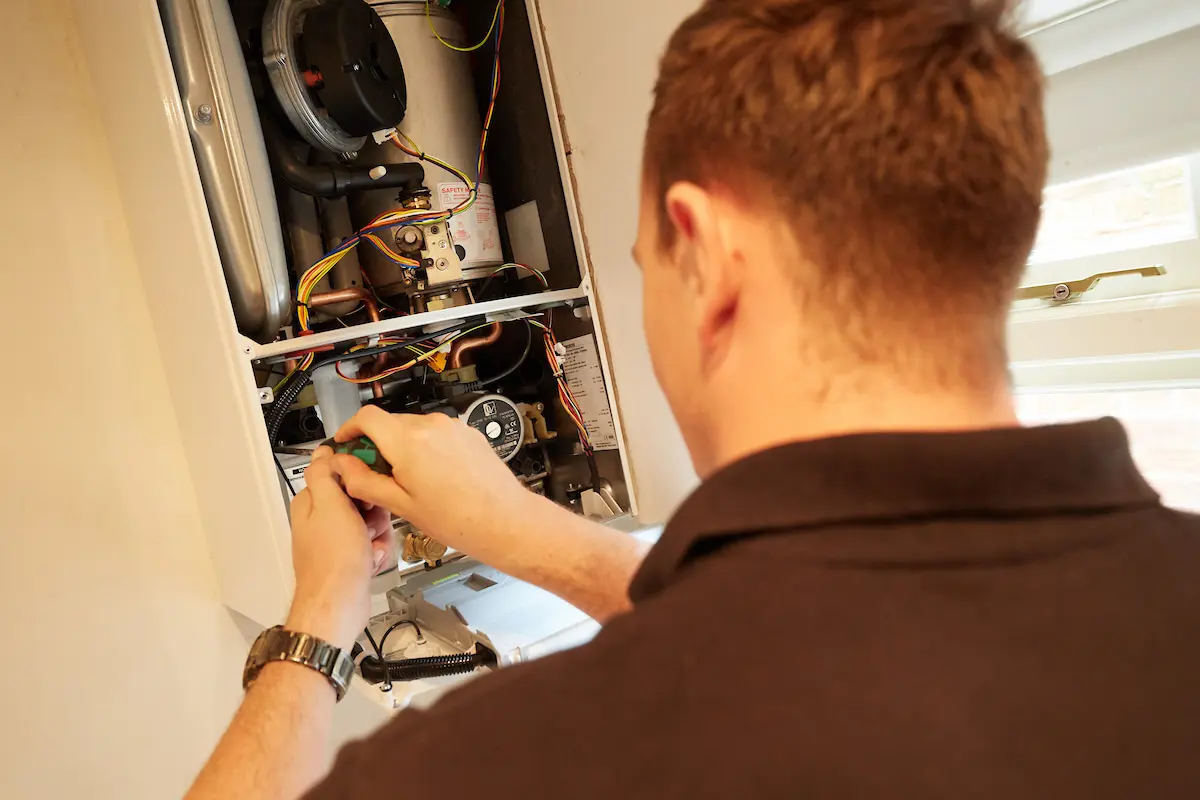
Water Under the Boiler
Water under the boiler does not automatically mean the leak starts at the bottom of the boiler.
Check the wall and pipework above the boiler. Look for water tracking down pipes, staining, damp plaster, or a leak from a pipe that happens to drip onto the boiler.
This is especially worth checking in airing cupboards, lofts and cupboards where several pipes pass above the boiler.
If the water is clearly coming from inside the boiler casing, stop there and book an engineer.
Water From a Pipe, Valve or Joint
A common leak point is where the boiler valves connect to the bottom of the boiler. These connections often use fibre washers.
Sometimes a careful nip-up stops a tiny weep. Sometimes the washer has failed, and tightening it makes the leak worse.
This is why preparation matters. Know where the water turns off. Have towels ready. If the boiler is in a loft or upstairs cupboard, remember that water travels downwards with impressive commitment.
If you are not completely sure what you are tightening or how to isolate it, leave it alone and call an engineer.
Water From the Outside Discharge Pipe
If water is coming from a small copper pipe outside, it may be the pressure relief valve discharge. The pressure relief valve is there to protect the system if pressure gets too high.
Do not cap or block the discharge pipe. It is part of the boiler's safety system.
The more useful question is why the pressure got high enough for it to open. Common causes include an expansion vessel that has lost its air charge, a filling loop left open or passing, or a fault that is pushing pressure into the heating system.
What the Pressure Gauge Tells You
The pressure gauge is one of the best clues on a leaking boiler.
If the pressure is dropping, water is probably leaving the sealed heating system somewhere. That could be from the boiler, radiator valves, pipework, a hidden leak, or the pressure relief valve.
If the pressure rises high when the heating comes on, then later drops too low after the system cools, the expansion vessel is high on the suspect list.
The vessel absorbs the expansion of heating water as it warms. If it has lost its air charge, pressure can climb too high, water can discharge through the pressure relief valve, and pressure can then be too low once the system cools.
That is when people get stuck in the classic loop:
- Boiler pressure is low.
- They top it up.
- Heating comes on.
- Pressure goes too high.
- Water leaves through the relief valve.
- Boiler pressure is low again.
- The cycle repeats until the cause is repaired.
Topping up once or twice to keep heating or hot water going temporarily is understandable. Constant topping up is not a repair. Fresh water brings oxygen into the system, which can contribute to corrosion.
Common Causes of a Boiler Leaking Water
Pressure relief valve
Can discharge water if the boiler pressure gets too high.
Expansion vessel
Often linked to pressure rising high, then dropping low.
Filling loop
If it passes or stays open, mains water can push pressure up.
Internal parts
Seals, valves, pumps and heat exchangers can all leak.
Pressure Relief Valve
The pressure relief valve can discharge water if the boiler pressure gets too high. Sometimes the valve does not reseal properly after opening, especially if dirt or debris gets trapped.
Expansion Vessel
An expansion vessel issue is one of the most common reasons pressure rises too high when the heating is on. It can often be repressurised, but sometimes it needs replacing. That decision needs proper testing.
Filling Loop
If the filling loop is left open or passing slightly, mains water can keep entering the heating system and push the pressure too high.
Condensate Pipe or Trap
Modern condensing boilers produce condensate. That is normal.
If the condensate pipe, trap or internal route has a problem, water can appear around the boiler. This is not something to investigate by removing the case.
Internal Seals, Pump, Diverter Valve or Heat Exchanger
Combi boilers contain heating, hot water, cold mains, condensate, pumps, valves and seals in one appliance, so there are several possible internal leak points.
Internal leaks need an engineer.
Corrosion or Poor Installation
Old seals, poor water quality, corrosion, bad joints and poor installation can all cause leaks.
A good repair is not just about stopping the drip. It is about finding why it happened, so it does not come back.
What Can You Safely Check Yourself?
You can safely do the basic detective work:
- look for water above the boiler
- check whether the leak happens only when heating is on
- check whether pressure is dropping
- check whether pressure rises high during heating
- look outside for water from the pressure relief discharge pipe
- take clear photos for the engineer
- write down any fault codes
Photos are useful because they show the leak before it dries up or moves. Fault codes and the hot/cold pressure readings also help.
Do not remove the boiler case. Do not tighten random fittings without knowing how to isolate the water.
Do not keep topping up for weeks. If you cannot see where the water is going, our guide to a boiler losing pressure with no visible leak explains the hot/cold pattern, relief-valve discharge and hidden leaks.
When Should You Call a Heating Engineer?
Call an engineer if:
- the leak appears to be inside the boiler
- the pressure keeps dropping
- pressure rises close to 3 bar
- water is coming from the outside discharge pipe
- the leak is near electrics
- the boiler is cutting out
- you are topping up repeatedly
- you are not sure where the water is coming from
Vector Heat diagnoses boiler faults across Lincoln and the surrounding villages. If you can send photos of the boiler, the pressure gauge and the leak area, that often helps us understand what is likely before we arrive.
Can a Leaking Boiler Be Repaired?
Often, yes.
A leaking boiler does not automatically mean a new boiler. Many leaks involving washers, valves, seals, expansion vessels, pressure relief valves, condensate parts and pipework can be repaired.
Replacement becomes more likely if the boiler is old, heavily corroded, has a failed heat exchanger, or needs a repair that costs too much compared with the value and condition of the boiler.
The decision depends on the leak, boiler age, part cost, access and general condition.
How to Reduce the Chance of Boiler Leaks
Have the boiler serviced properly, keep system pressure in the correct range, deal with pressure problems early, and do not ignore small leaks.
Good system water quality also matters. Sludge, corrosion and debris can damage parts, block waterways and cause seals or valves to suffer.
If your heating water is dirty, the leak may be one symptom of a wider system-water problem.
FAQ
Is a Boiler Leaking Water Dangerous?
It can be. Water can damage electrical parts, flooring, ceilings and the boiler itself.
The bigger safety point is that you should not remove the boiler case or work inside a gas boiler unless you are qualified.
Should I Turn My Boiler Off If It Is Leaking?
Turn it off if the leak is heavy, close to electrics, getting worse, or you are worried. If it is a tiny contained drip, you may be able to contain it while booking an engineer, but do not ignore it.
Can I Use My Boiler If It Is Leaking Water?
It depends where the leak is and how bad it is. If the leak is inside the case, near electrics, causing pressure loss or discharging outside, stop using it and get it checked. If in doubt, turn it off.
Why Is My Boiler Leaking From Underneath?
The leak might be from the bottom connections, internal parts, or water travelling down from somewhere above.
Always check above and around the boiler before assuming the source is underneath.
Why Is My Boiler Leaking and Losing Pressure?
On a sealed system, pressure dropping usually means water is leaving the heating circuit.
That could be from the boiler, radiators, pipework, hidden leaks or the pressure relief valve.
Why Does My Boiler Pressure Go High, Then Low?
This often points to expansion vessel or pressure relief valve issues.
The pressure rises as the heating water warms up, water discharges when pressure gets too high, then the pressure is too low after the system cools.
Can I Keep Topping Up the Boiler Pressure?
Only as a short-term workaround. Constant topping up adds fresh oxygenated water to the system, which can encourage corrosion over time.
If the pressure keeps dropping, find and fix the cause.
Can I Fix a Leaking Boiler Myself?
You can make safe checks around the boiler, contain water and look for obvious external pipework leaks. Do not remove the case or work inside the boiler. If the source is not obvious and external, call a heating engineer.
Got a leaking boiler?
If your boiler is leaking, losing pressure or dripping from the outside discharge pipe, send Vector Heat a few clear photos and we can help arrange the right next step.
Arrange boiler repair in Lincoln