
Boiler Fault Guide
Why Is My Boiler Losing Pressure?
If your boiler keeps losing pressure and needs topping up, the expansion vessel is the most common cause I find. Leaks are next. First, check whether the pressure is actually being lost or just changing as the heating warms up and cools down.
Insights by Vector Heat
Pressure rising sharply when hot, then falling to zero when cold, is an important clue. The system may be losing water through its safety valve because the expansion vessel is not doing its job. Topping up gets the pressure back, but does not fix the cause.
This guide is for sealed heating systems: most combis and system boilers, plus regular boilers installed on a sealed system. The gauge measures heating-circuit pressure, not the pressure at your taps.
Is the Boiler Losing Pressure or Just Fluctuating?
A hot system normally has higher pressure than a cold one because water expands as it heats. Many domestic boilers are filled to around 1 to 1.5bar when cold, but use the range specified for your boiler and installation.
Compare like with like: a cold reading today with a cold reading tomorrow, with the pump stopped. A gauge that rises during heating and returns to the same cold reading is different from one that keeps returning lower until the boiler stops working.
You may also see a sudden small movement when the pump starts. Depending on where the gauge and expansion vessel connect, pressure at the gauge can fall on the pump's suction side. If it returns when the pump stops, that movement alone does not prove a leak. Large changes or fault codes still need checking.
| What you notice | What it may mean | Next step |
|---|---|---|
| Rises when hot, returns to the same cold reading | Normal thermal expansion, if within the specified range | No top-up just because it cooled |
| Small movement as the pump starts, then returns | A pressure change caused by circulation | Compare with the pump stopped |
| Climbs towards 3bar, then falls very low after cooling | Expansion vessel problem and relief-valve discharge | Arrange an engineer; do not run it up to test this |
| Cold pressure keeps falling without a big hot rise | A leak or passing relief valve | Check accessible areas and record the loss |
| Dropped after radiators were bled | Air or water was released | Check cold pressure and top up only if needed |
These are clues, not a diagnosis. If pressure is falling rapidly, water is reaching electrics, or the boiler has a low-pressure fault, switch it off if safe and arrange help. Do not keep running it at zero.
The Most Common Cause I Find: The Expansion Vessel
An expansion vessel gives the expanding heating water somewhere to go. A rubber diaphragm separates the water from a cushion of air or gas. That cushion compresses as the water heats.
If the vessel loses its air charge, it cannot accommodate expansion properly. The pressure can rise quickly until the pressure relief valve opens, commonly around 3bar on domestic heating systems. Water discharges, and the pressure then falls too low as the system cools.
- Cold: the pressure looks normal after topping up.
- Heating on: pressure climbs sharply because expansion is not being absorbed.
- Relief valve opens: heating water leaves through the discharge pipe.
- Cold again: the gauge reads very low or zero, so you top up again.
That is the cycle I see most often on pressure-loss jobs. It may start with occasional top-ups and become more frequent. A zero reading does not mean the whole heating system has emptied. It means there is no positive pressure showing at the gauge.
Worcester Bosch advises that a hot pressure rise of more than 1bar can indicate a vessel that needs recharging by an engineer. Our guide to boiler pressure rising too high covers that side of the fault in more detail.
Does the Expansion Vessel Need Replacing?
Not always. In my experience, roughly four out of five expansion vessels I attend for this problem can be recharged. That is my estimate from the jobs I see, not a guarantee for your boiler or a national failure rate.
If the rubber diaphragm has split, recharging will not repair it and the vessel usually needs replacing. Sometimes the Schrader valve, the small air-charging valve, is leaking. An engineer may be able to repair the valve core or fit a suitable sealing extension, depending on the vessel and manufacturer's requirements.
The engineer also needs to check that the vessel is correctly sized and connected. This is not a case of attaching a tyre pump while the heating is still pressurised. Leave testing and recharging to an engineer.
The Relief Valve May Keep Dripping Afterwards
Once a pressure relief valve has opened, dirt or damage to its seat can stop it closing properly. The expansion vessel may be the original fault, but the valve can then keep losing water as well.
From a safe position, look for dripping from the discharge pipe outside. On many installations it is a small metal pipe through the wall. Do not touch hot discharge, operate the valve to test it, or block the pipe. A wet outlet needs investigation; it does not by itself prove which part failed first.
Leaks: The Next Most Common Cause
A leak can be anywhere on the heating circuit: a radiator valve, pipe under a floor, filter, airing-cupboard connection or component inside the boiler. You will not always find a puddle. A small weep can dry on a warm fitting before you notice it.
With the heating off and cool, look around accessible radiator valves, pipe joints and the underside of the boiler for dampness, staining, rust or crusty deposits. A dry tissue held against a cool, accessible radiator joint can reveal moisture. Do not disturb corroded fittings, lift floors or open the boiler.
If you can see water coming from the appliance, use our boiler leaking water guide. Tell the engineer about marks on ceilings, floors and skirting boards too. Hidden leaks may need testing before anyone starts opening up the building.
Boiler Losing Pressure but No Leak Visible?
I have attended several Ideal Logic boilers where the primary heat exchanger was leaking into the condensate route. The heating water went straight into the waste pipe, so there was no obvious wet patch under the boiler.
That is a fault I have found on individual jobs, not a diagnosis of every Ideal Logic losing pressure. Condensing boilers normally produce water in the condensate pipe anyway, so seeing that water does not prove a leaking heat exchanger.
This needs a qualified engineer to investigate. Do not remove the casing or combustion-chamber cover, disconnect the condensate pipe or try to isolate the boiler yourself.
Has Someone Bled the Radiators?
Ask everyone in the house. I have had customers report a pressure problem after somebody bled the radiators and did not check the gauge afterwards.
It is worth checking radiators for trapped air at least once a year. Bleed them if needed, with the heating off and cool. Afterwards, check the cold pressure and top up if it has fallen below the correct range. There is no benefit in letting water out of an already air-free radiator or adding water when the pressure is already right.
Can I Top the Pressure Up Myself?
Yes, where your boiler's user instructions explain how and you can safely identify the filling controls. Filling loops, keys and levers vary, so follow the exact model's instructions rather than guessing from a valve colour.
- Switch the heating off and let the system cool.
- Check the manual's cold filling pressure.
- Fill slowly, watching the gauge, and stop at the specified pressure.
- Fully close the filling controls afterwards and follow the instructions for any removable key or hose.
If the pressure will not rise, falls straight back, or water is visibly escaping, stop filling and arrange help. Do not leave a filling loop open to compensate for a leak.
Why Repeated Topping Up Makes Matters Worse
Fresh mains water brings dissolved oxygen into the heating circuit. Repeatedly replacing lost water encourages corrosion and can dilute the corrosion inhibitor. That can leave you with more problems than the original leak.
A one-off top-up after bleeding is different from doing it every few days. If topping up has become part of your routine, make finding the fault a priority.
Can Lowering the Flow Temperature Help Temporarily?
On suitable systems, I have temporarily lowered the heating flow temperature to around 45 to 50°C while arranging an expansion-vessel repair. Cooler heating water expands less, which can keep the pressure below the relief valve's opening point.
Ask your engineer before using this workaround. It is only an option after they have assessed the fault and confirmed that the boiler can safely keep operating within its permitted pressure and temperature range. It does not repair the vessel, stop a separate leak or make repeated high-pressure swings acceptable.
A condensing combi's radiator temperature can normally be adjusted separately from its tap-water temperature. Do not apply 45 to 50°C as a blanket setting to an oil or non-condensing boiler, or a system/regular boiler that uses the same flow setting to heat a cylinder. The cylinder still needs its required reheating temperature and hygiene controls.
The house may also struggle to get warm at a lower flow temperature. See which boiler temperature settings suit your system. If pressure still falls, rises excessively or the boiler locks out, stop using it and get advice.
What to Record Before the Engineer Arrives
A few readings are much more useful than "it keeps dropping". Photograph the gauge or write the readings down. Start with what you have already noticed; do not deliberately run a faulty boiler to high pressure to collect evidence.
| Record this | Include these details |
|---|---|
| Date and time | When you checked or topped up |
| Pressure before and after topping up | The actual readings, not just "low" and "normal" |
| How far it fell and how quickly | Hours, days or weeks between top-ups |
| Heating state | Cold, warming up or hot; whether the pump was running |
| Other evidence | Fault-code photo, visible drips, outside discharge, or recent radiator bleeding |
These details help separate a temperature-related fault from a continuing leak. The gauge alone cannot tell us exactly how many litres have escaped, but the pattern helps us plan the investigation.
What Will an Engineer Check?
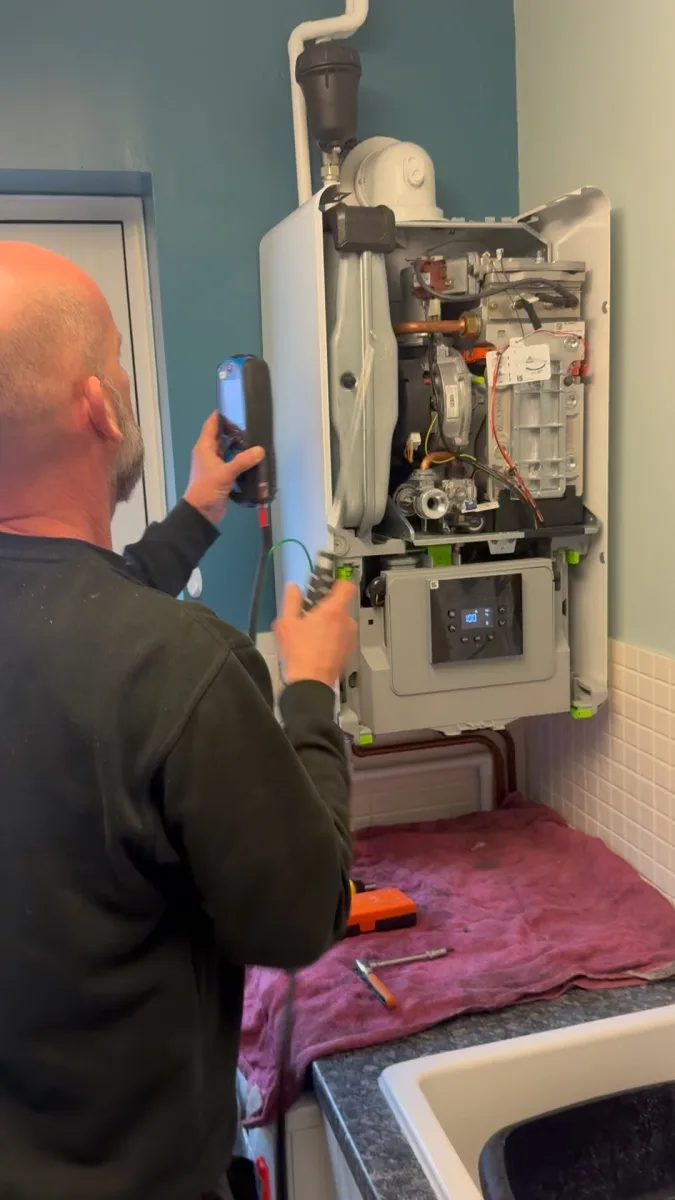
We check the expansion vessel, relief valve, filling controls and visible system first, then investigate hidden losses if needed. A faulty pressure gauge or sensor is another possibility if its readings do not match what the system is doing.
Tell us about the pressure loss when booking. A routine service appointment is not automatically long enough for fault finding, especially if the leak is hidden. Knowing beforehand lets us allow the right time.
Frequently Asked Questions
Why does my boiler keep losing pressure with no visible leak?
Water may be escaping through the pressure relief pipe outside, hidden heating pipework or an internal boiler leak. On some condensing boilers, a leaking primary heat exchanger can send heating water into the condensate drain. No puddle does not rule out water loss.
Why does my boiler pressure drop when the heating is off?
Some fall is normal as the water cools. If the cold reading gets lower after each heating cycle, water may have discharged while the system was hot. A leak can also continue while the heating is off. Compare readings when the system is equally cold.
Is low boiler pressure dangerous?
A low gauge reading alone does not diagnose a gas safety problem, but it should not be ignored. Many boilers stop on low pressure; do not rely on every model doing so. Do not keep operating at zero or bypass a fault. Switch off if safe and seek help for rapid loss, water near electrics or other danger signs.
How often should I need to top up my boiler?
Worcester Bosch describes once or twice a year as typical, but that is not a target or a reason to ignore a known leak. A change from your system's usual behaviour matters. Repeated weekly or daily top-ups need investigation, not a routine of adding more water.
Does bleeding radiators lower boiler pressure?
Yes. Releasing trapped air or water can lower pressure on a sealed heating system. Check the cold gauge afterwards and top up only if needed, following the boiler's instructions. If the pressure stays steady after that, it may have been a one-off rather than a leak.
Will I need a new boiler if it keeps losing pressure?
Not necessarily. A vessel recharge, valve repair or system leak repair may solve it. The decision depends on the confirmed fault, boiler condition, parts availability and repair cost. Pressure loss alone is not a reason to replace the boiler.
Need Help With a Boiler Losing Pressure in Lincoln?
Send Vector Heat the boiler make and model, any fault code and your pressure readings. Let us know how often you are topping up and whether you have seen water outside or around the system.
Sources and Further Reading
- Worcester Bosch: cold pressure, top-up frequency and expansion-vessel warning signs
- Worcester Bosch: checks for repeated pressure loss
- Vaillant: how an expansion vessel works
- Caleffi: thermal expansion and pump-related pressure changes
- Energy Saving Trust: heating flow temperature and cylinder limitations