
First, Which Type of Boiler Do You Have?
Before choosing a number, we need to know whether the boiler is condensing and whether it heats a separate hot-water cylinder. Two boilers can look almost identical but need different settings.
| Your boiler | What I would do |
|---|---|
| Condensing gas or LPG combi | Try 45-50°C for radiator flow, within the boiler's user settings. Leave the separate hot-water setting alone. |
| Non-condensing boiler, including an older combi | Do not apply that low-temperature test. Follow the model's recommended operating range. |
| System or regular boiler with a cylinder | Check how the cylinder is heated. A shared boiler flow setting must be hotter than the cylinder target. |
| Oil boiler | Check its minimum operating temperatures, even if it is condensing. Do not copy a gas-combi setting. |
A combi normally supplies hot water without a separate cylinder. A condensing boiler also has a condensate drain: usually a plastic pipe carrying condensation to a drain. Not seeing that pipe does not prove the boiler is non-condensing, because it may be hidden.
All gas and LPG boilers fitted in England and Wales since April 2005, and oil boilers since April 2007, are required to be condensing, unless a permitted exemption applies. These are installation requirements, not a rule that an existing older boiler had to be replaced. The dates and exemptions are set out in the government's condensing-boiler guidance.
Check the model and manual if you are unsure. Our guide to identifying your boiler type has photographs of the different arrangements. You do not need to remove the boiler casing.
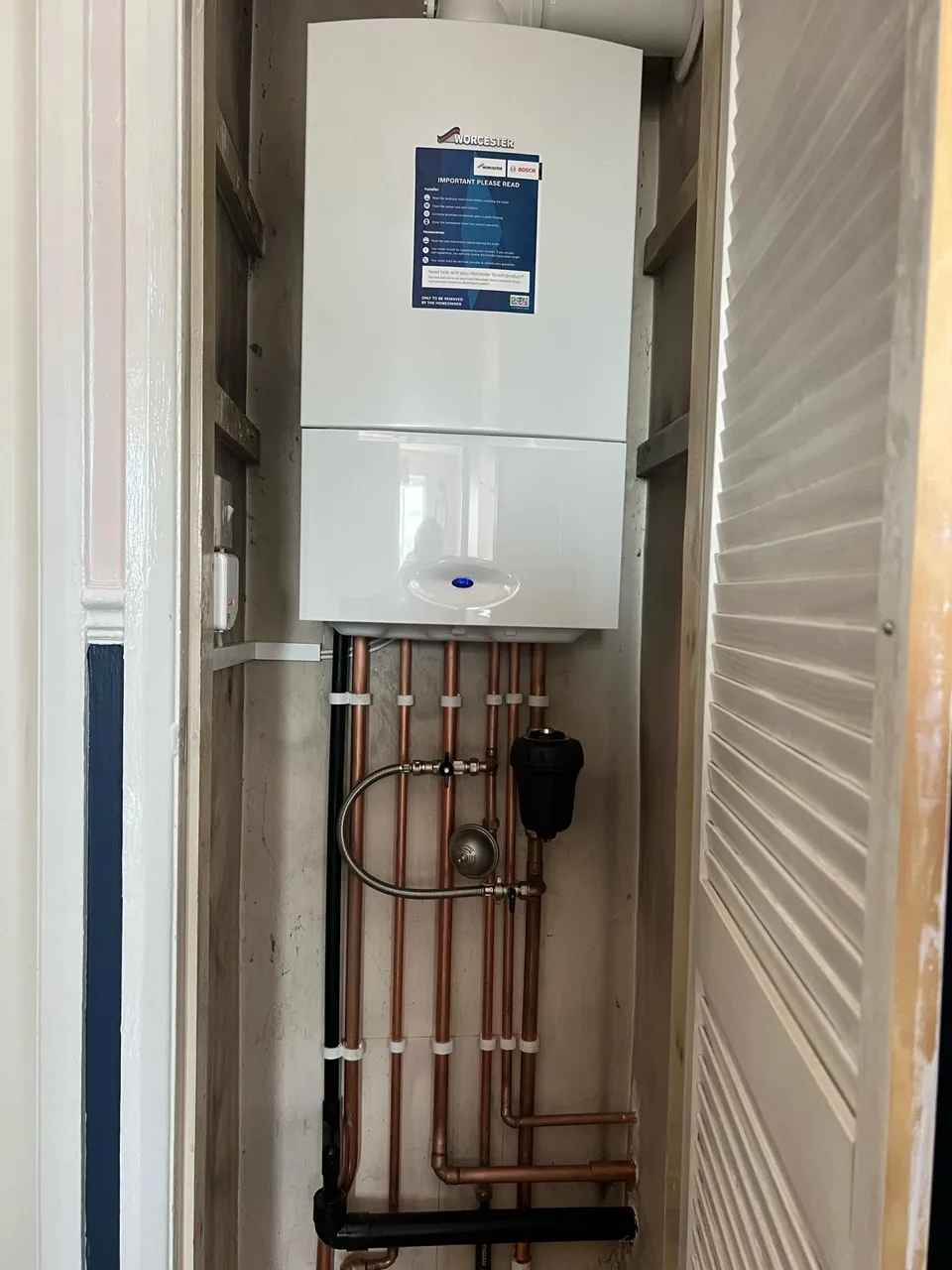
What Temperature Should a Condensing Combi Be Set At?
My starting point is 45-50°C for the central-heating flow. That is the temperature of the water leaving the boiler for the radiators, not the room temperature and not the water coming out of your taps.
On a normal gas or LPG combi boiler, the heating and tap-water targets are separate. Turning the radiator setting down does not mean colder showers.
If the house heats properly at 45-50°C, that is a good result. If it does not, turn the flow up a little. The aim is the lowest practical temperature that keeps the home comfortable, not the lowest number the boiler can display.
How I Would Test a Lower Flow Temperature
- Record the original setting. Take a photograph or write it down.
- Find the heating-flow control. It is usually marked with a radiator. The tap symbol controls combi hot water; the room thermostat controls room temperature.
- Set the heating flow to 45-50°C. Use the normal user controls and stay within the manufacturer's limits. Leave installer settings alone.
- Keep your usual room target and heating schedule. Give the house a full heating period to respond, then check the rooms you use.
- Adjust for comfort. If the house stays too cool, increase the flow by about 5°C and test again. If it heats comfortably, there is no reason to turn it back up just to make the radiators feel hotter.
Radiators will feel cooler and the house may warm up more slowly. Judge the room temperature, not how hot the radiator feels to your hand.
When it gets colder outside, particularly around 3°C and below, you may need a higher setting. That is a prompt to check how the house is coping, not a rule that every boiler must be turned up at 3°C.
Worcester Bosch also recommends testing a combi at around 50°C, then increasing it in cold weather if needed.
Why Does Lowering the Flow Temperature Help?
Burning gas produces water vapour. A condensing boiler cools the flue gases enough for some of that vapour to become liquid, recovering extra heat as it condenses. That recovered energy is called latent heat.
The important temperature is the water returning from the radiators. For natural gas, condensing starts at roughly 55°C return temperature, with more heat recovered as it gets cooler. A 45-50°C flow helps keep the return comfortably below that. It is not a guarantee of a particular bill saving.
Technical background: Caleffi's explanation of return temperature and flue-gas condensation.
What About the Combi's Hot-Water Setting?
Leave it at the setting that gives you suitable hot water while you test the heating flow. You do not need to lower both controls together. A combi heating water on demand is different from storing a cylinder of hot water.
Some storage combis and specialist control arrangements work differently. Check the model instructions if the controls are not clearly separate. Hot water can scald, so do not increase the tap setting unnecessarily.
Why You Should Not Turn an Older Boiler Right Down
A non-condensing boiler is not designed to collect condensation from its flue gases. It needs to run hot enough to avoid prolonged condensation inside the boiler and flue. This applies even if it is a combi.
The water produced by combustion normally leaves as water vapour. If the gases cool too far, that vapour condenses. The resulting condensate can corrode parts that were never designed to stay wet.
Caleffi explains this corrosion risk in conventional boilers. There is no single low-temperature setting suitable for every older model: keep to its instructions or ask your engineer before reducing it.
What About a System or Regular Boiler?
This is where it gets more complicated. Many system and regular boilers use the same flow-temperature setting to heat both the radiators and the coil inside the hot-water cylinder.
The boiler water passes through that coil and transfers heat into the stored water. The boiler flow must be hotter than the temperature you want the cylinder to reach. Turn it down too far and the hot water may reheat very slowly or never reach its target.
My Own Boiler: 55°C Flow, 50°C Hot Water
At home, I have a condensing regular boiler. I run it at 55°C flow and heat my hot water to 50°C. The low flow helps keep the return cool enough for the boiler to spend much of its time condensing.
That is my own operating example, not a recommendation to set every cylinder to 50°C. It shows why the boiler setting and the cylinder target have to be considered together.
If Your Cylinder Needs to Reach 60°C
The boiler must run above 60°C. A flow temperature of 55°C cannot heat the cylinder to 60°C through its coil.
Whether 65°C is enough, or the system needs 70°C or more, depends on the boiler, the cylinder coil and how quickly it needs to reheat. A 5-degree gap is not automatically enough; neither is 10 degrees a universal rule. Use the boiler and cylinder requirements.
Energy Saving Trust's flow-temperature guide also distinguishes combis from boilers heating a cylinder. Do not apply the combi test to a shared heating-and-hot-water setting.
Can the Radiators Run Cooler Than the Cylinder?
Yes, with the right boiler and controls. Some systems use a lower flow temperature for space heating, then increase it when the cylinder needs heat. This is often part of a hot-water-priority arrangement.
Do not assume yours does this just because it is a modern boiler. Ask your engineer whether heating and cylinder-reheat temperatures can be controlled separately.
What Temperature Should an Oil Boiler Be Set At?
Do not automatically copy the 45-50°C gas-combi test onto an oil boiler. Even a condensing oil model can have minimum operating or return-temperature requirements.
For example, the Grant Vortex Pro External installation instructions require the return to remain at or above 40°C once the system is up to temperature, to protect the boiler water jacket. That does not mean setting its flow to 40°C.
Use your model's recommended settings, and account for the cylinder if it heats one. An older non-condensing oil boiler also needs protection from prolonged flue-gas condensation.
What If the Boiler Adjusts Its Own Temperature?
Weather compensation changes the heating flow as the outdoor temperature changes. Load compensation responds to the heating demand indoors. If your system already has either, a fixed boiler setting may be a limit rather than the temperature it runs at all day.
Check how your controls work before changing that limit. You may already have the automatic version of turning the flow down in mild weather and up when it gets colder. Worcester Bosch explains both control approaches.
If the boiler keeps firing for very short periods or one room stays cold, repeatedly changing the flow is not a complete diagnosis. See our guide to a boiler turning on and off, or have the system checked.
Boiler Temperature FAQs
Is 50°C hot enough for my boiler?
It can be enough for the radiator flow on a condensing gas or LPG combi. The test is whether the home reaches its normal room temperature. It is not a general setting for a non-condensing boiler, an oil boiler or a boiler heating a separate cylinder.
Does boiler water need to be at 60°C to prevent Legionella?
Radiator water and the hot water you wash in are separate. The 60°C storage guidance concerns stored domestic hot water, not the heating circuit. Lowering the radiator-flow setting on a normal condensing combi does not lower its separate tap-water target.
Why is my hot water cooler after turning the boiler down?
If you have a cylinder, you may have lowered the temperature of the boiler water heating its coil. Restore the previous setting and check the boiler and cylinder requirements. On a combi, check that you changed the radiator setting rather than the tap setting.
Should I turn the boiler temperature up in winter?
Only if the home needs it. If your condensing combi heats the house properly at 45-50°C, keep it there. If the house struggles as the weather gets colder, increase the heating flow gradually. Compatible weather compensation can make that adjustment automatically.
Not Sure Which Setting to Change?
If we look after your boiler, send us a photograph of its controls and tell us whether you have a cylinder. We can help identify the setting before you change it. We can also review it during your next boiler service.