
Heat Pumps
How Does a Heat Pump Work?
Inside the box, through the heating system, and into your rooms.
Published
How does a heat pump work? It uses electricity to move heat from outside into your home, even when the weather is cold. I realise “there’s heat outside” is a difficult argument to win in a Lincolnshire garden in January.
The trick is refrigerant: a fluid that absorbs and releases heat as its pressure, temperature and state change. A compressor makes it hot enough to heat your home. It is the same basic technology used by your fridge, but we want the heat it delivers rather than the cooling it provides.
That explains the principle. It does not explain why one installation needs several components beside the cylinder while another keeps more of them outdoors. I’ll cover both, because the equipment around the refrigerant circuit matters too.
How does an air source heat pump work?
An air source heat pump takes heat from outdoor air using refrigerant in a sealed circuit. The compressor raises the refrigerant’s pressure and temperature. It then gives up heat to your heating system, before an expansion valve lowers its pressure so it can absorb more heat outside.
For the air-to-water systems we normally install, there are four main stages. The air stays outside; the heat goes into water for your radiators, underfloor heating and hot-water cylinder.
- 1. EvaporatorRefrigerant absorbs heat from outside air and evaporates.
- 2. CompressorElectricity drives the compressor, raising the gas pressure and temperature.
- 3. CondenserHeat passes into the heating water. The refrigerant condenses.
- 4. Expansion valvePressure falls, producing a cold refrigerant mixture ready to absorb heat again.
1. The evaporator collects heat from outside
The fan draws air across the outdoor coil. Refrigerant inside the coil is colder than that air, so heat transfers into it. As it absorbs heat, liquid refrigerant boils into a gas.
Boiling does not always mean 100°C. That is the familiar temperature for water at normal atmospheric pressure. Refrigerants can boil at much lower temperatures, and changing the pressure changes their boiling temperature. That is why the process can work when the air feels freezing to us.
2. The compressor makes the refrigerant hotter
The compressor takes in refrigerant gas and compresses it. Its pressure and temperature rise. This takes electrical energy: we are doing work to move heat from a colder place to a warmer one.
The compressor is not the circulation pump. One moves refrigerant around the sealed refrigeration circuit; the other moves water around the heating system.
3. The condenser heats the system water
The hot refrigerant passes through a heat exchanger. In a typical domestic monobloc, this is a plate heat exchanger inside the outdoor unit. Refrigerant flows on one side and heating water on the other, separated by metal plates.
Heat crosses the plates without the fluids mixing. As the refrigerant gives up heat, it condenses back into liquid. The warmed system water heads towards the radiators, underfloor heating or cylinder coil.
4. The expansion valve prepares it to start again
The refrigerant passes through an expansion valve. The pressure drops, some liquid flashes into vapour, and a cold mixture enters the evaporator. It can now absorb heat from the outdoor air again.
That is the refrigeration cycle. Vaillant’s explanation of the four stages covers the same principle.
The refrigerant, heating water and tap water stay separate
There are normally three different fluids involved in an air-to-water installation with an indirect hot-water cylinder. Heat passes between them through heat exchangers. They do not become one shared supply.
| Circuit | What it does | Where the heat goes |
|---|---|---|
| Refrigerant | Collects heat outside and carries it through the compressor. | Into the heating water through the heat exchanger. |
| Heating water | Circulates through pipes, radiators or underfloor loops. It may contain treatment or antifreeze as specified. | Into rooms, or through the hot-water cylinder’s coil. |
| Stored tap water | Supplies baths, showers and hot taps. | Warmed by the cylinder coil, without mixing with heating water. |
When the cylinder needs reheating, the controls usually give hot water priority. A valve directs system water through the cylinder coil instead of the room-heating circuit. Once the cylinder is satisfied, space heating can resume.
This can require a higher water temperature than heating the rooms. We agree the cylinder temperatures, schedule and hygiene settings during commissioning. The radiator temperature is not the same thing as your hot-tap temperature.
Most air-to-water homes need a suitable cylinder or another designed hot-water solution. Standard air-to-air heat pumps warm room air directly and normally need a separate arrangement for domestic hot water. The Energy Saving Trust’s air source guide explains this distinction.
More heat out than electricity in
This is the part that sounds suspicious until you include the outside air in the calculation.
An electric resistance heater turns electrical energy into heat. A heat pump also gathers heat that already exists outside. The heat delivered therefore includes both the energy moved from the air and the electrical energy supplied.
Illustrative example: 1 kWh of electricity plus approximately 3 kWh of heat collected outside can deliver approximately 4 kWh of heat.
That is a coefficient of performance, or COP, of 4. It is an explanation of the ratio, not a promised result for every installation or hour of operation.
The International Energy Agency explains why heat output can exceed electrical input. Nothing is creating energy from nowhere.
Efficiency changes with outdoor conditions, the temperature of the water being heated, defrosting and the way the system is controlled. Electricity prices then affect the running cost. A COP figure alone does not tell you the bill.
My guide to what makes air source heat pumps efficient goes further into those design choices.
How does a heat pump work in winter?
A heat pump still collects heat in winter because its refrigerant can be colder than the outdoor air, even below 0°C. It takes more work to deliver useful heating as conditions become less favourable. The system must be sized for the house’s heat loss and the chosen model’s cold-weather output.
Cold weather does not switch off the laws of heat transfer. It does make design important. We need enough output from the heat pump and from the radiators or underfloor heating in each room, at the temperatures used in the design.
Moisture can freeze on the outdoor coil. The heat pump periodically defrosts it, temporarily redirecting heat to melt the ice. Water draining beneath the unit, and sometimes a brief cloud of water vapour, can be normal during this process.
The installation needs appropriate drainage and clear airflow. Persistent heavy icing or failure to clear ice needs investigating; do not chip at the coil or assume every ice problem is normal defrosting.
Old homes are not automatically unsuitable. I look at the individual building, useful insulation and draught improvements, and the heating required in every room. There is more on that in our heat pumps for older Lincolnshire homes guide.
Why different heat pumps need different equipment indoors
The refrigerant cycle does not tell you everything included with the heat pump. We also need water circulation, expansion capacity, air removal, flow monitoring, safety devices and electrical controls. Some manufacturers package more of these together; others leave more for the installer to select and connect.
I am quite interested in what is not in the box. It usually needs finding a home somewhere.
With a monobloc, the refrigeration circuit is contained in the outdoor unit and heating water runs between it and the building. In a split system, refrigerant pipework connects outdoor and indoor equipment. Neither description, by itself, tells you exactly which pumps, vessels and controls are supplied.
| Arrangement | What it means on the job |
|---|---|
| Separate circulation equipment | A pump and other hydraulic components are selected or fitted outside the outdoor unit. This can provide flexibility for a more complicated heating system. |
| Pump integrated outdoors | The outdoor unit includes the circulation pump and may include other components. Check the exact model: it still needs the appropriate system connections and equipment. |
| Indoor hydraulic module | A packaged indoor unit brings together components such as the pump, controls and expansion vessel, depending on its specification. |
With the externally pumped Mitsubishi Ecodan and Samsung arrangements we fit, the plate heat exchanger is outdoors while much of the circulation and control equipment is separate. That lets us select and arrange the equipment around the job.
There are more integrated alternatives. Vaillant aroTHERM units include circulation and flow-monitoring equipment outdoors. Samsung also offers an R290 pump-integrated model, including a pump and expansion tank. Do not assume every Samsung has the same arrangement.
Viessmann’s Vitocal 200-A ie moves the circulation pump outdoors. Stiebel Eltron offers packaged hydraulic modules, depending on the system. These are different ways to assemble the equipment needed for the same underlying job.
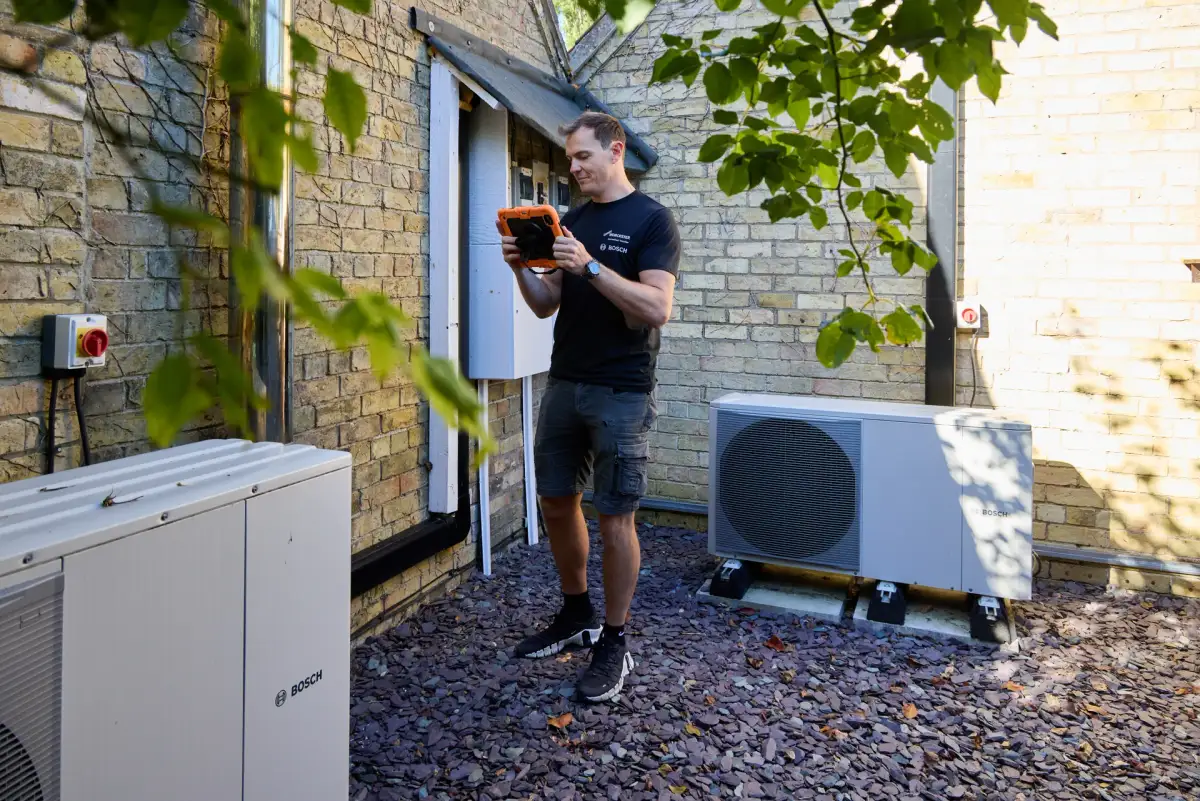
The Bosch Compress 2000 AWF we fit uses a particularly integrated monobloc arrangement. Keeping more equipment outdoors can be useful where there is little space beside the cylinder. It still needs the appropriate cylinder, pipework and system components.
A pump being outdoors does not automatically make it more efficient. An external pump can also receive speed-control signals. Suitable sizing, controls and sensor feedback matter more than which side of the wall it sits on.
Getting the heat into your rooms
Once the water is warm, the circulation pump must move enough of it through the system. The emitters then have to pass enough heat into each room.
Large radiator surfaces and underfloor heating can deliver useful output with cooler water. Lower heating-water temperatures generally make the refrigerant cycle less demanding, but turning the temperature down is only useful if the rooms still get warm enough.
That is why I start with heat loss and emitter output. We may be able to keep existing radiators or improve a few, or use underfloor heating where it suits the house. We also check pipework, water flow and controls rather than treating the outdoor unit as the whole design.
Weather compensation adjusts the target heating-water temperature as outdoor conditions change. Milder weather usually needs cooler water; colder weather needs more heat. It helps match what the system supplies to what the building needs.
The best package depends on the property, available space and how you want to use it. The refrigerant cycle follows the same principle. Making it work well in your house is the installation and commissioning part.
Heat pump questions
How does a heat pump work in simple terms?
It uses electricity to move heat from a colder source to somewhere warmer. Refrigerant absorbs heat, a compressor raises its pressure and temperature, and a heat exchanger passes that heat to your heating water. An expansion valve then lowers the refrigerant pressure so the cycle can repeat.
How does a heat pump work in winter?
The refrigerant in the outdoor coil is colder than the outside air, so it can still absorb heat below freezing. Efficiency and available output depend on the conditions and model. The installation must be designed for cold weather, including the heat needed by every room.
Does a heat pump use electricity?
Yes. Electricity powers the compressor, fan, circulation equipment and controls. It moves heat from outside as well as contributing energy itself, so the heat delivered can exceed the electrical energy used. That ratio changes with operating conditions.
Does outside air come into the house?
Not with an air-to-water heat pump. The fan moves outdoor air across the coil outside. Heat passes through separate refrigerant and water circuits to the radiators or underfloor heating. It does not blow that outdoor air into the rooms.
Does a heat pump work with radiators?
Yes. Each radiator must provide enough heat at the proposed water temperatures. Some existing radiators can stay, while others may need changing. Underfloor heating is another option, not a requirement for every heat-pump installation.
How does a heat pump heat tap water?
In a typical cylinder system, a valve sends heated system water through a coil inside the cylinder. Heat passes through the coil wall into the stored tap water. The two water supplies remain separate, and hot-water controls manage reheating.
Is the circulation pump always inside the heat pump?
No. Some models include it in the outdoor unit; others use a separate pump or an indoor hydraulic module. This changes the installation layout. Efficient operation depends on correct sizing, control and commissioning, not simply where the pump is fitted.
Can a heat pump cool the house as well?
Some heat pumps support cooling, but the whole installation must be designed for it. Ordinary radiators do not automatically become a suitable cooling system. Fan coils or other compatible emitters, controls and condensation protection may be needed.
Technical sources checked on 5 October 2026. Equipment descriptions refer to the arrangements named, not every model sold by each manufacturer.
Work out what your home needs
We design and install heat pumps across Lincolnshire. We can explain the heat loss, equipment positions and radiator changes before you decide what to install.
Heat pump installation in Lincolnshire Talk to Vector Heat