Heat pumps
Ground Source Heat Pump: Is It Worth the Extra Cost?
What my own air-source versus ground-source comparison showed, and when I would look at ground source more closely.
Published
A ground source heat pump can be very efficient. Whether it is worth paying substantially more for one depends on how much it will actually save in your home.
I recently compared ground source with air source for the same property. The ground source option cost about £10,000 more after the grant, before installing the ground loops, for an estimated saving of £50 a year.
That is a simple payback of 200 years. You might want to leave the calculation in your will.
That was one comparison, not a verdict on every ground source installation. But it explains why I want numbers beside the words more efficient before recommending the extra investment.
Ground source vs air source: my £5,000 and £15,000 comparison
I compared a 5kW Vaillant aroTHERM plus air source heat pump with a flexoTHERM ground source system. Same property, same heat loss, same heating system, same design conditions and flow temperature.
| Item | Air source | Ground source |
|---|---|---|
| Price after the grant | About £5,000 | About £15,000 |
| Ground-loop pipe | Not needed | Included |
| Installing the ground loops | Not needed | Not included; customer arranging the work |
| Predicted annual saving against air source | Comparison baseline | About £50 |
These are figures from that comparison, not a price list or measured annual bills. The ground source total would increase once the customer's groundworks were included.
Dividing the £10,000 additional cost by the £50 estimated annual saving gives 200 years. That calculation does not include financing, changes in electricity prices, differences in maintenance or replacing equipment. It is a simple way to show how small the predicted saving was beside the extra purchase cost.
For that property, I could not justify the extra money on running-cost savings. A different property, collector arrangement or pair of heat pumps needs its own calculation.
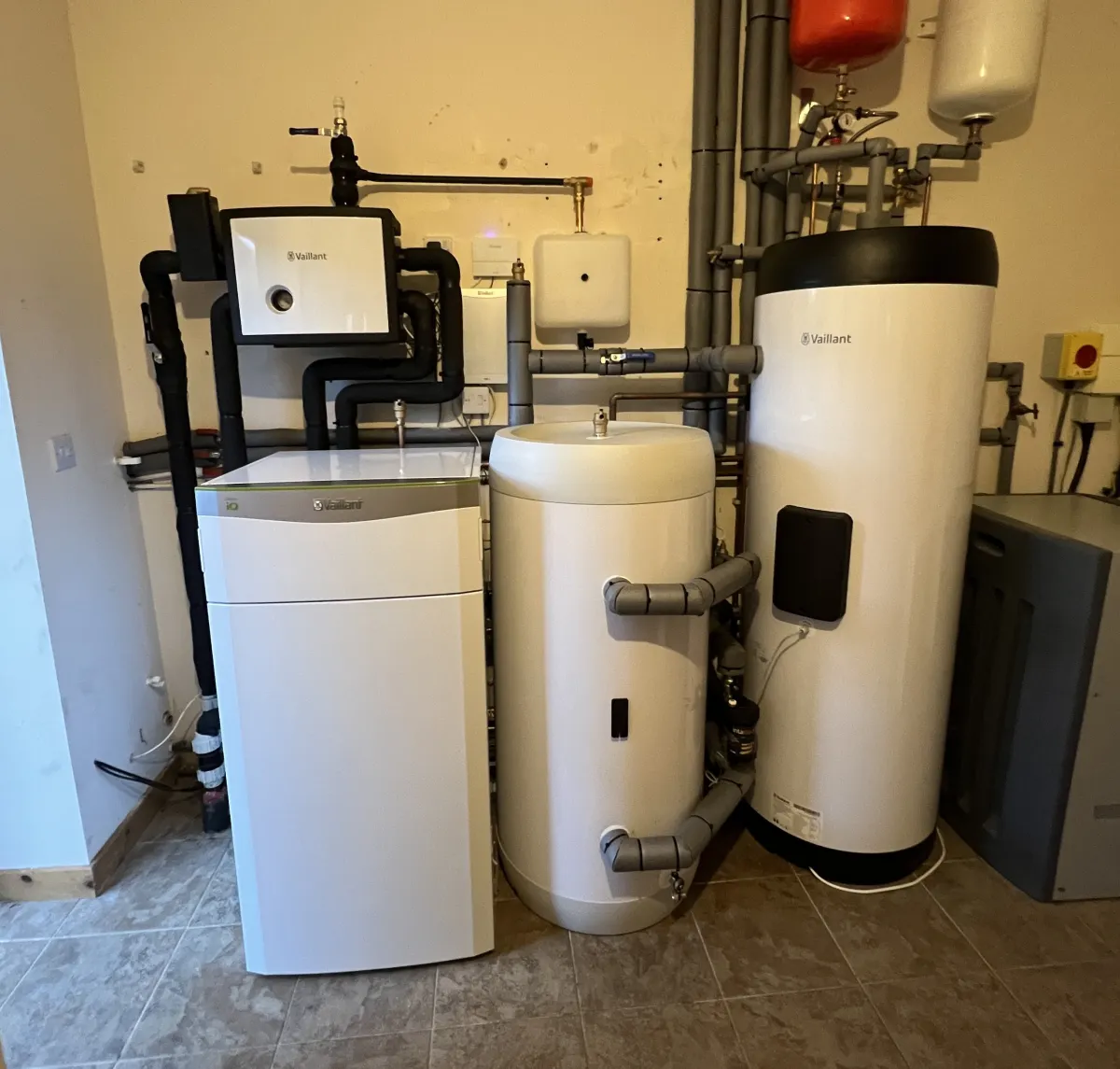
Where a ground source heat pump gets its heat
A ground source heat pump collects heat through buried pipes. A water-and-antifreeze mixture circulates through the collector, and the heat pump raises the temperature to supply the heating and hot water.
The collector can be laid horizontally in trenches or installed vertically in boreholes. The Energy Saving Trust's ground source guide explains both arrangements.
The ground offers a steadier heat source than outdoor air. That can help seasonal efficiency, particularly in winter. It does not remove the need for a suitable collector, properly sized radiators or underfloor heating, and sensible flow temperatures.
The groundworks are part of the heating installation
When comparing a ground source heat pump cost with air source, include everything needed to finish the job. Supplying a coil of pipe is not the same as putting a working collector in the ground.
- Access and excavation: machinery, trenches or specialist drilling.
- The collector: pipework, connections, manifolds, filling and testing.
- Making good: reinstating the ground and any surfaces disturbed.
- Inside the property: the heat pump, cylinder, controls and necessary heating-system alterations.
The land needs assessing, not just measuring. Ground properties, moisture and the amount of heat being extracted affect collector design. The British Geological Survey explains the role of the ground in these systems.
A large garden creates an opportunity. It doesn't tell us the installation cost or predicted saving. Ask who is responsible for the groundworks and where that cost appears in the quote.
Efficiency needs turning into pounds per year
Ground source can deliver excellent seasonal efficiency. What matters to this decision is the annual electricity saving compared with a well-designed air source system heating the same home.
Keep the heat demand, indoor temperatures, hot-water use and electricity tariff consistent. Then compare predicted electricity consumption across the year, not one impressive efficiency figure at a favourable test condition.
For the same efficiency improvement, a property using a lot of heat has more potential electricity to save than a small, well-insulated home. That is why I would look more closely at a hotel or swimming pool than assume the result from my domestic comparison applies everywhere.
Modern air source systems make this a serious comparison. Ground source technology has continued developing too: NIBE's current S1256, for example, uses an inverter to adjust its output. Compare current equipment rather than assuming every ground source unit works like an older fixed-speed model.
My heat-pump running-cost guide explains how heat demand, efficiency and electricity price combine. The cheapest installation and the lowest electricity bill are not necessarily the same option.
RHI and the Boiler Upgrade Scheme are different
I started installing heat pumps as the domestic Renewable Heat Incentive was finishing, so I didn't install under that scheme. Customers have told me about ground source support totalling around £25,000.
That was not a £25,000 upfront grant for everyone. Ofgem explains that domestic RHI paid quarterly over seven years. It closed to new applicants on 31 March 2022.
Under the Boiler Upgrade Scheme in England and Wales, equivalent eligible air-to-water and ground source installations receive the same support: £7,500, or £9,000 for qualifying off-gas oil and LPG replacements. I checked the official grant categories on 15 October 2026. Eligibility and the rules applying to your installation still need checking.
That changes the decision. Ground source has to justify its extra cost through the benefits it delivers, rather than an assumption that it gets a larger grant.
When I would look more closely at ground source
| Your situation | What needs checking |
|---|---|
| Usable ground loops already installed | Their design, condition and capacity for the replacement heat pump. |
| A very large annual heat demand | Whether the predicted electricity saving justifies the complete additional cost. |
| Groundworks already planned | The actual additional collector cost, rather than assuming all excavation is covered. |
| A difficult air source location | Whether ground source offers a practical alternative after checking the land and indoor equipment space. |
Existing ground loops are a different starting point from paying for a completely new collector. But a replacement heat pump is not automatically a straight swap.
I want the original design information where it exists, the system's operating history and an assessment of the collector and associated equipment. A house being warm on one visit does not establish that the ground loop will suit a different heat pump through a full winter.

Ground source still needs servicing
I wouldn't choose ground source simply to avoid maintenance. There are still pumps, controls, filters, heating water, a hot-water cylinder and a refrigerant system to look after.
Checks also include the ground circuit's fluid condition and antifreeze protection, pressures, circulation and fault history, following the equipment requirements. Buried pipework does not make the rest of the installation maintenance-free.
What I would ask for in both quotes
- The same building assessment. Compare the same heat loss and indoor temperatures.
- The same heating design. Use equivalent flow temperatures and make radiator changes clear.
- A complete installation price. Include groundworks, connections and making good, with exclusions written down.
- Predicted annual electricity use. Include heating and hot water, using the same tariff assumptions.
- Current equipment and aftercare. Know the exact models, servicing arrangements and who will support them.
Our heat-pump survey guide explains what I check in the house. The installation-cost guide explains why quotes vary.
Don't choose ground source purely because you've heard it is the best. Find out whether it is the best buy for your home.
Ground source heat pump questions
Is a ground source heat pump worth the extra cost?
It depends on the complete installation price and predicted annual saving for your home. In my comparison, about £10,000 extra before groundworks saved an estimated £50 a year. Existing usable loops or a much larger heat demand can change the calculation.
Are ground source heat pumps cheaper to run than air source?
They can be, but the size of the saving depends on the equipment and system design. Compare annual electricity use for the same house, heating temperatures, hot-water demand and tariff. A small saving does not automatically justify a large installation premium.
How much does a ground source heat pump cost?
The ground source option in my comparison was about £15,000 after the grant, with loop pipe supplied but ground-loop installation excluded. That is one quote, not a universal price. Ask for a complete price including excavation or drilling and making good.
Does ground source get a bigger grant than air source?
Not for equivalent eligible installations under the current Boiler Upgrade Scheme in England and Wales. Both air-to-water and ground source qualify for the same applicable grant level. Check the current category and eligibility before relying on funding.
Can existing ground loops be reused?
They can be considered for reuse, but their design, condition and capacity must suit the proposed heat pump. Existing loops change the cost comparison; they do not remove the need for assessment.
Do ground source heat pumps need servicing?
Yes. Checks include the ground-circuit fluid and pressures, pumps, filters, heating water, cylinder and fault history, following the manufacturer's requirements. Ground source is not a maintenance-free alternative to air source.
Comparing heat-pump options for your home?
I can help you assess the building, heating system and likely installation work before you decide what to buy.
Heat-pump installation in LincolnshireTalk to Vector Heat