
Case Study
Fixing a Faulty Heat Pump Installation: Customer Case Study
How Vector Heat corrected a poor heat pump installation so the home became warm, quiet and easier to run.
Published by Vector Heat
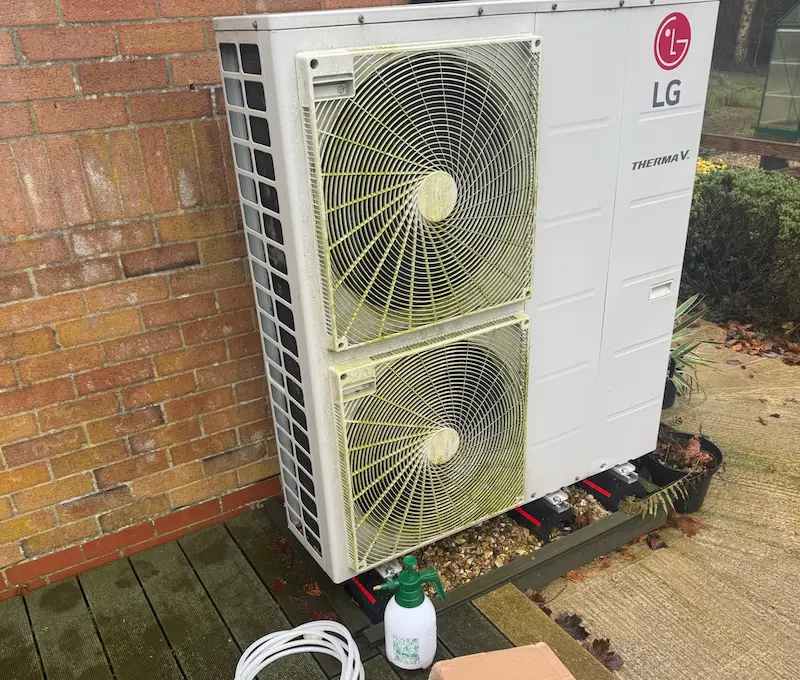
Some heat pump problems are blamed on the heat pump. This case study is a good reminder that the box outside is not always the guilty party.
Andy came to us after two years of frustration with an air source heat pump installed by a national company. The home was cold, the system was noisy and the heat pump ran constantly without delivering comfort.
"We are extremely pleased with the solution. Now we can heat the house to whatever temperature we desire, and the whole system functions quietly with minimum fuss." Andy, Vector Heat customer
Quick answer: what was wrong with the heat pump installation?
The heat pump itself was not the main issue. The system around it had design and installation problems, including undersized primary pipework, an unwanted buffer arrangement and two circulating pumps working against each other.
The problem: a cold house and noisy system
Andy’s home struggled to get above 13.5°C in winter.
The heat pump ran constantly, made enough noise at night to disrupt sleep and still did not heat the property properly.
That is exactly the kind of experience that makes people lose confidence in heat pumps.
The diagnosis
During assessment, Liam found:
- undersized primary pipework restricting heat flow
- a buffer tank causing unwanted distortion in the system
- two circulating pumps fighting each other
- poor heat distribution
- wasted energy
- poor comfort
This was not a case of "heat pumps do not work". It was a case of the system not being designed and configured properly.
The solution
We reconfigured the system so the heat pump could do its job.
The work included:
- upgrading pipework to the correct size
- removing the buffer tank
- simplifying the hydraulic layout
- stopping pumps from working against each other
- improving heat distribution
- recommissioning the system
The aim was not to sell a new heat pump. It was to make the existing system work properly.
The result
The home became warm, quiet and easier to control.
Andy could heat the house to the temperature he wanted, and the system operated with far less fuss.
That is what good heat pump design should feel like: comfortable and boring in the right way.
Once a corrected system is working properly, regular air source heat pump servicing helps track its condition and performance.
What this case teaches
Heat pumps are sensitive to system design.
Pipe sizing, buffers, pumps, flow rates and commissioning all matter. If those are wrong, the customer feels the result through poor comfort, noise and running cost.
Before blaming the heat pump, check the system.
FAQs about faulty heat pump installations
Can a faulty heat pump installation be fixed?
Often, yes. The first step is diagnosing whether the problem is the heat pump, pipework, emitters, controls, hydraulics, commissioning or customer settings.
Why would a heat pump run constantly but not heat the house?
Possible causes include poor heat distribution, undersized emitters, incorrect flow rates, high heat loss, bad controls or hydraulic problems.
Are buffer tanks always bad on heat pumps?
No, but they are often added without enough thought. If designed badly, they can distort flow temperatures and reduce performance.
Should I replace an underperforming heat pump?
Not before diagnosing the system. In some cases, the heat pump can work well once the surrounding design problems are corrected.
Who should inspect a poor heat pump installation?
Choose someone who understands heat loss, hydraulics, emitters, flow temperature and commissioning, not just appliance fault codes.
Is an existing heat pump leaving rooms cold or bills high?
Send us the model, controller photos, recent electricity use and a description of the problem. We can start separating appliance faults from design, flow and control issues.
Speak to Vector Heat