
Boiler Fault Guide
Why Is My Boiler Not Heating Water?
Boiler not heating water? First check whether the heating works, even if it is the middle of summer. If the radiators heat up but the taps stay cold, we can narrow it down to the hot-water side. If neither works, start with the boiler's power, controls, pressure and fault code.
Insights by Vector Heat
A cold shower is a fairly direct way for a heating system to get your attention. This guide is about no hot water at the taps: water comes out, but it stays cold. Most of the fault-finding below is for systems where the heating still works, so establish that first. It is not a guide to a tap with no water flowing at all.
A combi heats tap water on demand, without a separate working cylinder. A regular or system boiler normally heats a cylinder, often in an airing cupboard. An immersion is an electric heater fitted into that cylinder, either as its main heat source or a backup. Not sure? Check which boiler type you have.
First Check Whether the Heating Works
It might be the middle of summer and you have not used the heating for months. Do not assume it still works because it worked last winter. A short test helps separate a hot-water fault from a wider boiler problem.
Do not run this test if the boiler has been banging on ignition, overheating or showing other signs of an unsafe fault. If you smell gas or suspect carbon monoxide, follow the emergency advice below.
- Note your normal settings. Photograph or write down the thermostat, timer and any radiator-valve setting you change.
- Ask for heating. Use the normal controls to select Heating On or a temporary heating override, rather than summer or hot-water-only mode. Set the room thermostat a few degrees above the current room temperature and make sure a radiator valve is open.
- Close the hot taps and give it several minutes. Check whether the boiler fires and the radiators start warming. A light on the thermostat alone does not confirm that the heating works.
- Finish the test. Cancel the override and restore your previous settings. Before the hot-tap test below, make sure there is no heating demand and allow the radiators to cool, so leftover warmth does not mislead you. Restore your normal schedule after the checks.
If a summer setting or weather-compensated control prevents heating in warm weather, check its normal user instructions. If you cannot confirm that it is calling for heat, tell us the heating is untested rather than assuming it has failed.
- Heating works, but the taps stay cold: follow the combi or boiler-heated cylinder checks below. These are aimed at a hot-water-only fault.
- Neither heating nor hot water works: start with the shared power, controls, pressure and fault-code checks below. Do not jump straight to a hot-water sensor or valve diagnosis.
An immersion heater is separate from the boiler. Whether the radiators work does not establish whether the immersion works; use its own checks below.
Other Quick Checks
- Try another hot tap. If only one tap or shower is cold, its mixer or local supply may be the problem.
- Check power and controls. Note a blank display, an accidentally switched-off supply or changed settings after a power cut. Do not keep resetting a tripping circuit breaker.
- Read the pressure and fault code. Use your boiler manual's required cold pressure. If it keeps falling, follow our pressure-loss checks, rather than repeatedly topping up.
- Check the hot-water setting. A cylinder needs a scheduled reheat or boost and time to warm up. A standard combi heats on demand; turning up the room thermostat is not normally needed.
If both heating and hot water have stopped, an interrupted fuel supply, lockout or, in freezing weather, a frozen condensate pipe are possibilities. Check the displayed code against the exact manual. Use a boiler reset only where that manual advises it and the cause has been dealt with; stop if the fault returns.
Combi Boiler: What Happens When You Open a Hot Tap?
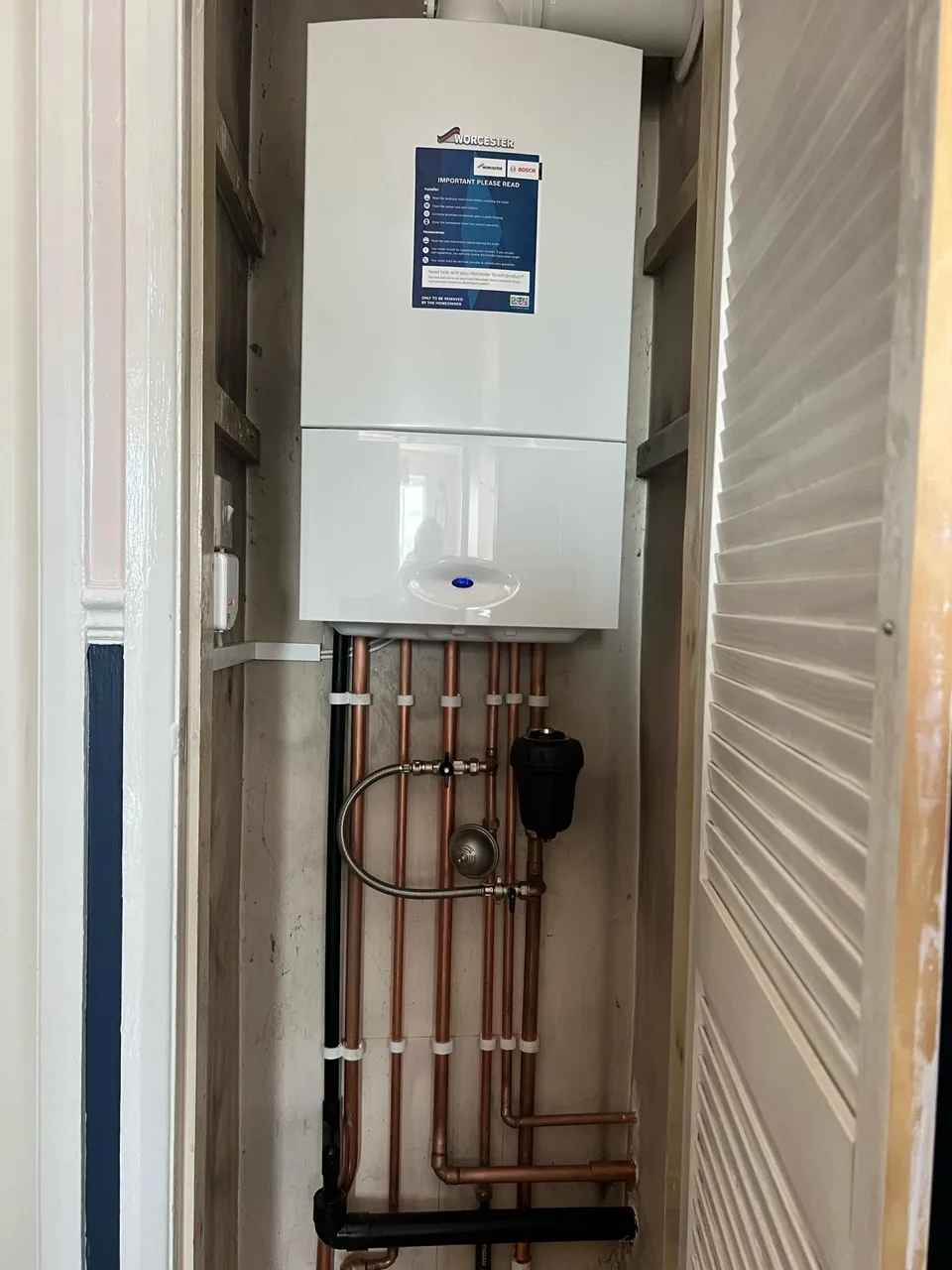
Once you have confirmed the heating works, turn the heating demand off and watch the boiler's normal display when you open a hot tap. Does it recognise the demand, start the pump, attempt ignition or actually fire? Those are different stages. A boiler doing nothing points us in a different direction from one that fires but sends heat to the radiators.
Keep the casing on. You do not need to touch hot pipes or reach inside to gather useful information.
| What happens | What it points towards | What to do |
|---|---|---|
| Heating works, but no response to the tap | Hot-water flow detection, provided the tap has adequate flow | Record whether any symbol or sound changes |
| Demand appears, but it cannot fire | An ignition, supply or other boiler fault | Photograph the code; do not keep resetting |
| Fires and radiators heat during hot-water-only demand | A diverter valve sending heat the wrong way | Report the pattern to an engineer |
| Fires, becomes very noisy and overheats | A restriction or poor circulation | Stop using it and arrange investigation |
No Reaction: The Hot-Water Flow Sensor
If the heating works but the boiler does nothing when you open a hot tap with good flow, the hot-water flow sensor or switch is a strong suspect. Depending on the model, it may use a turbine or another mechanism to detect water moving through the boiler.
This tells the boiler that somebody has opened a hot tap. It is different from a temperature sensor. Weak mains flow, a restriction or an electrical fault can produce similar symptoms, so the observation helps an engineer diagnose it; it does not prove which part to buy.
It Fires but Heats the Radiators: The Diverter Valve
The diverter directs heated boiler water towards the hot-water heat exchanger or the radiators. If radiators start warming while only a hot tap is calling for heat, a faulty diverter is a strong possibility.
Radiators still warm from an earlier heating period are not the same clue. Nor does working central heating, by itself, prove that the diverter is faulty. Internal checks and repairs need a suitably qualified engineer: Gas Safe registered for gas or LPG, with the relevant appliance qualifications.
It Fires, Makes a Noise and Overheats
A blockage or poor circulation can stop heat leaving the boiler properly. The water may briefly warm up, then go cold as the boiler shuts down. A restricted plate heat exchanger is one possibility, but the pump and other parts of the circuit need checking too.
A really big bang as the burner first lights is different. It can be explosive ignition and can be dangerous. Turn the boiler off immediately, if safe, and arrange urgent help. Do not fire it again to make a recording. Our boiler noise guide explains the other noise patterns.
Boiler Not Heating the Hot-Water Cylinder
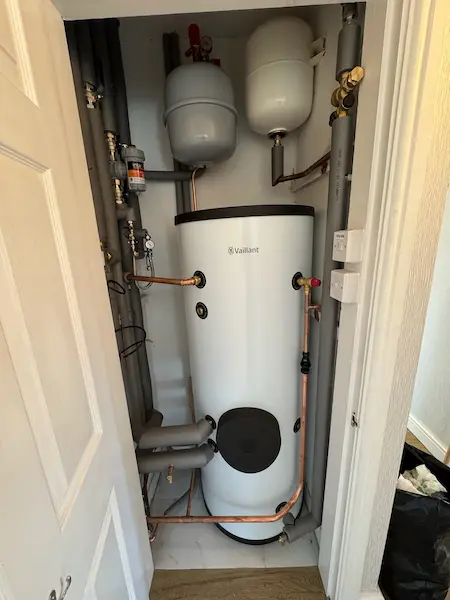
With a cylinder, check its hot-water schedule and controls before blaming the boiler. When the radiators work but the cylinder stays cold, I first look at the hot-water motorised valve on systems with a separate two-port valve. A usual three-port setup needs a different diagnostic order.
Try a normal hot-water boost at the programmer, provided there are no overheating or safety concerns. Check the clock and whether holiday mode is active. Check the cylinder thermostat's normal setting without opening its electrical cover. Do not simply turn everything to maximum.
Two-Port Valve: My First Suspect
A two-port valve has a pipe connection on each side. In a typical installation there is a separate valve for the cylinder and another for the heating. The hot-water valve opens when the cylinder calls for heat; its switch then allows the boiler to run.
The motor is the valve fault I find most often. If it cannot open the valve, the cylinder stays cold even though the heating can still work. The valve switch, wiring or a seized valve body can also be responsible. Sometimes only the motor or head needs replacing.
Three-Port Valve: Why It Is Different
A three-port valve has three pipe connections and can share boiler flow between heating and the cylinder. On the common spring-return Y-plan mid-position arrangement, its resting position is open to hot water.
That means a failed motor alone is not my first explanation for hot-water-only failure on that arrangement. I would next check the time clock or programmer, then the cylinder thermostat. A stuck valve, wiring fault or a different valve design can still change the diagnosis.
You can photograph the valve and controls for us. Do not remove the valve head, open the wiring centre or force the lever across as a workaround.
Immersion Heater Not Working
An immersion heats the cylinder electrically, independently of the boiler. Check its timer, off-peak period and normal boost control first. A light on the switch does not prove the element is heating. The fault could be the supply, thermostat, overheat cut-out or the element itself.
I see failed immersion elements regularly, especially on hard-water jobs in Lincolnshire. Scale deposits can contribute to element problems. A confirmed failed element needs replacing; a thermostat or supply fault needs a different repair. Neither automatically means a new cylinder.
How to Reset an Immersion Heater
Many immersion thermostats have a small manual-reset safety cut-out. Its position varies, so identify yours from the heater or cylinder instructions. It is not the temperature dial, and not every cut-out is resettable.
Turn the power off before trying to reset it. If the reset is behind an electrical cover, you must know how to isolate the supplies and prove dead using a suitable two-pole voltage tester. If you cannot do that, leave the cover on and ask us. An unlit switch or a non-contact voltage pen is not proof that it is safe.
- Isolate the immersion's electrical supplies. Use the correct isolator and isolate the supplying circuit at the consumer unit. Prevent anyone switching it back on. Account for separate off-peak, boost or solar-diverter supplies. Switching the boiler off, or selecting Off on a timer, is not isolation.
- Let the cylinder cool. If the water has been unusually hot, the cylinder has been bubbling, or hot water is discharging through a safety outlet, leave the heat sources off and get it investigated. Do not reset it to keep it running.
- Access the reset as the manual shows. Where you are competent to carry out safe isolation, remove only the specified electrical cover after isolating. Before touching anything inside, prove dead with suitable equipment, checked before and after use. Do not undo wires or pull out the thermostat.
- Press the identified reset button or pin once. Use the method and suitable implement specified in the manual. You may feel a click. Do not probe around, force it, or bridge any contacts.
- Refit and secure the cover before restoring power. Only return the heater to use once the reason for the trip has been understood and dealt with. If the cause is unknown, leave it isolated for investigation.
- Check the result using the normal controls. Allow the cylinder time to reheat. If the cut-out trips again or the water remains cold, switch it off and arrange a repair. Do not keep pressing reset.
For a model-specific example, Grant's cylinder instructions, section 11.3, show the immersion safety-reset procedure. Use your own model's instructions for the button location. A reset restores the safety switch; it does not repair a failed element or thermostat.
What to Send Before Booking a Repair
- The boiler make and model, plus the cylinder or immersion details if relevant.
- Whether the radiators work and whether all hot taps are affected.
- What changes on the boiler when a hot tap opens: display, pump, ignition attempt or firing.
- A photo of the fault code or pressure gauge. For a flashing light, send a video so we can see the pattern.
- Any recent power cut, plumbing work, control changes or reset, and what happened afterwards.
Use observations you already have. Do not recreate overheating or a dangerous noise for evidence. Tell us about the fault before the appointment: a routine service is not the same as a fault-finding visit, and we need to allow the right time.
Frequently Asked Questions
Why does my heating work but I have no hot water?
On a combi, the hot-water demand sensor, diverter valve or heat exchanger can be at fault even while the heating works. With a cylinder, its programmer, thermostat or motorised valve can stop reheating independently. The first step is identifying which system you have.
Why does my combi boiler not fire when I turn on a hot tap?
Check that the heating works first, even in summer. If it does, but the boiler shows no response to a hot tap with adequate flow, a faulty hot-water flow sensor or switch is a strong possibility. If neither heating nor hot water works, check power, controls, pressure and fault codes before narrowing it down.
Why is there hot water at the kitchen tap but not the shower?
If other hot taps work normally, the problem is more likely at the shower or its supply, such as a mixer cartridge or thermostatic valve. An electric shower heats its own water and does not rely on the boiler. Tell the engineer which outlets are affected.
Can I reset an immersion heater myself?
Follow the exact model's reset instructions and isolate its electrical supplies first. If access involves an electrical cover, you must be competent to isolate and prove dead; otherwise leave the cover in place. Allow cooling, press the identified reset once and refit the cover before power. An unexplained trip or overheating needs investigation before reuse.
Does a cold cylinder mean I need a new immersion heater?
No. A supply, timer, thermostat or cut-out fault can leave a working element cold. A confirmed failed element needs replacement, but it does not usually mean replacing the cylinder. Electrical tests are needed to distinguish these faults.
Should I book a boiler service if I have no hot water?
Book a fault investigation or repair and describe the problem beforehand. A routine service appointment may not allow time to diagnose it and obtain parts. Mention whether the heating works, which taps are affected and what the boiler does when you open a hot tap.
No Hot Water in Lincoln or Lincolnshire?
Send Vector Heat the details above and tell us whether you have a combi, a boiler-heated cylinder or an immersion problem. We can plan the right investigation, rather than booking a service and discovering the fault when we arrive.