
Avoid the draught
Throw air across the room, not straight at sleepers.
Air conditioning
A cool bedroom can transform a hot night. The best installation also stays quiet, avoids a cold draught and sends its condensate somewhere other than your sleep schedule.
Insight by Vector Heat
Aircon in a bedroom is worth considering when the room regularly becomes too hot to sleep comfortably. For most homeowners, a quiet fixed split system gives better overnight cooling and makes less indoor noise than a portable unit.
Choose the complete installation, not just the indoor unit. The position over or beside the bed, low-speed sound, outdoor vibration, condensate drain and route through the building can matter more at 2am than an extra app feature.
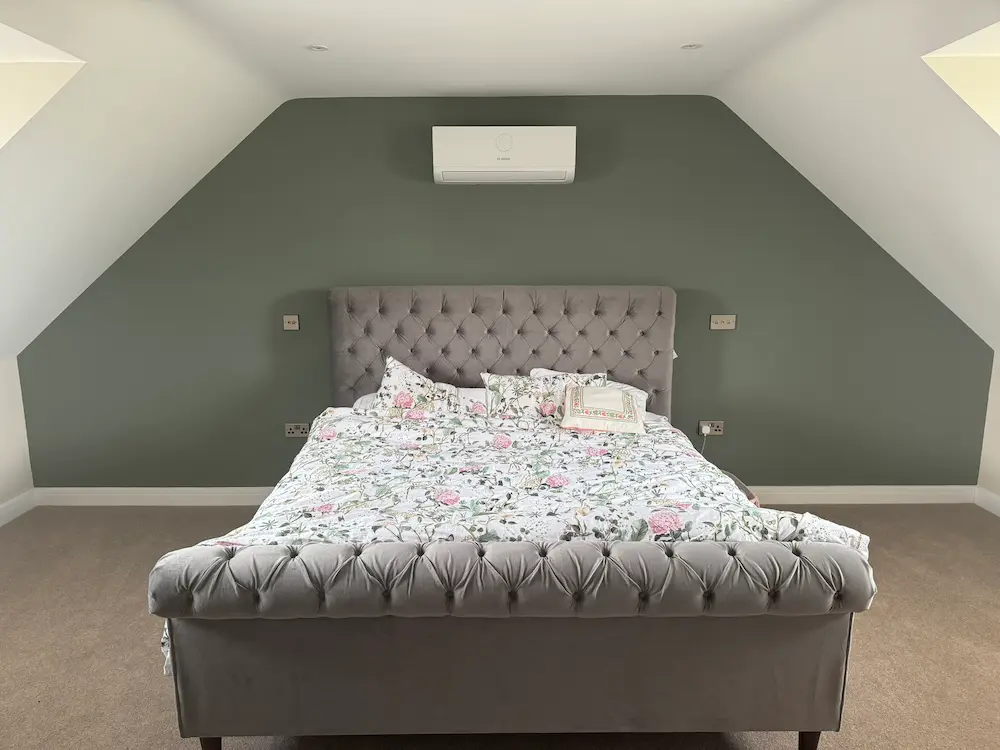
Throw air across the room, not straight at sleepers.
Night operation is different from a daytime showroom.
A falling condensate drain avoids pump noise.
It may spread cooling, but room control is weaker.
Heating needs a winter heat-loss check.
Yes, if the room's heat is interfering with sleep and ordinary ventilation is not enough. Bedrooms can overheat because they are upstairs, face afternoon/evening sun, sit under a poorly protected roof or belong to a well-insulated modern home that loses heat slowly after sunset.
Fixed air conditioning is particularly useful where open windows create their own problems:
It is not the only answer. External shading, loft insulation, sensible daytime window/curtain use and night ventilation can reduce heat gain. Air conditioning deals with the remaining cooling load and gives control when weather and ventilation cannot.
The indoor unit normally sits high on a wall so its air can spread through the room. The best position directs the main airflow across open space rather than down onto the bed, while leaving enough access to clean filters and service the unit.
A survey should check:
An outside wall can create the simplest route, but the nearest wall is not automatically the most comfortable. An internal wall may give better airflow if there is a neat pipe and drain route through an adjacent loft, cupboard or bathroom.
It can. The photograph on this page is one of our own installations. The deciding question is where the louvres send the air in normal and quiet modes. If they can throw it beyond the bed, the position may work well. If the only realistic airflow lands on someone's face, a side or opposite wall is usually kinder.
A unit inside the bedroom gives the best control of that bedroom. A landing unit can sometimes take heat out of a wider upstairs area and encourage cooler air towards several rooms, particularly when doors remain open.
| Question | Unit inside bedroom | Unit on landing |
|---|---|---|
| Temperature control | Direct control where you sleep | Indirect and dependent on airflow through doors |
| Bedroom door closed | Still effective | Little cooling reaches the closed room |
| Several bedrooms | One room benefits most | Can take the edge off several open rooms |
| Noise at the bed | Indoor fan is in the room | Fan is outside the bedroom, though sound travels |
| Whole-home influence | Can help if aimed through an open door | Often has the better route towards rooms and stairs |
Cooler air tends to fall and warmer air rises, so an upstairs unit can often reduce the wider home's temperature by a few degrees and make a heatwave feel less oppressive. It will not hold every closed room at 18°C or create individual control from one indoor unit. Layout, door positions, stairwell, insulation and solar gain set the limit.
Modern wall-mounted splits can be very quiet at their lowest fan setting. Some manufacturer data lists indoor sound pressure in the low-to-mid 20 dB(A) range under controlled test conditions. Treat that as a model-comparison figure, not a promise of what your room will measure.
Bedroom sound has several sources:
Samsung WindFree is one option I like for bedrooms because its micro-hole mode disperses air gently rather than relying on one stronger cold jet. Other manufacturers have good quiet and draught-reduction modes too. Compare the exact model at low fan speed and make sure the installer can explain how it behaves overnight.
When the indoor coil cools humid air, water condenses on it and runs into a drain tray. That water needs a reliable route away.
A gravity drain is usually best in a bedroom because it has no pump motor. The pipe can discharge correctly outside or fall to a suitable internal waste connection, sometimes in an adjacent bathroom. The whole route needs continuous fall and protection against leaks, smells and poor termination.
If gravity is impossible, a condensate pump can lift the water. It is not automatically a bad installation, but ask where the pump will be, how loud its short cycle is, how it can be maintained and what happens if it fails. The wrong answer tends to introduce itself just after you have fallen asleep.
| Feature | Fixed split | Portable unit |
|---|---|---|
| Indoor noise | Compressor is outside, so normally quieter | Compressor and fan are in the room |
| Window | Can remain closed | Exhaust hose needs an opening/sealing kit |
| Installation | Permanent professional work | Quick setup and movable |
| Cooling performance | Usually stronger and more efficient | Useful for occasional or rented use |
| Floor space | None used by the high-wall unit | Unit and hose occupy the room |
A portable unit can be a completely reasonable answer for renters or a few hot nights. If it is being run beside the bed for weeks, the fixed split's quieter indoor arrangement becomes much more valuable. Our wall-mounted AC unit guide compares the full range of fixed indoor styles and single-versus-multi layouts.
The installed cost depends less on the word “bedroom” and more on the route. A straightforward single split through an outside wall is different from long pipework through a loft, a high outdoor position, a condensate pump or new electrical supply.
Main price factors include:
A room survey should make those items visible before the work starts. The complete quotation should show the equipment, routes, drainage, electrical work and outdoor support before installation begins.
Yes. The systems Vector Heat installs are reversible air-to-air heat pumps, so they can heat quickly as well as cool. That can be useful for a bedroom, loft conversion or home office without turning on the whole central-heating system.
If the unit is only occasional top-up heating, the cooling selection may already be useful. If it will be the room's main heat source, calculate heat loss and check output at the winter design temperature, including defrost. Cooling load and heating load are different design questions.
The Boiler Upgrade Scheme currently includes £2,500 for eligible residential air-to-air heat pumps in England and Wales. It is subject to scheme and MCS requirements, so it should be checked as part of a qualifying whole-heating proposal rather than assumed for any bedroom cooling installation.
Keep the washable filters clean in line with the instructions and do not block the indoor or outdoor airflow. Periodic professional maintenance can check the coil, drain, electrical connections, refrigerant system, fan condition and operating performance.
A dirty filter raises resistance and noise. A neglected condensate route can smell or leak. Neither improves the atmosphere of a bedroom, despite both being impressively avoidable.
It can be one of the most useful places for fixed air conditioning if overheating is disrupting sleep. Choose the position, low-speed sound, airflow and condensate route as carefully as the cooling output.
Usually high on a wall where air can travel across the room without blowing directly onto the bed. The position must also allow service access, a sensible route to the outdoor unit and preferably gravity condensate drainage.
It can work where the louvres throw air beyond rather than directly onto the sleepers, but a side or opposite wall is often more comfortable. The room layout and pipe/drain routes decide what is practical.
One upstairs unit can sometimes lower the wider home's temperature by a few degrees, especially with open doors and a useful route towards the landing or stairs. It will not give closed rooms independent control or guarantee one set temperature everywhere.
A landing unit can spread some cooling towards several open bedrooms, while an indoor unit inside one bedroom gives that room much better control. Door positions, stairwell, solar gain and where people sleep determine the better compromise.
Modern high-wall splits can run very quietly at low speed, but compare the exact model's sound-pressure data and listen for condensate-pump or structural vibration risks too. Published figures depend on test and room conditions.
Not if water can fall continuously to a suitable outside or waste connection. Gravity drainage is normally preferred in a bedroom. A pump is useful where that route is impossible, but its location, sound and maintenance need discussing.
Yes. The systems Vector Heat installs heat and cool. For occasional top-up heat the room's cooling-sized unit may be useful; for main heating it must be checked against room heat loss and cold-weather output.
Vector Heat can survey the room, bed and outdoor positions, compare bedroom and landing options and design the airflow, condensate and pipe route before drilling starts.
Arrange an air-conditioning survey