LPG boiler chemistry
Why Do LPG Boilers Corrode Faster? The Chemistry Explained
In my experience, LPG boilers often look far older inside than equivalent mains-gas boilers. The chemistry explains several possible reasons, but not one convenient culprit.
Insight by Vector Heat
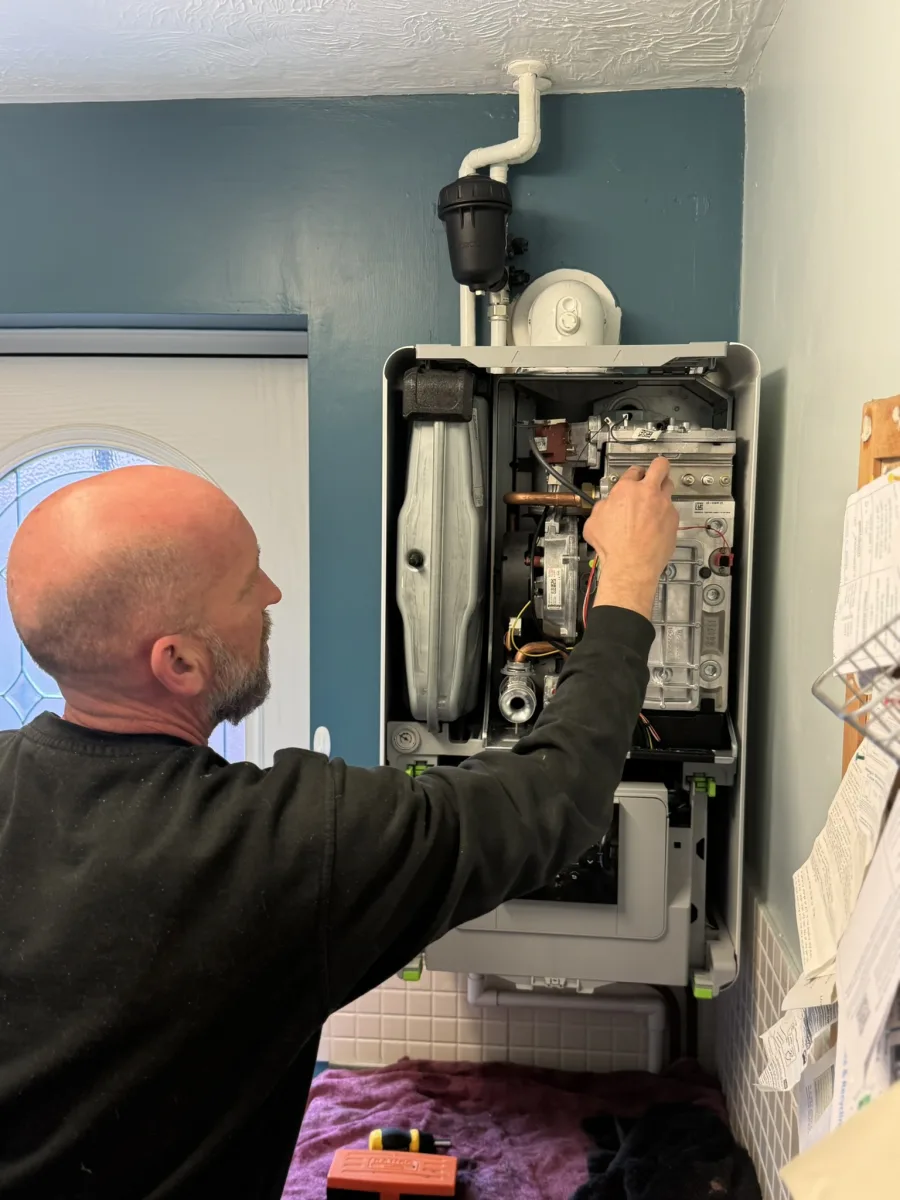
I kept opening LPG boilers and finding the same thing: the combustion chambers and heat exchangers often looked in worse condition than I expected for their age. After enough of them, "bad luck" stops feeling like a technical answer.
I originally suspected sulphur in the LPG. That is a credible part of the chemistry, but the full answer is more complicated. Current UK data does not prove that normal domestic LPG contains more sulphur than mains gas, and no study I found compares the lifetime of otherwise identical UK boilers on both fuels.
The honest answer is that LPG boilers can suffer from a combination of trace sulphur, acidic condensate, combustion deposits, fuel-supply condition, setup and heat-exchanger materials. My field experience says the deterioration is real. The available research says it is not responsible to blame one ingredient on its own.
If you are deciding whether an older appliance is still worth repairing, my guide to gas, LPG and oil boiler lifespan explains the practical age ranges and the repair history I would assess.
The Short Answer
Why do LPG boilers corrode faster? In my servicing experience, they often show more combustion-side deterioration because several effects can work together: acidic condensate, deposits, LPG pressure and combustion setup, appliance materials, and trace sulphur compounds.
The most defensible explanation is several effects working together. Commercial LPG is odorised with a sulphur-bearing compound and can contain trace sulphur. Condensing boilers deliberately create water on cool heat-exchanger surfaces. Acidic condensate and deposits can then attack the material, while incorrect pressure or combustion setup can make conditions worse.
That is different from saying, "LPG contains loads of sulphur and that is the answer." Current evidence does not support that simple claim.
What Do We Know, and What Are We Inferring?
This subject becomes much clearer when the evidence is separated into three levels.
| Evidence level | What we can say |
|---|---|
| Field observation | I repeatedly find LPG boiler combustion chambers and heat exchangers in worse condition than comparable mains-gas appliances. |
| Established chemistry | LPG is odorised with a sulphur-bearing compound. Sulphur compounds can become acidic species during combustion and condensation. Other combustion products also make condensate acidic. |
| Not established | We cannot currently say that every UK LPG supply has more sulphur than mains gas, or that sulphur alone caused the damage in a particular boiler. |
This is an awkward answer if you wanted one chemical in the library with the candlestick. It is a much better answer if you want to diagnose a boiler properly.
What Is Actually in UK LPG?
LPG means liquefied petroleum gas. A domestic bulk tank normally contains commercial propane rather than laboratory-pure propane. The fuel must meet a specification and is deliberately given a smell so a leak can be detected.
GOV.UK says commercial LPG supplied in the UK meets BS 4250 and identifies ethanethiol, also called ethyl mercaptan, as the odorant. Ethanethiol contains sulphur.
A DESNZ-commissioned review of UK fuel carbon factors states that BS 4250:2014 limits total sulphur in LPG to 50 mg/kg. It also says there was no quantitative contemporary supplier data available and retains an estimated 6.9 mg/kg for domestic LPG in the UK emissions inventory.
That distinction matters. A specification limit is the maximum allowed, not the amount in every delivery. An inventory estimate is useful for national calculations, not a test certificate for the propane in one customer's tank.
How Can Sulphur Reach a Boiler Heat Exchanger?
The route is chemically plausible and fairly easy to follow:
Fuel to Acidic Condensate
- The LPG contains its sulphur-bearing odorant and may contain other trace sulphur compounds.
- Combustion can oxidise sulphur compounds to sulphur dioxide and sulphur trioxide.
- A condensing boiler cools the combustion products below their dew point, so water forms on the heat exchanger.
- Those sulphur oxides can dissolve or react in the water, producing sulphurous or sulphuric acidic species.
- Deposits can hold moisture and corrosive material against the heat-exchanger surface.
Published fireside-corrosion research on gas-fired heat exchangers identifies acidic condensate as a major cause of corrosion and found that adding sulphur to the fuel increased sulphate deposition. It is strong evidence for the mechanism. It is not a field trial proving why one domestic LPG boiler failed.
The amount of time a surface stays wet, the temperature profile, drainage, alloy, deposits and local chemistry all influence what happens next. This is why two boilers on the same fuel can age very differently.
Why Sulphur Is Not the Whole Answer
Condensing-boiler water is acidic even without sulphur. Carbon dioxide dissolves into water and forms carbonic acid. Nitrogen oxides from combustion can contribute nitric and nitrous acids. Appliance-condensate studies have found sulphate, nitrate and nitrite species.
Propane also produces a little less theoretical condensate per unit of heat than methane. Published condensing-technology data gives roughly 0.13 kg/kWh for propane and 0.16 kg/kWh for natural gas. In theory, acid-forming compounds may have less water available to dilute them.
I treat that as a possible contributor, not proof that LPG condensate is always more acidic. Manufacturer data puts propane and natural-gas condensate in the same broad acidic range, and the exact sample depends on the boiler and how it is operating.
What About LPG Residue and Deposits?
Commercial LPG can carry heavier hydrocarbon or oily residues introduced during processing, pumping, compression, storage and transport. Published research shows that residue can collect in vapourisers, regulators and instruments.
That gives engineers another supply-side factor to consider, but it needs careful wording. I have not found evidence that oily residue simply passes through a domestic burner and directly corrodes the heat exchanger. Its clearer relevance is that contamination or poor fuel delivery can affect regulators, pressure and combustion quality.
Inside the boiler, combustion deposits matter because they can retain water and acidic compounds against the metal. They can also alter heat transfer. A deposit is therefore part of the corrosion environment, but it still does not tell you whether its starting cause was fuel composition, pressure, mixture, air path, servicing or a combination.
Why LPG Setup and Combustion Matter
A boiler designed to run on LPG must be correctly configured for LPG. The engineer then has to work from the manufacturer's instructions and actual measurements rather than assuming that "gas is gas".
Relevant factors can include:
- the correct LPG conversion or appliance configuration
- standing and working inlet pressure
- the regulator and supply arrangement
- gas rate where the manufacturer's method requires it
- combustion readings at the specified test points and outputs
- burner and heat-exchanger deposits
- the condensate route and drainage
- the combustion-air and boiler flue path
If the pressure or air-gas mixture is wrong, poor combustion and deposits can make an already wet, acidic environment worse. That does not mean every marked LPG heat exchanger was set up incorrectly. It means setup belongs in the investigation.
For Heating Engineers: A Better Inspection Question
Instead of asking, "Is this sulphur damage?", ask, "What evidence do I have for the fuel supply, combustion condition, condensate environment and material damage?"
| Area | Useful evidence |
|---|---|
| Fuel and supply | Correct LPG category, regulator arrangement, inlet and working pressure, supply condition and any known delivery issue |
| Combustion | Manufacturer-specified readings, gas rate where applicable, stability across the required outputs and evidence of incomplete combustion |
| Combustion side | Deposit colour and location, burner condition, heat-exchanger surface, condensate drainage and comparison with previous service records |
| Appliance context | Age, material, service history, known model issues, flue and air route, operating pattern and previous parts |
Photographs and previous readings are especially useful. "It looked rough" is a start; a dated sequence showing how it changed is much better.
What Should an LPG Boiler Owner Do?
You do not need to become a fuel chemist to own an LPG boiler. You do need the right servicing and sensible records.
- Have the boiler serviced annually by a Gas Safe registered engineer with the correct LPG categories.
- Keep service reports so changes in combustion readings and internal condition can be compared over time.
- Report repeated lockouts, unusual smells, soot or staining rather than waiting for the next routine service.
- Tell the engineer whether the supply is from cylinders or a bulk tank.
- Ask what condition the combustion chamber and heat exchanger are in, especially as the boiler gets older.
Do not remove the casing to look inside. On a room-sealed boiler, the casing can form part of the combustion seal. Internal inspection and testing belong with a properly qualified engineer.
A straightforward LPG service normally takes 30 to 45 minutes, but the exact routine depends on the appliance. My guide to how long a boiler service takes explains what faults add and why known problems should be reported before the appointment.
So, Why Do LPG Boilers Often Look Worse Inside?
My answer is still that LPG boilers often deteriorate faster on the combustion side. I have seen that pattern too many times to dismiss it.
The chemistry supports a combination of causes. Sulphur-bearing odorant and trace sulphur can contribute acidic compounds. Carbon dioxide and nitrogen oxides add other acids. A condensing boiler creates the water needed for those acids to act. Deposits can hold moisture against the metal. Pressure, mixture, drainage, servicing and the heat-exchanger material decide how severe the result becomes.
What I cannot honestly say is that every tank of LPG contains more sulphur than mains gas, or that one damaged boiler proves sulphur caused it. That would be tidier, but tidiness is not evidence.
FAQ
Do LPG boilers corrode faster than natural-gas boilers?
In my servicing experience, LPG boilers often show more combustion-side deterioration than equivalent mains-gas appliances. Current research supports several credible contributing mechanisms, but it does not prove that sulphur alone causes the difference or that every LPG boiler will deteriorate faster.
Does LPG contain sulphur?
Yes. UK LPG is odorised with the sulphur-bearing compound ethanethiol and can contain other trace sulphur compounds. A current DESNZ-commissioned review states that BS 4250:2014 limits total sulphur to 50 mg/kg and retains an estimated 6.9 mg/kg for domestic LPG because current supplier data was unavailable.
Is LPG boiler condensate more acidic?
It can be acidic, as all condensing-boiler condensate is, but the evidence I reviewed does not establish that LPG condensate is always more acidic than natural-gas condensate. Sulphur compounds, carbon dioxide and nitrogen oxides can all contribute acidic species.
What causes corrosion inside an LPG boiler?
The most defensible explanation is a combination of acidic condensate, deposits that retain moisture, combustion setup, LPG pressure, appliance materials and design. Trace sulphur and sulphur-bearing odorant are plausible contributors, but a damaged heat exchanger does not identify one chemical cause by itself.
Can a homeowner inspect an LPG boiler for corrosion?
No. Do not remove the casing of a room-sealed boiler because it can form part of the combustion seal. Internal inspection and combustion testing should be carried out by a Gas Safe registered engineer with the correct LPG categories.
How often should an LPG boiler be serviced?
LPG boilers should normally be serviced every year, following the instructions for the exact make and model. The engineer should hold the relevant LPG qualification and check the fuel-specific setup and combustion as required by the manufacturer.
Book an LPG Boiler Service
Vector Heat services LPG boilers around Lincoln, including appliances supplied from cylinders and bulk tanks. Report any fault or unusual behaviour when booking so we can allow the right time.
LPG boiler servicing in Lincoln