
Heat Pumps
Heat Pump Hot Water: Which Cylinder Should You Choose?
Keep what works. Choose the hot-water arrangement that suits your home.
Published
Nobody buys a heat pump hoping for a more interesting airing cupboard. But the hot-water choice matters: it affects space, running costs, how quickly the water reheats and what happens if the heat pump breaks down.
A heat pump can supply your showers, baths and taps. For a whole-home air-to-water system, I consider four options: keep a suitable existing cylinder, fit a standard heat-pump cylinder, choose a Heat Geek Super Cylinder, or use a Mini Store where space is tight.
My usual choice is a standard heat-pump cylinder with an immersion heater for backup. That does not mean it is the right answer for every house. Here is how I decide.
The four hot-water options
| Option | Why consider it? | What I check |
|---|---|---|
| Existing cylinder | Avoid replacing equipment that can still do the job. | Coil, capacity, condition, insulation and compatibility. |
| Standard heat-pump cylinder | My usual balance of cost, storage and immersion backup. | Hot-water use, recovery, cupboard space and controls. |
| Super Cylinder | A larger coil can improve heat transfer, particularly with a larger heat pump. | Whether the extra coil area justifies the extra cost. |
| Mini Store | A compact alternative when a conventional cylinder will not fit. | Available heat output, shower flow, operating temperature and backup. |
How does a heat pump heat your hot water?
In a conventional cylinder arrangement, hot heating-system water passes through a coil inside the cylinder. Heat moves through the coil into the stored tap water. The two lots of water stay separate.
The heat pump normally switches between heating the house and reheating the cylinder. During a hot-water cycle, it supplies the temperature needed for that job; it does not need to run your radiators at the same temperature.
A heat pump generally works more efficiently at lower water temperatures. A suitable cylinder coil transfers enough heat without unnecessarily high heating-water temperatures. That is why I look beyond the number of litres on the label.
1. Can you keep your existing cylinder?
Sometimes, yes. My first check is the coil surface area and whether it can transfer the proposed heat pump's output effectively. Then I check capacity, condition, insulation, controls and the manufacturer's compatibility requirements.
Usually, a good candidate is a modern unvented cylinder with a decent-sized coil, paired with a smaller heat pump. A cylinder designed for a boiler may rely on much hotter water through its coil. It can struggle to absorb the output of a larger 10–12kW heat pump at suitable temperatures.
That mismatch can make the heat pump repeatedly stop and restart during hot-water heating. It is not simply a question of whether the water eventually gets hot; recovery and efficiency matter too.
Where keeping it and replacing it are both sensible options, I show the customer the installation price difference and estimated running costs. Both arrangements will give them hot water. They can decide whether the improvement is worth paying for.
2. A new standard heat-pump cylinder
This is my usual recommendation: an unvented cylinder with a coil suitable for the heat pump, enough stored hot water and an immersion heater for backup. It normally costs less than the specialist options below.
The immersion matters to me because I attend breakdowns. If the heat pump cannot heat the cylinder, an independently functioning immersion can still provide hot water while the fault is sorted. It costs more to run than an efficient heat pump, but it is useful backup.
What size cylinder do you need?
I start with the people in the house and how they use hot water. A bath, several showers in a row and two showers running together are different demands. Mains pressure and flow matter as well: a bigger cylinder does not fix a poor incoming water supply.
For some households, the minimum I arrive at is around 150–175 litres. If there is room, I often favour 250 litres. It gives useful storage and flexibility without automatically choosing the biggest cylinder available.
More stored water can let us meet demand at a lower everyday temperature, with less cold water mixed in at the tap. The actual setting and hygiene programme still need to suit the equipment and household. A bigger cylinder is not automatically more efficient: standing losses and how much you actually use also count.
The cupboard often decides what is possible. A slimline cylinder may fit where a standard-width one will not. I check the access route and space for pipework and servicing, not just whether the cylinder can be squeezed through the door.
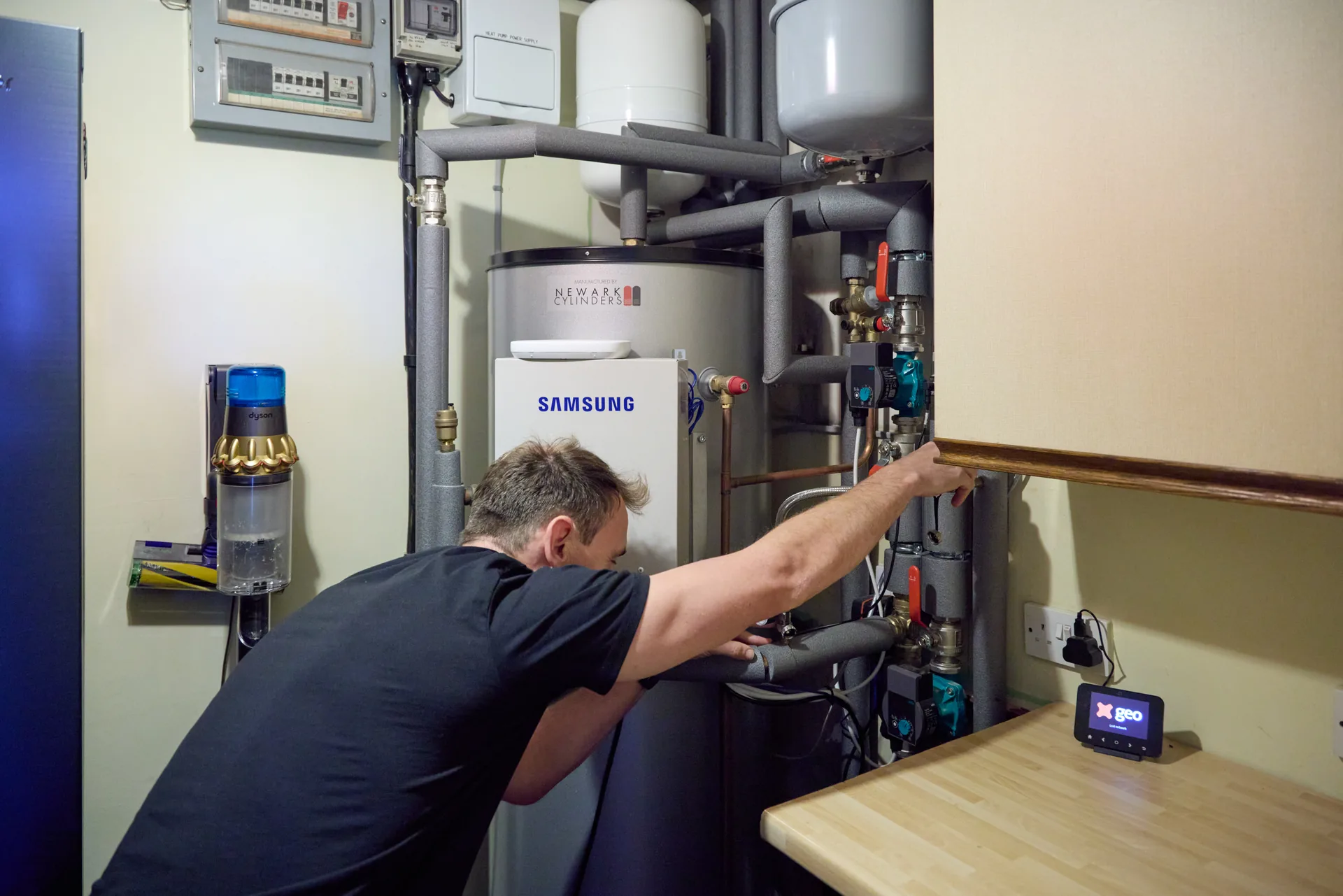
3. When is a Heat Geek Super Cylinder worth it?
The Newark Heat Geek Super Cylinder has a much larger coil than many conventional cylinders. The point is to transfer heat effectively, rather than asking the heat pump to produce unnecessarily hot water to get the job done.
I mainly consider it for bigger heat pumps. Where a smaller coil would limit heat transfer, the extra surface area can improve recovery, efficiency and cycling. Newark offers different coil options, so the actual model matters.
With a smaller heat pump, I am less likely to recommend the extra spend. The standard cylinder's coil may already handle the output well. There is no universal size below which a Super Cylinder cannot help, but there needs to be a worthwhile benefit on that particular installation.
Our Super Cylinder guide has the model codes, dimensions and manuals. I would choose the coil to suit the system, not assume the most expensive cylinder is automatically the best purchase.
4. A Mini Store when space is the problem
The Newark Heat Geek Mini Store is a specialist option, often useful when replacing a combi boiler and there is no obvious space for a conventional cylinder. I do not normally choose one if a suitable standard cylinder fits comfortably.
It works differently. The store holds hot heating-system water, while fresh tap water is heated as it passes through a heat exchanger. It is not a small conventional cylinder full of stored domestic hot water.
Continuous hot water depends on the system keeping up. Heat pump output, incoming water temperature and the flow through your shower all affect that. Start-up and defrost also need considering. It is not a promise of unlimited hot water at any flow rate.
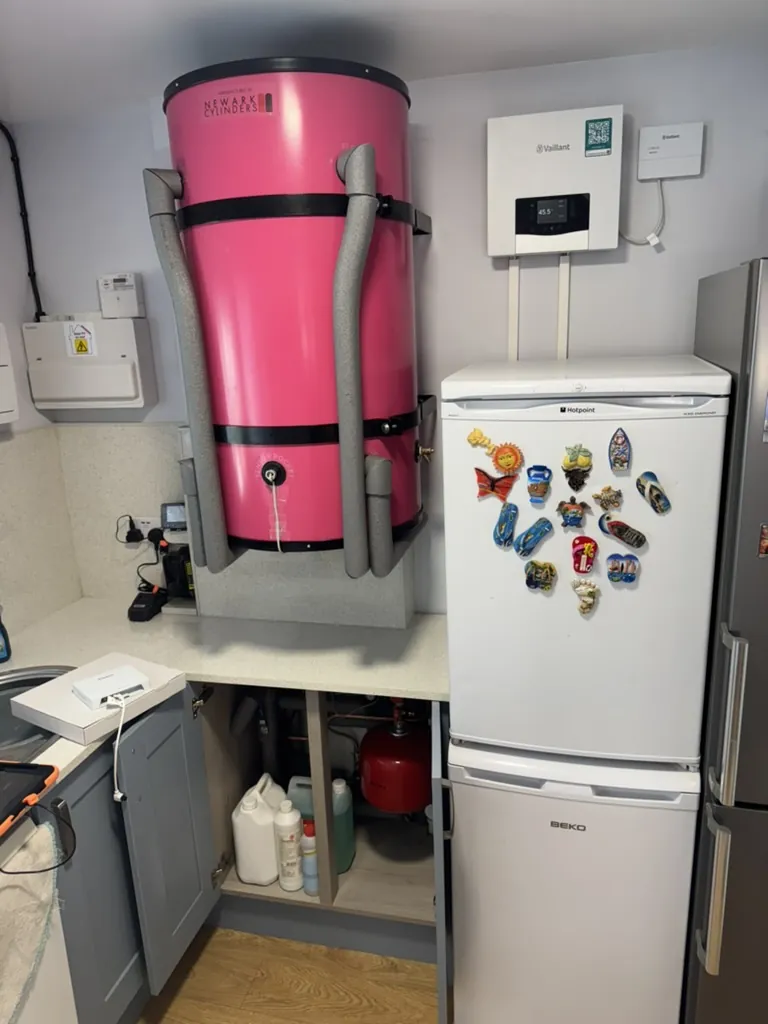
A Mini Store under a utility worktop
One of my customers has theirs beneath a utility worktop, taking up no usable space. They found a 55°C store setting gave them their daily bath. Running hotter costs some efficiency, but the space saving makes it worthwhile for them.
That is their primary-store setting, not a recommended temperature for everybody's domestic hot-water cylinder. The arrangement has to suit the household and the equipment.
The compromise: backup and stored energy
The version we fit has no immersion heater; the Mini Store v1.4 manual lists no immersion boss. If the heat pump fails, there is no independent immersion backup for hot water. Any alternative backup would need planning separately.
It also offers much less flexibility to heat a large reserve during cheap electricity periods and use it throughout the day. It stores some heat, but needs to be ready for hot-water use and relies on the heat pump keeping up.
Our Mini Store guide explains its sizing, controls and current manual in more detail.
Solar panels and cheap electricity periods
A larger conventional cylinder can give more scope to schedule hot-water heating. Where demand and space justify it, 250–300 litres can be useful for this. We still need to allow for your actual hot-water use and recovery time.
- Cheap overnight electricity: schedule the heat pump to heat the cylinder directly during the cheap period. You do not need to run it from a home battery to benefit.
- Solar PV: a midday heat-pump hot-water cycle can use available solar generation. Compare that with the export income you would otherwise receive.
- A solar diverter: this sends surplus electricity to an immersion heater. Whether that beats exporting or running the heat pump depends on the tariffs and system efficiency.
The Mini Store version above has no immersion for a solar diverter to feed. Solar electricity can still power the heat pump itself. Those are two different arrangements.
Keep the hygiene programme agreed during commissioning. Do not disable it to squeeze every hot-water cycle into a cheaper period. Stored hot-water temperature, hygiene and scald protection need to be considered together.
How much more do the specialist options cost?
In my comparisons, a Super Cylinder or Mini Store can add roughly £600–£800 compared with a standard heat-pump cylinder, depending on the models being compared. This is an indication, not a fixed installed-price supplement.
Moving equipment, difficult access and pipework changes can affect the quote separately. Reusing a suitable cylinder may save money upfront; replacing it may improve recovery or estimated running costs. I want the customer to see both sides before deciding.
Heat pump hot-water questions
Can a heat pump provide enough hot water for a bath?
Yes, with a suitable design. We check bath volume, shower use, storage and recovery. A Mini Store also needs enough available heat output at the required water flow.
Do I always need a new hot-water cylinder?
No. An existing cylinder may work if its coil, capacity, condition, insulation and controls suit the proposed heat pump. Compatibility needs checking rather than assuming every boiler cylinder must go.
Is 250 litres the right size for everyone?
No. It is a size I often favour when the household demand and available space suit it. The choice depends on how much hot water you use, when you use it and how quickly it can reheat.
Does a heat pump need an immersion heater?
It does not normally need an immersion to do all the everyday hot-water heating. An immersion is useful for backup and may be part of the commissioned hygiene programme. The Mini Store version discussed here has no immersion heater.
Is the Super Cylinder always better than a standard cylinder?
No. Its larger coil is useful where heat transfer would otherwise limit performance. I compare the likely benefit with the extra cost, especially when the heat pump is small.
Can I use solar panels to heat the hot water?
Yes. Solar electricity can run the heat pump, or a suitable diverter can supply an immersion heater. The Mini Store version discussed here has no immersion for a diverter, but solar can still power its heat pump.
Choose it around your home
Tell me about your baths and showers, cupboard space and whether backup hot water matters to you. Our survey preparation guide explains what I will check.
For a heat pump installation in Lincolnshire, we can compare the practical options and agree the hot-water arrangement before the work starts.
Technical sources: Newark HG cylinder specifications, the Mini Store v1.4 manual, Energy Saving Trust heat-pump guidance and myenergi on solar diversion and heat pumps. Choices and job examples are from my own installations.