Heat pumps
Heat Pump Flow Temperature: How Low Should You Go?
Lower water temperatures, efficient heating and making sure every room stays warm.
Published
I spend a surprising amount of my working life explaining why a radiator not being roasting hot is good news.
The best heat pump flow temperature is the lowest heating-water temperature that keeps every room comfortably warm. Lowering it improves the heat pump's efficiency, but it also reduces the heat your radiators or underfloor heating can give out. Both sides need to work.
That does not mean setting every heat pump to 35°C and hoping for the best. It means designing the heating properly, then using weather compensation to match the water temperature to what the house needs.
- Flow temperature: the temperature of the water going out to your heating.
- Lower is more efficient: provided the radiators or heated floors still deliver enough heat.
- It should change with the weather: colder days generally need warmer water.
- Comfort comes first: a cold bedroom is not a successful efficiency improvement.
What is heat pump flow temperature?
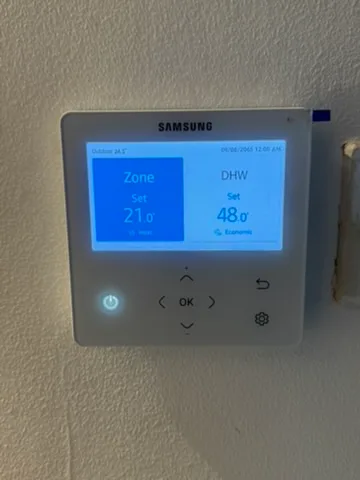
Flow temperature is the temperature of the water leaving the heat pump to supply your heating. The water gives up heat through radiators or underfloor pipes, then returns cooler. The difference between those two temperatures tells us something about heat transfer, but neither number is your room thermostat setting.
- Flow temperature: heating water going out, for example 40°C.
- Return temperature: water coming back after releasing heat.
- Room temperature: the indoor temperature you want, for example 21°C.
- Flow rate: how much water is moving, normally shown in litres per minute. That is a different measurement.
The hot-water cylinder also has its own target. Heating your radiators with 35°C water does not mean your shower has to be 35°C. The heat pump changes operating conditions when it heats the cylinder.
Why lower flow temperature improves efficiency
The heat pump moves heat from outside into your home. Asking it to deliver hotter water increases the temperature difference it has to work across. Keeping the water temperature lower reduces that work and improves efficiency under otherwise comparable conditions.
That is why I care about radiator output, heated floor area and heat loss before we choose the settings. They determine how low we can run the water while keeping the house warm.
Vaillant's explanation of heat-pump energy use describes how outdoor and flow temperatures affect performance. A quoted efficiency figure at 35°C is not a promise of the same result at 55°C.
I would not promise a fixed percentage saving for every degree you reduce it. The heat pump, outdoor conditions, hot-water use, operating pattern and electricity tariff all affect the final bill. The direction is clear: lower heating-water temperatures help efficiency. The saving needs to be assessed for the actual system.
Should a heat pump run at 35, 45 or 55°C?
There is no single correct temperature for every heat pump. The right figure depends on the home's heat loss, the radiators or underfloor heating, and the weather. A design that needs 45°C on a very cold day should normally use lower temperatures when the weather is milder.
| Flow temperature | What to understand |
|---|---|
| 35°C | A useful low-temperature design target where the heated floor or radiators can provide enough output. Not automatically enough for every home. |
| 40–45°C | Radiators can work at these temperatures when their output matches the room's heat loss. They do not all need to be enormous. |
| 50–55°C | Can be a valid design choice for suitable equipment and emitters. It carries an efficiency penalty compared with meeting the same demand at a lower temperature. |
In a well-insulated new build, radiators can work at around 40°C without taking over every wall. I still strongly recommend underfloor heating downstairs when there is the opportunity to install it. A large heated floor can provide the required heat output using only low-temperature water.
In an existing house, I start with what is already there. Good insulation and practical draught-sealing reduce the heat the rooms need, which helps us use lower temperatures. But a heat pump can also be designed for an older, leakier house. It needs the heat-loss calculation and emitters to suit it.
My underfloor heating versus radiators guide explains where each option makes sense.
Being able to make hotter water is different from needing it. My high temperature heat pump guide explains why that capability is now standard on many newer models and what it means for existing radiators.
Lower water temperature means less radiator output
The same radiator gives out less heat when the water running through it is cooler. That is not a fault. We need enough radiator surface area to meet the room's heat loss at the intended water temperature.
A radiator's catalogue output at ΔT50 does not mean a 50°C flow temperature. It means the average water temperature is 50 degrees above the room temperature. Flow and return temperatures both matter.
| Flow / return | Room | Mean water above room | Heat output |
|---|---|---|---|
| 75 / 65°C | 20°C | 50°C | 2000W |
| 55 / 45°C | 20°C | 30°C | 1026W |
| 45 / 35°C | 20°C | 20°C | 604W |
Calculated using Stelrad's radiator correction factors: 1.000, 0.513 and 0.302. The 10°C flow-to-return differences make this example easy to compare; they are not a recommended heat-pump setting. Use the actual radiator manufacturer's data and your system's design temperatures.
If the room only needs 500W at the design outdoor temperature, that last example has enough output. If it needs 900W, it does not. That is the useful comparison, rather than whether the radiator feels hot to your hand.
Nor does this mean replacing every radiator. We check each room and make the changes that are needed. See my guide to radiators with a heat pump for how I approach that assessment.
Weather compensation changes the flow temperature for you
A house loses more heat as the temperature difference between indoors and outdoors increases. Weather compensation responds by changing the heating-water target: warmer water in cold weather, cooler water in mild weather. The heating curve describes that relationship.
The design flow temperature is a sizing point, not a temperature the heat pump should hold all year. It is the temperature used to check the emitters at the chosen cold outdoor design condition. Actual operation changes with the weather, controls and demand.
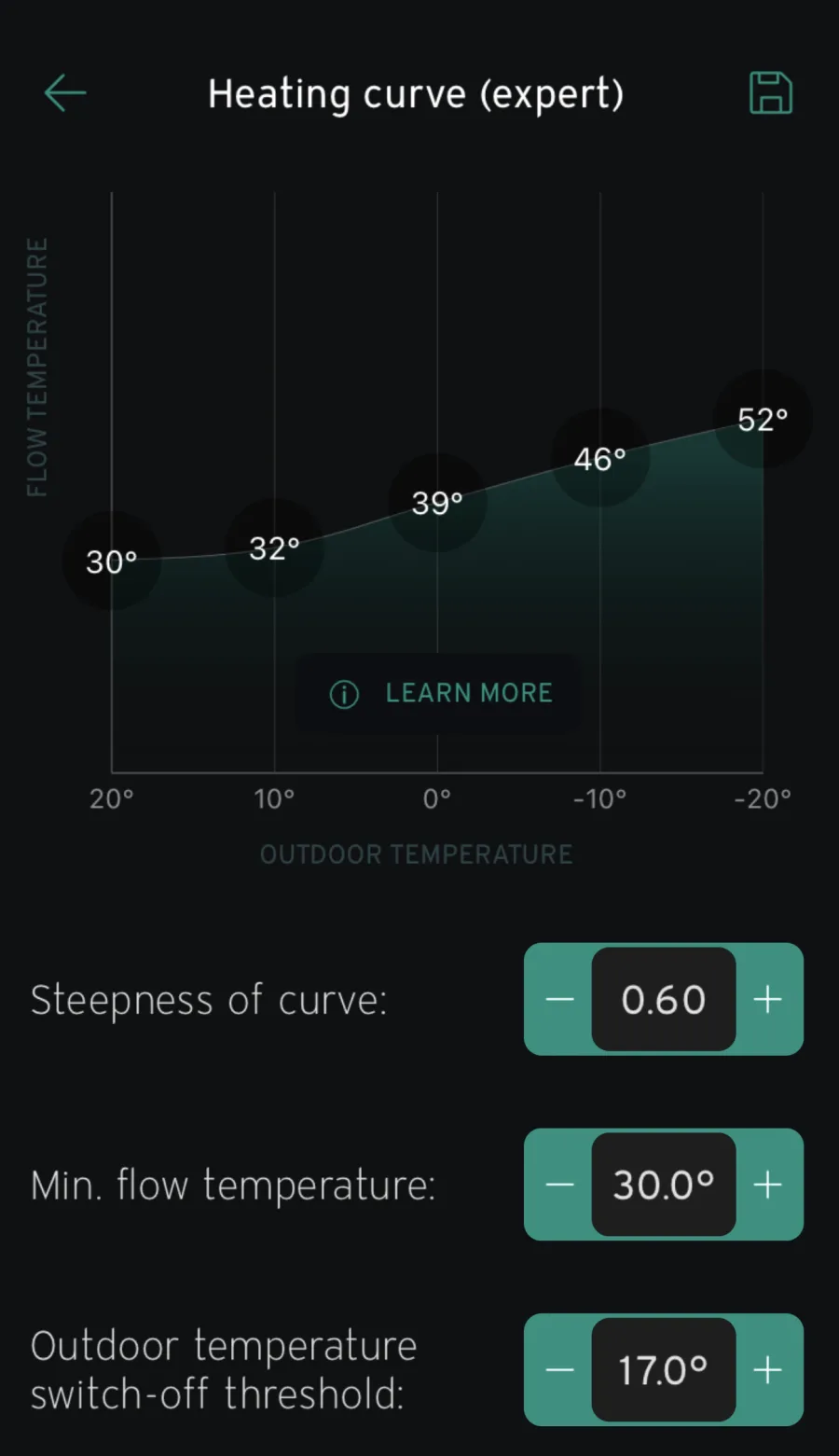
The graph shows why a heat pump does not need one fixed water temperature. Minimum flow temperature can flatten the mild-weather end, while room feedback can also influence the target.
The Energy Saving Trust's weather-compensation guide explains this relationship. My heat-pump controls guide covers how room feedback works alongside it.
How to try a lower flow temperature
If you understand the settings and want to improve your system, start with a small heating-curve adjustment rather than forcing one fixed temperature. Record the original setting, change one thing and check comfort throughout the house. The aim is to remove unnecessary heat, not to see how cold you can tolerate being.
- Check what you are changing. Heating curve and room target are different. Leave hot-water hygiene programmes, safety limits and installer-only pump settings alone.
- Record the original. Screenshot, photograph or write down the setting so you can put it back.
- Make one small reduction. On Vaillant, a curve change of 0.05, such as 0.60 to 0.55, is a sensible small test. That is a curve number, not a 0.05°C change in water temperature.
- Allow at least 24 hours. Check several rooms in comparable weather. UFH can take longer to show the full effect.
- Keep the change only if comfort is maintained. If rooms no longer reach their targets, restore the setting and establish why.
When tuning the heating curve, put your heat source into weather compensation only, with no room influence. This lets you check the curve without room compensation concealing the result.
For example, on Vaillant, put Room Temp Mod into Inactive while checking the curve. Afterwards, use the room-control mode that suits the property, particularly if sunshine or a stove provides extra heat.
myVAILLANT: Heating → scroll to Heat curve settings → Heating curve (expert). The graph lets you see the target line move as you adjust the curve.
Use the advanced Vaillant settings guide for the fuller explanation. Other brands use different controls and curve scales, so do not copy the Vaillant numbers.
Use the problem to decide what to check
- Whole house too warm from the heating: look at lowering the curve.
- Comfortable in mild weather, too cold in cold weather: the curve may need to be steeper. Check the emitter design too.
- Comfortable in cold weather, too cool in mild weather: check the mild-weather end, minimum flow temperature and outdoor heating cut-off. Raising the whole curve could make cold-weather heating unnecessarily hot.
- Only one room too cold: check its radiator or floor circuit, valve, air, balancing and draughts before raising the temperature for every room.
- Room overheats in sunshine or with a fire: look at room influence. That is a different problem from the heat pump supplying too much heat.
If the system is repeatedly stopping, faulting or failing to circulate, get that investigated. A curve adjustment will not clear a blocked filter or repair a pump.
Do not judge it from one temperature reading
Check whether the screen is showing the target or the measured flow temperature. Then check what the heat pump is doing. A cylinder reheat, start-up or defrost cycle is not the same as settled space heating.
Compare heating operation over time, along with room temperatures and outdoor conditions.
And if the rooms are comfortable with radiators that feel only warm? Perfect, that is the intended result. We are heating the house, not trying to recreate how a radiator felt with the old boiler.
Heat pump flow temperature: common questions
What is the best flow temperature for a heat pump?
The lowest heating-water temperature that still meets the heat demand in every room. There is no universal number: the weather, heat loss and radiator or underfloor output determine what is needed.
Is 35°C enough for radiators?
It can be, if the radiators have enough output at the actual flow, return and room temperatures. Check that output against each room's heat loss. A 35°C setting alone does not prove the house will be warm enough.
Is 50°C too high for a heat pump?
Not necessarily. It can be a valid operating temperature for suitable equipment and a particular heating design. Meeting the same heating demand at a lower water temperature improves efficiency, so it is worth checking whether that higher temperature is needed.
Will lowering the flow temperature save money?
Lower flow temperature improves heat-pump efficiency under comparable conditions. The final saving depends on how the system operates and your tariff. Keep every room comfortable and compare more than a single day's electricity use.
Does lower flow temperature mean colder hot water?
No. Space heating and cylinder heating have separate targets. The heat pump can operate at a higher water temperature for a cylinder reheat. Keep the commissioned hot-water hygiene settings in place.
Should I keep changing the flow temperature as the weather changes?
A correctly configured weather-compensated heating curve does that automatically. You can fine-tune the curve if comfort is wrong, but you should not need to manually choose a new fixed temperature every morning.
Should I activate weather compensation on my heat pump?
Yes. This is an energy-saving feature. It will keep your home at a stable temperature throughout the heating season when configured correctly.
Design the heating around your home
I check the heat loss and emitters room by room, then choose a practical flow temperature and explain the controls at handover.
Our heat-pump installation service