Heat pumps
Heat Pump Controls: Which Thermostat Should You Use?
Manufacturer controls, room temperature, underfloor zones and the settings worth understanding.
Published
You can spend thousands on a clever heat pump, then give it a thermostat whose entire vocabulary is “on” and “off”.
I normally recommend the manufacturer's own heat pump controls. A compatible controller can give the heat pump information about the temperature inside your home, not just whether someone wants the heating on. With the right setup, that helps it adjust the heating-water temperature to suit the house.
A third-party thermostat is not automatically wrong. The useful question is what it tells the heat pump, and whether the two are working together.
- Weather compensation: adjusts heating-water temperature according to the outdoor temperature.
- Room influence: uses the indoor temperature to help adjust that target.
- Schedules: decide when you want comfort temperature or a setback.
- Zones and radiator valves: need to work with the heating design, without leaving too little circulation.
Manufacturer controller or a basic room thermostat?
A basic thermostat measures the room temperature and asks for heating when it is too cold. Once satisfied, it removes that demand. The heat pump may receive only that on/off signal, rather than the actual room temperature.
A compatible manufacturer's room controller can share more information. With room influence enabled, the system can use the difference between the room temperature and your chosen target to adjust the flow temperature.
Basic on/off thermostat
- Requests or stops heating.
- Can provide a schedule.
- Does not necessarily send the measured room temperature to the heat pump.
Compatible manufacturer control
- Can share room-temperature information.
- Brings heating, hot water and system status together.
- Can work with weather compensation and model-specific settings.
An on/off thermostat does not mean the compressor only runs at full power. The heat pump can still modulate its output and use weather compensation while there is demand. What it may lack is feedback about what is happening inside the house.
Nor does “smart” on the box settle the question. An app can be convenient while the connection to the heat pump is still a simple switch. Some third-party controls offer closer integration, so check the exact equipment and connection rather than judging by the brand alone.
A Samsung customer example
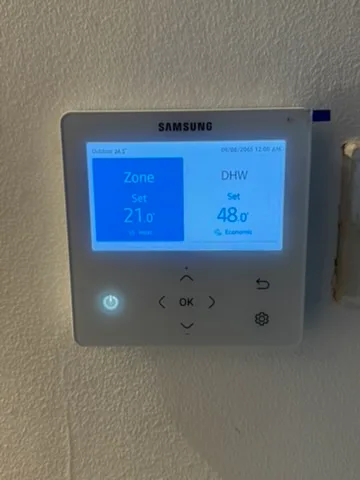
On one job, we removed the third-party thermostat and used Samsung's own controller. The customer had more information on the screen, more control over the heating and a better understanding of what the system was doing. They found it much better to live with.
I want customers to understand their heating, not just be able to turn it up.
Weather compensation and room influence do different jobs
Weather compensation sets the heating-water target from the outdoor temperature. When it gets colder outside, the building generally needs more heat, so the controller raises the target. In milder weather, it lowers it.
Room influence adds information from inside. A sunny living room, a wood burner or extra heat loss on a windy day can change what the house needs. Outdoor temperature alone does not tell the system all of that.
Some homes follow a well-tuned heating curve very closely without room feedback. Others benefit from the controller responding to indoor conditions. More room influence is not automatically more efficient. The best setting is the one that suits the property.
Vaillant is a useful example
- Inactive: the measured room temperature does not adjust the heating curve. Useful when checking whether the curve itself is right.
- Active: room temperature influences the flow-temperature target. It is not a strict cut-off at the room setpoint.
- Expanded: adds room-temperature-based switching of the heating zone. Useful where sunshine or another heat source would otherwise overheat the room.
These are Vaillant mode names, not settings to copy onto every brand. The sensoCOMFORT manual explains how room influence and zone assignment work.
The controller needs to measure a useful room
If we are using indoor feedback, its position matters. I put the sensoCOMFORT in a habitable, heated space where its reading represents the home, not in a garage or airing cupboard. Keep it away from direct sun and other misleading heat sources. The radiator valve in that room must not shut the heat off before the controller can do its job.
A controller cannot make a sensible decision about the house from a temperature that does not represent it.
Does underfloor heating need a thermostat in every room?
I regularly see relatively new homes with a thermostat in practically every downstairs room, opening and closing individual underfloor circuits.
For many homes, I would rather heat downstairs together, balance the circuits properly and use a suitably positioned heat-pump controller to manage demand. The circuits can deliver different amounts of heat without each one repeatedly shutting off.
Closing circuits reduces the heated floor area and the water volume available to the heat pump. If too little remains, the heat pump can struggle to maintain the required flow or run in short bursts. That is especially relevant when only one small zone is asking for heat.
Heat Geek's explanation of zoning covers why flow, emitter area and controls need to be considered together. My underfloor heating versus radiators guide explains the emitter choices.
That does not mean every home should have one zone
Different parts of a home can genuinely need different temperatures or schedules. Bedrooms, an occasionally used extension and different floor constructions can justify separate control. Each zone needs a reason, and the system must still work when the smallest one is calling.
Do not remove actuators, bypass thermostats or disable floor-temperature protection to try this yourself. I would assess the flow requirements, balancing and floor limits before changing a zoned system.
What about radiator valves?
TRVs can limit the temperature in rooms that need less heat. But closing most of the radiators while asking the heat pump to keep running can create the same problem: too little available circulation and too little surface area releasing heat.
Ask which valves you can adjust and which circuits need to remain available. “Open everything” and “turn off every unused room” are both too simple as instructions for every house.
Should you leave a heat pump on all day?
Customers ask me this all the time. First, separate leaving the electrical supply on from heating the house to comfort temperature all day. Leave the supply on so the system can carry out its automatic protection routines. Use the controls to manage heating.
For the heating schedule, I start with long, steady periods and a setback 2–3°C below the comfort temperature. If comfort is 21°C, that means roughly 18–19°C during the setback period, not switching everything off and expecting an instant recovery.
- Someone home all day: set the schedule around their comfort.
- Empty house that loses heat quickly: a setback can reduce heat loss while nobody is there. Allow time to recover.
- Well-insulated home: it may barely cool during the empty period, so compare comfort and electricity use before complicating the schedule.
Lowering room temperature reduces heat loss, but the final bill also depends on recovery, flow temperature, efficiency and the tariff. A huge setback followed by a rushed warm-up is not my starting point.
On a time-of-use tariff, we can move some heating or hot water into cheaper periods. Do not force a whole winter day's heating into a short cheap window if the house cannot stay comfortable. My running-costs guide explains why electricity price and efficiency both matter.
Keep hot water separate
The cylinder has its own temperature target and schedule. You do not need to raise the room thermostat for a hotter shower. A cylinder reheat often temporarily takes priority over space heating, so avoid making it compete with the hardest morning recovery. Keep the commissioned water-hygiene programme in place.
Which heat pump settings can you adjust?
You should be comfortable changing the room target, weekly schedule and normal hot-water controls. You should also know what the heat pump is doing and where to find a fault message. None of that should require an engineering qualification.
For customers who want to go further, I am happy to explain the heating curve. It controls the heating-water target across different outdoor temperatures. Lowering it reduces that target; raising it increases it. There is no single curve number that suits every home.
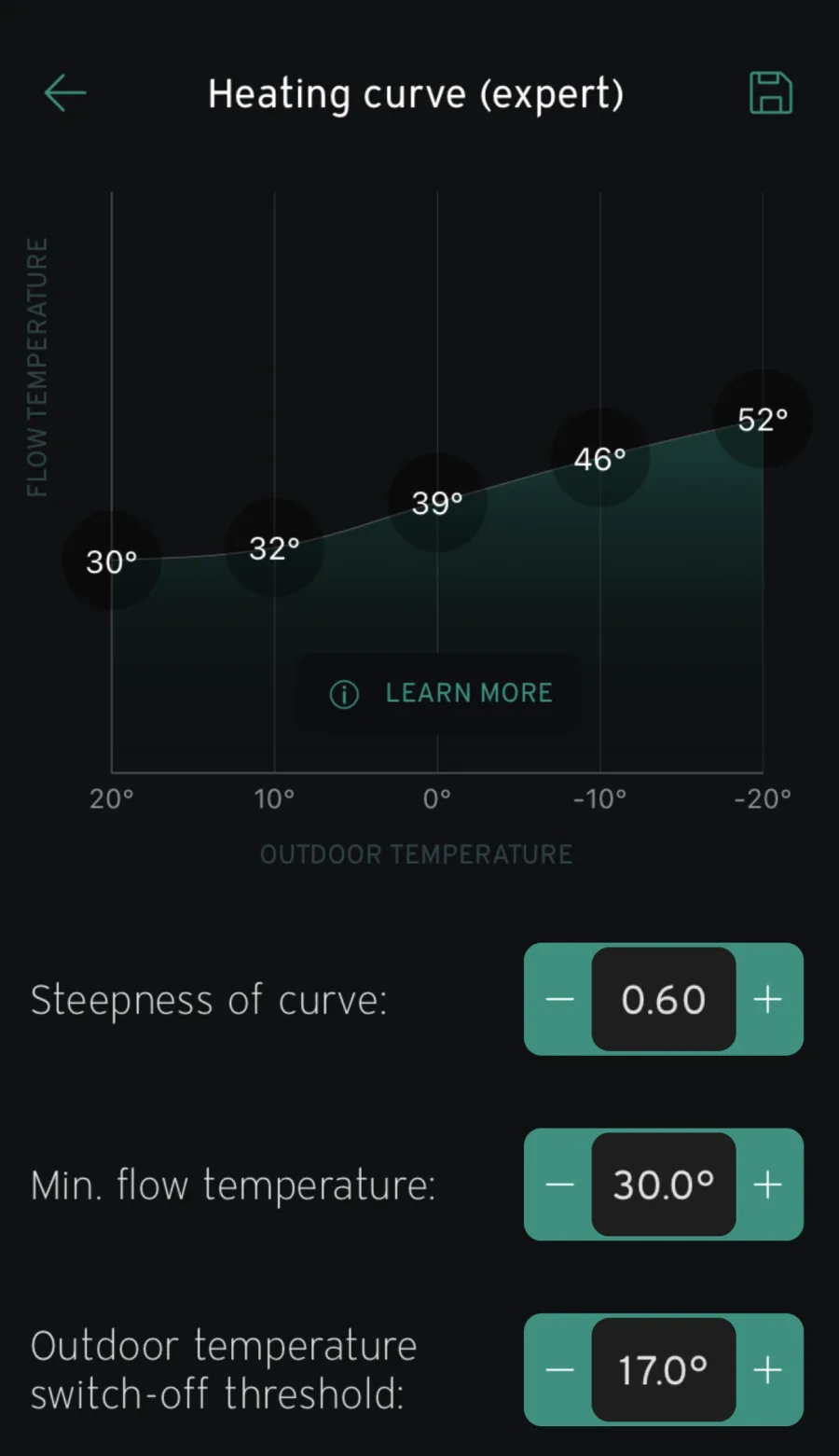
myVAILLANT: Zone 1 → Heat curve settings → Heating curve (expert).
I prefer using the app because you can see the target-temperature line move. For the steps, including putting Room Temp Mod into Inactive while tuning the curve, use my advanced Vaillant settings guide.
- Record the starting point. Screenshot, photograph or write down the original setting.
- Change one thing. Do not alter the curve, room influence and schedule together.
- Give it time. Normally allow at least 24 hours and compare similar weather. A heavy underfloor system may respond slowly.
- Check rooms, not just the controller. One cold bedroom is not a reason to raise the whole-house curve immediately.
Leave electrical wiring, pump settings, backup-heater configuration and safety limits to the installer. If you do not want to tune the system, tell us what feels wrong and we can help.
What I would check before buying a new thermostat
- Whole house too warm or too cool: check the schedule, room target and heating curve.
- One room wrong: check its radiator or floor circuit, balancing, draughts and heat loss.
- Room goes above the set temperature: identify the heat source. Sunshine or a fire points towards room-influence settings; excess heat from the heat pump points towards the curve.
- Heating off despite turning the thermostat up: check the operating mode, schedule, hot-water cycle and outdoor-temperature cut-off. Vaillant owners can use the outdoor-temperature switch-off guide.
- Repeated very short runs: ask the installer to check available flow, open circuits, controls and minimum output. Some cycling in mild weather is normal.
Before replacing anything, ask: is my thermostat just sending demand, or is the heat pump using the actual room temperature? Then ask why it was configured that way. There may be a good answer. There should certainly be an answer.
Heat pump controls: common questions
Do I need a special thermostat for a heat pump?
You need controls compatible with the heat pump and its design. I normally recommend the manufacturer's own controller because it can provide room feedback and useful system information. A basic on/off thermostat can work, but check what information it actually shares.
Can a heat pump still modulate with an on/off thermostat?
Yes. The heat pump can vary compressor output and follow weather compensation while there is demand. What may be missing is the measured room temperature, which a compatible controller can use to adjust the heating-water target.
Should I leave my heat pump on all the time?
Leave its electrical supply on for automatic protection. Whether to maintain comfort temperature all day depends on occupancy, insulation and the heating design. I normally start with a setback 2-3 degrees below comfort when less heat is needed, then adjust to suit the home.
Should every radiator valve be fully open?
Not as a blanket rule. The system needs enough open emitters and water flow, while some rooms may need temperature limiting. Ask your installer which radiator valves can be adjusted and which circuits must remain available.
Why does my heat pump carry on above the set temperature?
The controller may be influencing flow temperature rather than acting as a strict on/off thermostat. Stored heat in floors and other heat sources can also warm the room. Check the control mode and the source of the extra heat before changing settings.
Will a new controller definitely lower my bills?
No. It needs the right sensors, configuration and heating design. Better information and control can help, but buying a new thermostat does not fix a circulation problem, undersized radiator or unsuitable heating curve.
Want controls that suit your home?
We plan the controls alongside the heat pump, radiators and underfloor heating, then explain how to use them at handover.
Heat-pump installation in LincolnshireTalk to Vector Heat