
Best fit
A small flat with low heat and hot-water demand.
Boilers and electric heating
Compact, flueless and simple on paper. The difficult part is producing plenty of heat and hot water from an electrical supply without making the running cost painful.
Insight by Vector Heat
An electric combi boiler can make sense in a small, low-demand property where gas, a flue, an outdoor unit and a hot-water cylinder are all genuinely impractical. In most other homes I would treat it as a last-resort design, not the default no-gas replacement.
The appliance can be compact and nearly 100% efficient at turning bought electricity into heat at the point of use. That sounds impressive until you compare it with a heat pump, which can move several units of heat for each unit of electricity. “Efficient appliance” and “cheap heating system” are not the same sentence.
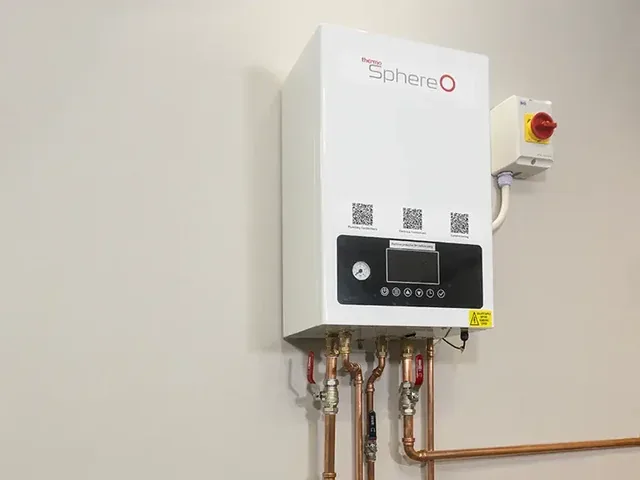
A small flat with low heat and hot-water demand.
Direct electricity normally makes space heating expensive.
Hot-water litres per minute may not feel like a gas combi.
The electrical load needs assessing before product selection.
Heat pumps and stored hot water can be better options.
An electric combi provides central heating and domestic hot water without burning fuel and without a separate hot-water cylinder. Electric elements heat water for the radiator circuit and, when a hot tap opens, produce hot water on demand.
It has some obvious practical advantages:
The trade-off is power. Space heating can consume many kilowatt-hours across a cold day, while useful instantaneous hot water needs a high rate of heat input. A compact casing does not make either requirement disappear.
The strongest case is usually an awkward flat or very small house with modest demand. For example, a middle flat may have no legal or practical flue route, nowhere acceptable for an outdoor heat-pump unit, no cupboard for a cylinder and lease restrictions on external alterations.
It becomes more plausible when all of these are true:
It is less convincing in a large, draughty house, for a busy family, or where two bathrooms need hot water together. In those situations the boiler may either feel weak at the tap or need a very large electrical input, while the annual space-heating demand remains expensive.
Usually, yes, compared with a well-designed heat pump and normally compared with mains gas at current capped rates. An electric boiler converts electrical input to useful heat very efficiently, but it still buys roughly one kilowatt-hour of electricity for each kilowatt-hour of heat delivered.
For a transparent snapshot, Ofgem's average direct-debit cap for 1 July to 30 September 2026 is 26.11p/kWh for electricity and 7.33p/kWh for gas. Ignoring standing charges and distribution losses:
| Heating system | Illustrative input | Approx. bought-energy cost per useful kWh |
|---|---|---|
| Electric combi | About 1 kWh electricity for 1 kWh heat | About 26.1p |
| Modern gas boiler at 90% seasonal efficiency | About 1.11 kWh gas for 1 kWh heat | About 8.1p |
| Heat pump at seasonal performance of 3.5 | About 0.29 kWh electricity for 1 kWh heat | About 7.5p |
This is an illustration, not a household quotation. Real results change with tariff, weather, controls, system losses, hot-water use and actual seasonal performance. Standing charges also matter if removing gas lets you cancel the gas supply completely. The useful point is the scale: an electric combi cannot use the same electricity-multiplying principle as a heat pump.
It can supply a shower, but check the model's hot-water output at a stated temperature rise. Do not judge it by the headline kW alone and assume it will behave like a 30 or 35 kW gas combi.
Instantaneous flow is a simple energy problem. In winter the incoming main is colder, so the appliance must add more heat to deliver the same shower temperature. With limited electrical input, it has to reduce the flow. Some electric “combi” products include a small internal store to improve delivery, which also changes their size and behaviour.
Ask these questions before buying:
Our guide to choosing a combi boiler explains why the household's simultaneous hot-water use often matters more than the number of bedrooms.
This needs checking before the model is chosen. A 12 kW boiler draws roughly four times the power of a 3 kW kettle while it is at full output. Larger instantaneous appliances can be a far more demanding load.
A competent assessment should consider:
A product being sold in a UK shop does not mean every UK flat can support it. The electrician and heating designer need to look at the same project, preferably before a boiler-sized hole appears in the budget.
| Option | Where it can be stronger | Main constraint |
|---|---|---|
| Air-to-water heat pump | Low electricity use for whole-home heating and stored hot water | Outdoor unit, cylinder, design and emitter checks |
| Air-to-air heat pump | Efficient room heating plus cooling, often useful in smaller homes | Outdoor unit and separate domestic hot-water solution |
| Hot-water cylinder plus electric heating | Better stored hot-water flow and potential off-peak charging | Cylinder space and separate space-heating design |
| Electric combi boiler | Compact wet central heating with no flue or cylinder | Running cost, supply capacity and hot-water flow |
| Gas boiler | Familiar high-output heating and hot water where gas exists | Gas connection, legal flue route and fossil-fuel use |
The Boiler Upgrade Scheme currently offers £7,500 towards an eligible air-to-water heat pump replacing direct electric heating in England and Wales. It also lists £2,500 for eligible residential air-to-air heat pumps. The installer applies and the property and system must meet the current rules, so treat the grant as something to verify, not money already in the bank.
If an electric combi still wins after those checks, it has earned its place. That is very different from fitting one because it was the first flueless product found online.
Usually, yes. It turns one unit of electricity into roughly one unit of heat, while a heat pump can move several units of heat for each unit of electricity. Your actual cost depends on heat demand, tariff and use.
It can supply a shower, but the available flow and temperature rise depend on the boiler's electrical input and the incoming water temperature. Check the model's litres-per-minute figure rather than assuming gas-combi performance.
No. It does not burn gas, LPG or oil, so it does not need a combustion flue. It still needs suitable heating pipework, controls, electrical work and safe access.
Not every model does, but higher-output appliances can require substantial supply capacity and some require three phase. Have the incoming supply, main fuse, consumer unit and other loads assessed before choosing a boiler.
The bedroom count is not enough to decide. Calculate the home's heat loss, assess simultaneous hot-water demand and confirm the electrical supply. Many three-bedroom households will find instantaneous hot-water performance or running cost restrictive.
Often, if the property can accommodate a properly designed system. A heat pump normally uses much less electricity for the same useful heat, but outdoor position, emitters, hot-water storage, lease rules and installation cost all matter.
The grant supports eligible low-carbon heating systems, not a replacement electric combi. An eligible property replacing direct electric heating may qualify for support towards an air-to-water or air-to-air heat pump, subject to current scheme rules.
Vector Heat can assess heat loss, hot-water demand, property constraints and the practical route for a heat pump. If an electric combi really is the least-worst answer, you should know why.
Explore a heat pump survey