
Samsung heat pump E911 means the heating water is not moving as it should when the circulation pump is supposed to be running. There may be no flow at all, or some flow but not enough.
It is by far the most common Samsung fault I come across. There are plenty of possible causes, so the code alone does not tell you which part needs replacing. Where do you start? Pressure, air and whether the pump is actually moving water.
The first checks: system pressure, trapped air, pump operation, leaks, dirty filters or strainers, a blockage and closed valves. A faulty flow sensor is possible too, but establish whether the water really is circulating before blaming the sensor.
For a new installation: ask the installer to check filling, air removal, the water path and pump control. For a system that worked previously: explain what changed and when the fault started.
Samsung manuals for these checks
- Samsung MIM-E03CN/MIM-E03EN installation manual: E911 and model-specific flow thresholds, printed page 47.
- Samsung MWR-WW10N controller user manual: Operation status and Water pump.
Match the instructions to the outdoor unit and control kit. The controller's appearance alone does not tell you the required flow rate.
What does Samsung E911 mean?
E911 is an insufficient-water-flow fault while the controller is commanding the circulation pump on. The system has not detected enough water moving through the monitored heating circuit. It does not automatically mean the pump has failed, and it is not the same fault as E912.
| Code | Pump command | What the controller detects |
|---|---|---|
| E911 | On | Insufficient water flow. |
| E912 | Off | Water flow when the pump should have stopped. |
If the pump runs continuously when it should be off, use the separate Samsung E912 pump-wiring guide. E911 needs a different set of checks.
- Pump requestedThe controller asks for water circulation.
- Flow too lowThe sensor does not detect sufficient flow.
- E911 appearsThe condition lasts beyond the model's allowed detection period.
Start with pressure, air and the pump
Before changing anything, photograph the code and note whether it happened during heating or a hot-water cycle. These observations help narrow it down without opening the heat pump or wiring centre.
- Read the pressure gauge. Compare it with the normal cold pressure recorded at handover or in your system instructions. Very low pressure needs investigating. Do not fill to an arbitrary internet figure or keep topping up a system that loses pressure.
- Listen for air. Gurgling around the pump or pipework, especially after draining or radiator work, is useful evidence. Take a short video with sound.
- Look for visible leaks. Check accessible pipe joints, valves and the area around the pump. A leak and repeated pressure loss can leave air trapped in the pipework near the pump. Simply removing the air will not fix the leak.
- Check ordinary heating controls. Have all the radiator thermostats been turned down, or most underfloor-heating zones closed? Tell the installer. Do not force motorised valves or start adjusting balancing valves.
- Record the pump status. Compare the controller's command with any visible pump display or sound. Leave electrical covers closed; a humming pump does not prove water is moving.
Pressure is not flow. A gauge reading in bar tells you about pressure, not litres of water moving each minute. A system can have normal pressure with a closed valve, blocked strainer or stopped pump. Adding more water does not clear a blockage.
When the fault happens helps narrow it down
| Pattern | Where to look first |
|---|---|
| First commissioning or just after draining | Trapped air, filling, closed isolation valves, pump control and the sensor's installation. |
| Pressure keeps falling; air keeps returning | A leak or pressure-loss problem, as well as air removal. |
| Previously worked, now flow has fallen | Dirty filters or strainers, sludge, a restriction or deteriorating pump operation. |
| Only when most rooms stop calling for heat | Whether the remaining open water path can maintain the required primary flow. |
| Only during hot water | The hot-water valve position and circulation through the cylinder-coil circuit. |
These are starting points, not diagnoses. A valve may look open externally but have a problem inside, and a pump may have power without producing useful circulation.
Air, sludge and blocked filters
Air trapped at a high point or around the pump can interrupt circulation. On a newly filled system, the installer needs to purge the circuits properly, not just bleed the nearest radiator. If the air keeps coming back, find out why.
A strainer catches solid debris before it reaches the heat pump. As it fills, it restricts the water path. A magnetic filter removes magnetic material, but the system may also have a separate mesh strainer that needs checking. Cleaning one does not prove the other is clear.
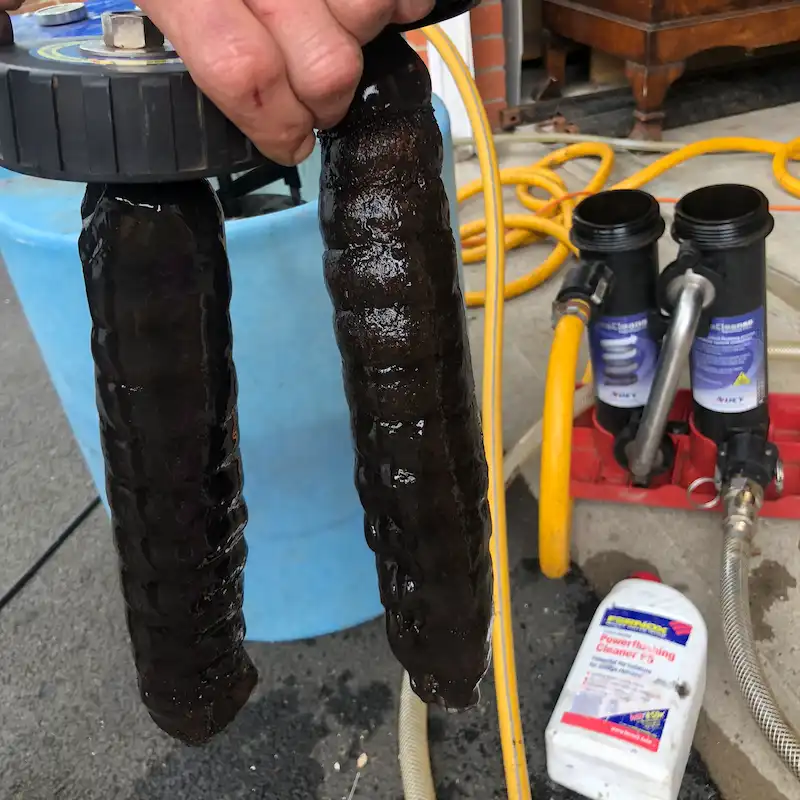
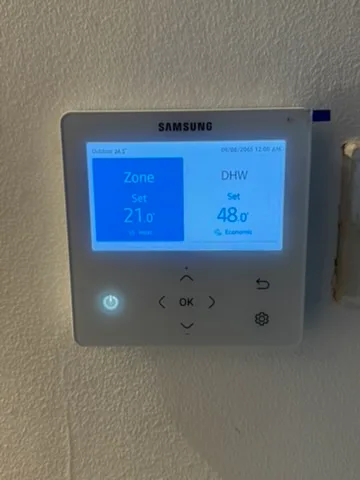
Have the engineer check and clean the relevant filters using their service instructions. Do not unscrew a hot, pressurised filter. The system needs correct isolation, pressure management, reassembly and air removal afterwards.
These checks form part of ongoing maintenance too. Our heat-pump servicing service covers Lincolnshire, but tell us about an active E911 fault when booking so we allow time for diagnosis.
Check the pump command and actual water flow
On the MWR-WW10N-style controller, open Operation status > Water pump. This tells you whether the control system is requesting the pump. It does not confirm that the pump is working or that there is an open path for the water.
For engineers, the MWR-WW10N installation manual lists Installation/Service mode > Indoor Zone Option > Indoor Zone Status Information. Look at Water pump, Flow sensor in L/min and, where applicable, Inverter Pump percentage. These are diagnostic readings, not settings to change at random.
Observe the sequence before the fault occurs: the controller may stop the pump after reporting E911. A reading taken only after the shutdown can miss the original problem. On a system with separate primary and secondary pumps, make sure you are checking the pump serving the monitored heat-pump circuit.
Debris in the flow sensor can give a false reading
The flow sensor itself can contain debris, causing it to report an inaccurate flow rate. The controller converts the sensor's electrical signal into the displayed L/min reading, so a number on the screen is not independent proof of how much water is moving.
Check where the sensor is fitted relative to the filter. If it is between the heating system and the return filter, follow the direction of water flow. Where returning water reaches the sensor before the filter or strainer, debris from the heating system can reach the sensor first.
Before replacing the sensor, the engineer should check for contamination as well as its installation, connection and signal. Inspect or clean it using the manufacturer's procedure, with the system safely isolated and depressurised as required. Do not assume that cleaning the filter has also cleared the sensor.
Minimum flow is not the same as design flow
There is no single L/min figure for every Samsung heat pump. For example, Samsung's Gen 6 Mono training gives the following rates for that range. The minimum is not the target for delivering the unit's full output.
| Gen 6 Mono output | Nominal flow | Minimum flow |
|---|---|---|
| 5 kW | 14.5 L/min | 7 L/min |
| 8 kW | 26 L/min | 7 L/min |
| 12 kW | 35 L/min | 12 L/min |
| 16 kW | 46 L/min | 12 L/min |
Source: Samsung Gen 6 Mono training, 2 June 2022, PDF page 28. These are Gen 6 examples, not a Gen 7 sizing table.
The linked CN/EN manual lists a 7 L/min flow-sensor threshold for AE050/080/120/160CXYD** models in the newer R290 range. That is a fault-detection threshold, not a design-flow recommendation. Check the exact outdoor model and matching manual rather than borrowing a figure from another generation.
The order I would investigate E911
- Confirm pressure and check for leaks. Establish whether the circuit is properly filled and whether pressure is stable. Repeated air problems need an explanation.
- Remove trapped air. Purge the relevant circuits and check air removal around the pump and high points.
- Prove pump operation. Compare the command, actual operation and measured flow. Check pump faults, control method and settings against the fitted equipment, not just whether the display lights up.
- Trace restrictions and valves. Check filters, strainers, sludge, pipework restrictions and the actual water path through the heating or hot-water circuit.
- Check the flow measurement. If circulation has been independently established but the reading is wrong, check for debris in the sensor, particularly if returning water reaches it before the filter or strainer. Inspect its direction, connection and signal using the matching service procedure.
- Test the conditions that caused the fault. Confirm heating and hot water operate correctly, including relevant zone closures. Passing a test with everything open does not prove the system will work when only one zone needs heat.
Electrical checks are for competent installers. Safely isolate all relevant supplies and prove dead before opening electrical enclosures or altering connections. Controller OFF is not electrical isolation. Never bypass the flow sensor to make E911 disappear.
Resetting Samsung E911
A reset can clear the displayed error without restoring circulation. Photograph the code first, then follow the reset instructions for your controller if your installer advises it. If E911 returns, stop repeating the reset and investigate the flow problem.
Do not leave a monobloc heat pump without power through freezing weather as a routine workaround. Its frost-protection functions need power, and a circulation fault may compromise protection anyway. Ask the installer promptly how to protect the system while it is repaired.
Samsung E911 questions
Is Samsung E911 a pump fault?
It can be, but E911 means insufficient water flow, not a confirmed failed pump. Low pressure, trapped air, sludge, a blocked strainer, a closed valve or a faulty flow sensor can also cause it.
Why is E911 showing when the pressure is normal?
Pressure and circulation are different. The gauge can show normal pressure while a valve is closed, a strainer is blocked or the pump is not moving water. Check flow in L/min rather than treating the pressure gauge as proof of circulation.
Can a leak cause Samsung E911?
Yes. A leak can lower system pressure and lead to air collecting in the pipework, including near the pump. If pressure falls or air keeps returning, the cause needs fixing rather than repeatedly topping up and bleeding the system.
Can closed radiator valves cause E911?
They can if closing them restricts the water path through the monitored circuit too much. The effect depends on the hydraulic layout. The installer should check minimum primary flow with the relevant zones closed, not only with every radiator open.
What flow rate does a Samsung heat pump need?
Use the exact model's instructions. Samsung's Gen 6 Mono training lists minimums of 7 L/min for 5 and 8 kW units and 12 L/min for 12 and 16 kW units. Newer models differ, and the required design flow is a separate figure.
Will resetting the heat pump fix E911?
Not if the low-flow condition remains. A reset may clear the screen temporarily, but it will not clear a blockage, repair a pump or open a failed valve. Record the fault and arrange diagnosis if it returns.
What to send your engineer
Send a photo of the E911 screen, the outdoor model label, pressure reading and pump-status screen. Include a video of any gurgling, whether it happens on heating or hot water, and details of recent draining, servicing or changes to valves and pumps.
For a new installation, contact the installing engineer first. For a Samsung fault in Lincolnshire, send the details to Vector Heat. Planning a new system? See our heat-pump installation service.
Technical sources
Samsung's Gen 6 Mono training handouts, dated 2 June 2022, cover strainers, air removal, commissioning, flow rates and E911. The model-specific installation and controller manuals are linked beside the relevant checks above.
Caleffi's hydronic operating guidance explains pressure and circulation. HSE electrical-safety guidance covers competence and safe isolation.