Heat pumps
Would I Still Fit Ecodan in 2026?
Where I choose Mitsubishi, what I like about it, and what I would improve.
Published
I have changed Mitsubishi compressors and fans. Not the usual opening to a glowing review, but being able to repair them is part of why I rate them.
Yes, I would still install a Mitsubishi heat pump. I particularly like Ecodan for a more complicated heating system, where I want flexibility over the pumps, controls and connections to another heat source. For a straightforward home with one heating system and a hot-water cylinder, I would normally recommend Vaillant or Viessmann.
That is a choice about the whole installation, not a claim that one badge is right for every house.
- Why I still fit them: flexible system arrangements, straightforward fault-finding and good technical support.
- What I would improve: the controls and access to useful running information.
- Efficiency and noise: respectable in my experience, but neither is why Mitsubishi would be my first choice.
- Already own one? I would investigate a repair before assuming an older Ecodan needs replacing.
What is a Mitsubishi Ecodan heat pump?
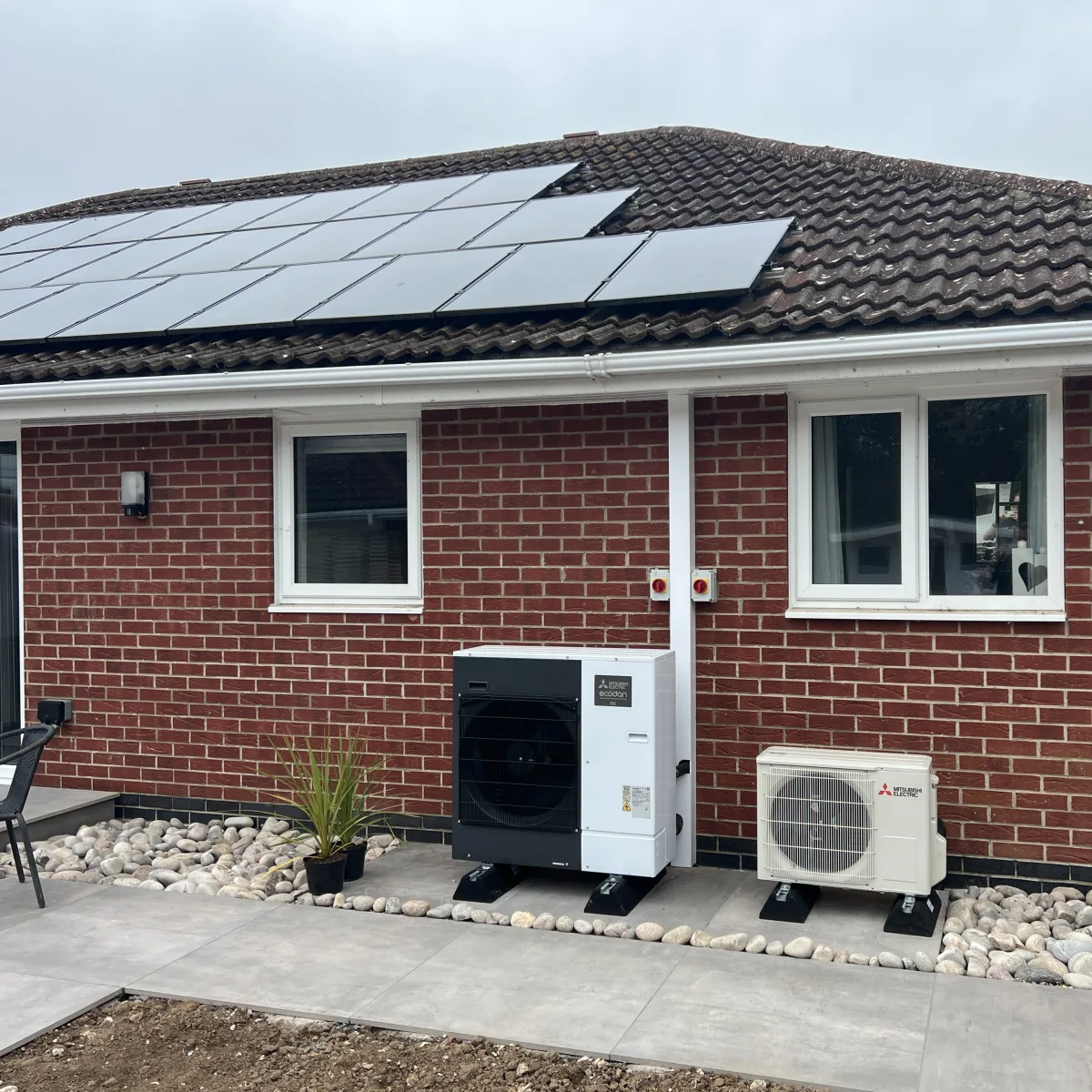
Ecodan is Mitsubishi Electric's heating heat-pump range. An air-to-water Ecodan takes heat from outdoor air and uses it to heat water for radiators or underfloor heating, and a suitable hot-water cylinder. It is not the same arrangement as an air-conditioning unit blowing warm air into a room.
The current Ecodan R290 range lists 5, 6, 8.5, 10 and 12kW models. Older Ecodans use different refrigerants and equipment, so an opinion about one generation is not a specification for every Mitsubishi ever installed.
Nor would I choose the size from the house's bedroom count. We need the heat loss, the water temperature the heating requires and the unit's output in cold weather. My heat-pump sizing guide explains that process.
Where I would choose Mitsubishi over another brand
I like being able to choose the external circulation pump and arrange the controls around the job. The pump moves heating water around the system. On the Mitsubishi installations I work with, that flexibility is useful when the heating is more complicated than a single circuit and cylinder.
| The property or system | My usual approach |
|---|---|
| Straightforward heating and hot water | I normally start with Vaillant or Viessmann. |
| Several heating zones with different requirements | Mitsubishi is worth considering for the flexibility of its system arrangements. |
| A log burner also supplies the heating | I consider Mitsubishi when planning how the two heat sources will work together safely. |
| An older Ecodan with a repairable fault | I investigate the fault and repair options before suggesting replacement. |
Other manufacturers can serve complicated systems too. The point is that I know how to make these Mitsubishi arrangements work, and I am comfortable maintaining them afterwards.
There are also different equipment packages within Ecodan. For example, Mitsubishi offers an FTC7 packaged cylinder. Do not assume every Ecodan quote has the same indoor components or layout.
A recent installation with a log burner
On my most recent Mitsubishi installation, the property had a log burner connected to the heating. The arrangement used a 200-litre cylinder, with a coil acting as a heat exchanger for the log-burner side.
I chose Mitsubishi because I knew I could arrange it to work with that other heat source. That mattered more on this job than having my favourite controller.
It is a system that needs proper design, including how heat is managed if the electricity goes off. A solid-fuel appliance cannot stop producing heat as quickly as an electrically controlled heat pump. This is not a case of simply joining their pipes together.
Mitsubishi heat pump reliability and repairs
I have worked on Mitsubishi heat pumps around 20 years old that were still going. The older systems I have seen doing well were often simple: one heating zone, uncomplicated controls and faults we could identify and repair. That is my experience, not a promised lifespan for a new unit.
I have replaced compressors and fans. So no, I am not saying they never go wrong. I am saying the straightforward design, spare-parts support and technical telephone help have made them repairable.
I have not yet had to replace a Mitsubishi heat pump. I have repaired the ones I have worked on. That is a useful distinction when someone asks whether an older unit must be scrapped.
It still needs an assessment. We look at the actual fault, the condition of the rest of the equipment, whether the right parts are available and what the repair will cost. Age alone is not enough to make that decision.
A lot of heating faults are also outside the outdoor unit. A circulation pump, valve or other system component can stop the heating working without the heat pump itself being beyond repair.
How efficient is a Mitsubishi heat pump?
In my experience, Mitsubishi delivers respectable efficiency, but I would not choose it on the assumption that it will produce the lowest electricity bill of every brand. The heat loss, radiator output, water temperature and commissioning all matter. A brochure efficiency figure cannot tell you what your particular installation will achieve.
On a straightforward system, I like the integrated pump control offered by the Vaillant and Viessmann arrangements I normally install. On a more complicated job, Mitsubishi's flexibility over the external pump and system arrangement can be more useful to me.
That does not mean every external pump is uncontrolled, or that every generation of Ecodan has identical capabilities. The actual pump, controller and configuration need checking. I would not turn that difference into a made-up percentage saving.
I also do not have a like-for-like set of monitored R290 installations that proves a precise ranking between those brands. My recommendation is based on the systems I install and support, not a claim to have tested every model against every other one.
For the things that affect the bill, see my heat-pump running costs guide. Getting the design and settings right is more useful than comparing two headline efficiency numbers measured under different conditions.
Ecodan controls: solid, but not my favourite
The Mitsubishi controls I use are straightforward in what they let me do: weather compensation, fixed water temperature, and room-temperature control using an appropriate controller or sensor. Which arrangement we use depends on the system. Basic third-party on/off controls are not the same thing as giving the heat pump indoor-temperature feedback.
I find the weather-compensation curve reasonably easy to set on the controller. At handover, I often take a video of myself changing the customer's settings and send it to them on WhatsApp. It is easier to follow a video of your own controller than remember everything from installation day.
My criticism is that useful running information is buried in the installer settings. The controls do the job, but that part is not particularly friendly for someone who wants to understand how their heating is performing.
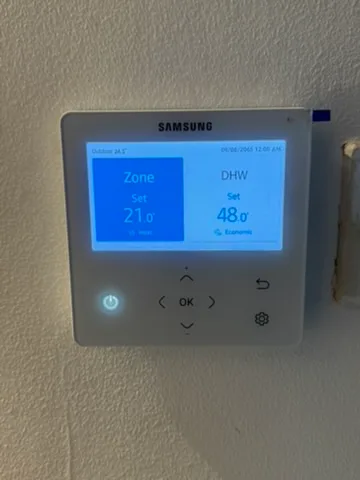
The newer FTC7 controller has a colour touchscreen, and Mitsubishi offers MELCloud app connectivity. To me, the newer presentation still feels more like a refresh than the larger change I had hoped for. Check which controller and app your proposed equipment uses, especially when comparing it with an older installation.
My guide to heat-pump controls explains the difference between weather compensation, room feedback and simple thermostats.
Mitsubishi heat pump cost and noise
Price is not usually the deciding factor for me
In the jobs I quote, there is not normally a huge price difference between Mitsubishi and the Vaillant or Viessmann alternatives I would consider. Mitsubishi can come in slightly cheaper, but I would not promise that for every model or installation.
Compare the whole proposal: cylinder, pumps, controls, any radiator changes, electrical work and commissioning. A cheaper outdoor unit is not necessarily a cheaper finished heating system. I choose Mitsubishi because it suits the job, not because it wins a small difference on an equipment price list.
Reasonably quiet, rather than a reason to buy it
I find Mitsubishi heat pumps reasonably quiet. I have not had customers complain about noise after the Mitsubishi installations I have carried out. That does not make every position suitable, or prove it is the quietest brand.
We still need to choose the location properly and assess sound at neighbouring properties. The model, operating conditions and installation all affect what someone hears. There is no useful single noise number for the entire Ecodan range.
Mitsubishi Ecodan: common questions
Are Mitsubishi heat pumps any good?
Yes. I still install them, particularly where a more complicated heating system benefits from their flexibility. I rate the repair support and straightforward design. For a simple installation, I would normally recommend Vaillant or Viessmann.
How long does a Mitsubishi heat pump last?
I have worked on Mitsubishi units around 20 years old that were still running. That is not a guarantee for every unit. Condition, maintenance, the fault and repair cost matter more than choosing a replacement date from age alone.
Can Mitsubishi Ecodan work with a log burner?
It can be designed to work alongside a suitable log-burner heating arrangement. I recently chose Mitsubishi for exactly that reason. The connection, controls and solid-fuel safety provisions need professional design; the two systems should not simply be connected together.
Is Mitsubishi cheaper than Vaillant?
Sometimes, in the installations I quote, but the difference is not normally large enough to decide the equipment choice. Compare complete installed proposals with the same scope, rather than just outdoor-unit prices.
Does Ecodan have weather compensation?
Yes, the Ecodan systems I install can adjust heating-water temperature with outdoor conditions. The curve and control arrangement need setting for the property. The exact menus depend on the controller generation.
Should I replace my old Mitsubishi heat pump?
Not simply because it is old. I would check its condition, diagnose any fault and price a repair first. I have repaired the Mitsubishi units I have worked on and have not yet had to replace one.
Choose the heat pump around the heating system
I look at the building, heating circuits and hot-water requirements before recommending equipment. That includes making sure we can maintain and support what we install.
Our heat-pump installation service