Heat pump design
Heat Pump Buffer Tanks: Why I Don't Fit Four-Pipe Buffers
What a buffer does, when a volumiser helps, and why I went back to change my first three installations.
Published
I started off fitting four-pipe buffers as standard. But after buying some Bluetooth pipe thermometers, I realised I'd need to do some re-piping.
I don't fit buffer tanks to my heat pump installations. I design open-loop systems, with the heating system's water available to the heat pump. If we need extra water volume, a two-pipe volumiser can provide it without separating the heat pump from the radiators or underfloor heating.
Since changing my approach, I've fitted one buffer because I had to. That installation needed hydraulic separation.
The quick version
- Extra water volume: a volumiser can help without hydraulic separation.
- Independent circuits: a four-pipe buffer can provide hydraulic separation, but usually we can manage without one.
- Distortion: mixing in the buffer means the radiators don't get all of the heat.
- Already have one? Measure what it is doing before deciding to change it.
Buffer tank vs volumiser: what is the difference?
A four-pipe buffer separates the heat pump circuit from the heating circuit. A volumiser adds heating-water volume without that separation. A buffer can do either job, depending on its connections. You need to look at the pipework arrangement, not just the name on the tank. There are also specific volumisers that can only be used as volumisers.
| Arrangement | What it does | What to check |
|---|---|---|
| Four-pipe buffer | Adds water volume and allows separate pumps to circulate the heat pump and heating circuits. | Flow rates on both sides, mixing, controls and additional pump electricity. |
| Volumiser | Adds water volume in the same circuit, commonly on the return to the heat pump. | Available volume and an adequate flow path when valves or zones close. |
Neither is the hot-water cylinder supplying your taps and showers. These vessels contain heating-system water.
The annoying thing about buying a volumiser is that it is often sold as a buffer. You can use a suitable buffer as a volumiser by capping off the unused ports and using two connections. Dedicated volumisers have two ports and can look a bit like expansion vessels. Caleffi's buffer-piping guide shows different connection arrangements.
The 10°C difference I measured
When I first did my heat pump training, I went to Daikin, Mitsubishi and Samsung. Every one of those training guides recommended using a four-pipe buffer to separate the heat pump from the heating system. So I fitted them on my first three jobs.
Then I did my Heat Geek training and learned about distortion caused by mismatched flow rates. I went back with Bluetooth pipe thermometers and measured all four connections.
The heat pump flow was 50°C, but the heating flow was only 40°C. The heating system was getting water 10°C cooler because it was going through the buffer and the pumps were mismatched.
I changed the pipework so the buffer became a volumiser on the return. It worked a dream: 45°C from the heat pump, 45°C straight into the heating flow. Perfect.
I went back to the other two jobs, turned those buffers into volumisers and never looked back.
I check the flow temperature going into the radiators and how quickly the heating warms up. Every time I have made this change, the customer has noticed how much faster the heating system heats up.
Why I don't fit four-pipe buffers
Four-pipe buffers are terrible for efficiency, except in very specific situations. Distortion reduces the flow temperature reaching the heating system and causes short cycling. That is why, as a rule, I don't fit them.
When the two pumps move different amounts of water, cooler return water mixes into the heating flow, or hot flow water goes straight back towards the heat pump. We don't want hot flow coming straight back: it warms the return and the heat pump has to turn off again. We never want short cycling on a heat pump.
| Flow condition | What happens | Possible result |
|---|---|---|
| Heating circuit moves more water | Some cooler heating return water mixes into the supply to the emitters. | Cooler radiators, or a higher heat pump flow temperature needed to compensate. |
| Heat pump circuit moves more water | Some hot flow water returns towards the heat pump through the buffer. | A warmer return, less useful heat reaching the emitters and, depending on controls and load, shorter runs. |
This is hydraulic distortion. It is not all heat escaping through the tank's insulation. Much of the issue is heat going where we do not want it, changing the temperatures the heat pump has to work at.
Lower flow temperatures improve heat pump efficiency. Producing unnecessarily hot water to compensate for mixing works against that.
There are situations where the flows match and the buffer does not cause issues. But as soon as a thermostatic radiator valve closes, the flow changes and they are mismatched again.
I regularly go out to heat pumps that are not working properly and find a four-pipe buffer. We re-pipe the system so it becomes a volumiser, and everything works a lot better. Sometimes other parts of the system need changing too, but on those jobs the buffer is the main problem.
What the customer notices
The first thing is cold rooms. The heat pump cannot get all of its output into the heating system, so when it gets cold outside it struggles to heat the property. Next are higher bills and short cycling, with the heat pump starting and stopping every couple of minutes, sometimes less.
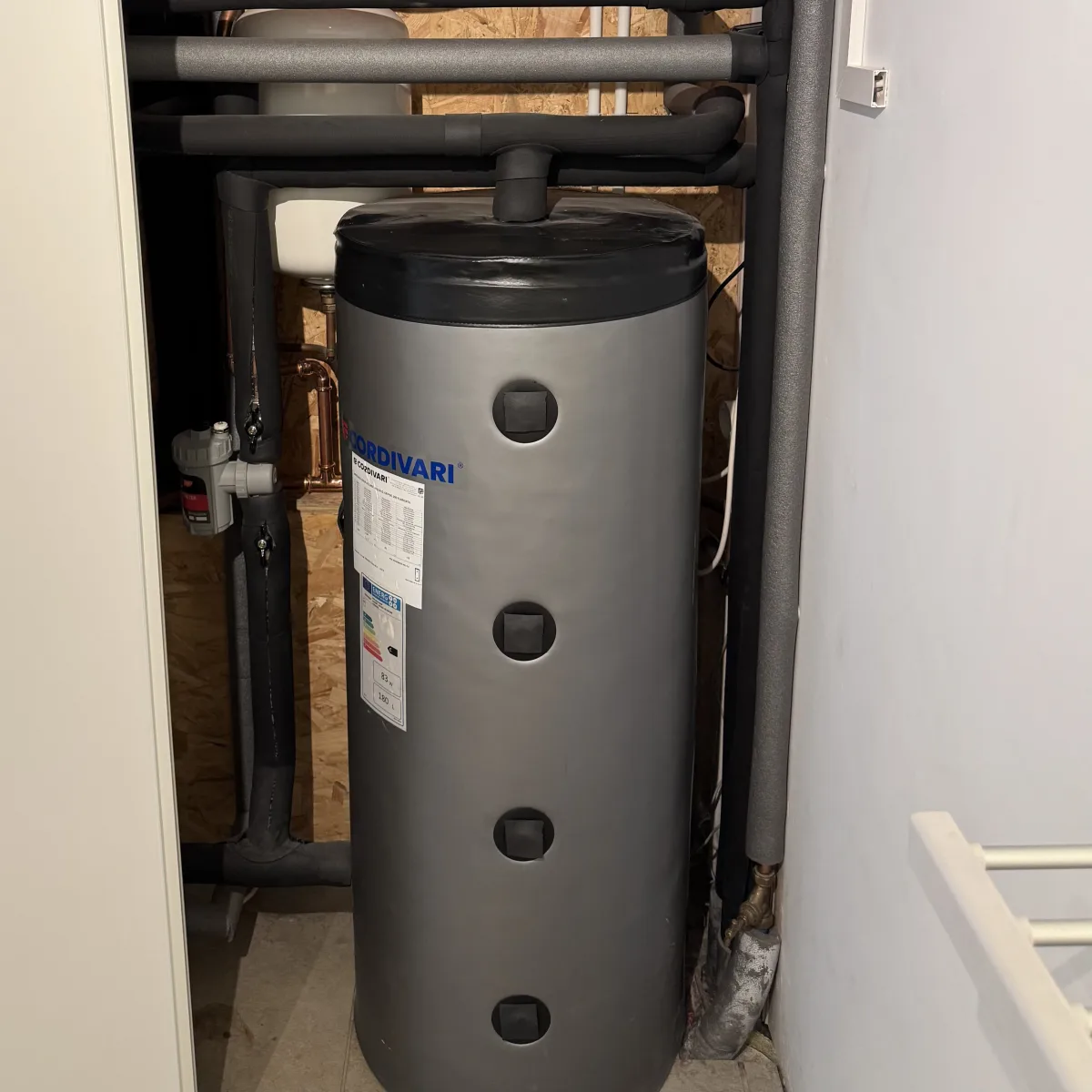
When does a heat pump need a buffer or volumiser?
It depends on what the system is missing. Extra water volume can help meet the heat pump's operating requirements or manage small heating loads. Hydraulic separation can help where circuits genuinely need independent flows. These are different problems, so they should not automatically receive the same solution.
When extra water volume is needed
Very occasionally I fit a volumiser for minimum water content. My systems are open loop, so all the heating-system water is available to the heat pump.
The main reason I fit a volumiser is when a customer will regularly use only part of their heating system. For example, if they are only heating upstairs or downstairs, the volumiser takes up the heat pump's extra output.
An air source heat pump also needs enough available thermal energy for defrosting. The Energy Saving Trust's system-volume guidance explains why the water must remain available when needed, including when controlled circuits close.
A volumiser does not create a route through closed valves. Enough water volume and enough water flow are separate checks. Nor does another tank make an unnecessarily oversized heat pump the right choice. Our heat pump sizing guide explains why minimum output matters as well as maximum output.
When hydraulic separation is justified
The one exception since changing my approach was a mixed-use property: an office with employees, a house, and parts of the house that were not being used. There were four zones with different heat losses. The customer planned to heat only one or two at a time, and the office would not be heated outside working hours.
I fitted a four-pipe buffer because that system needed hydraulic separation to maintain enough flow through the heat pump. The customer understood and accepted that it would be less efficient.
Less efficient does not always mean using more electricity. By heating only a quarter of his heating system, he will use less energy than heating the whole property. The heat pump will just be less efficient doing it.
That is a design decision, not a reason to fit one in every house. First I look at the pipework, pump capability and how the heating zones will be controlled.
A Kiwa study published by DECC in 2013 also recommended a two-pipe return arrangement where extra volume was useful. It is useful background, not a replacement for the instructions and design requirements of the equipment being installed today.
What size buffer tank do I need?
There is no single tank size I can recommend from the heat pump's kW rating alone. The calculation needs the model's requirements, water already available, minimum heat output, active heating load and control strategy. A minimum-volume check and a calculation to achieve longer runs answer different questions.
- Start with the exact equipment: minimum flow, water content and defrost requirements.
- Count usable water: not water isolated behind closed zone valves.
- Check mild-weather operation: compare minimum heat output with the smallest active heating load.
- Check the whole arrangement: pipework resistance, pump capability, controls, insulation and space.
Adding a bigger vessel costs money and takes up room. It can also add standing heat losses. It needs to earn its place in the design.
Already have a buffer? Measure it first
It is worth putting Bluetooth pipe clamps on all four connections to see what is going on. If the house is warm and the bills are normal, the pumps are probably well matched. If they are well matched, they might not have the issues I normally see.
I probably only see the bad ones, so maybe I have a skewed view.
A big difference between the flow-to-return temperature drops on the two circuits tells you the flows are not matched. Check during steady heating and see what happens when a radiator valve or zone closes.
Then we need heat-loss and pipework calculations before changing the arrangement. Removing separation can leave a circulation pump trying to drive a system it cannot manage.
For a homeowner, useful evidence is room comfort, bills, frequent short runs, controller readings and photographs of the pipework. You do not need to remove covers or start altering pumps and valves to collect it.
What to ask if your quote includes a buffer
- Will it be connected as a four-pipe buffer or a volumiser?
- Is it solving a water-volume problem, a flow problem, or both?
- Why is that size needed, and what water remains available when zones close?
- How will you measure whether the buffer is causing distortion?
- What happens to the two flow rates when only part of the house needs heating?
If they don't measure it and they don't know what distortion is, then I'd be worried.
Heat pump buffer tank questions
Does every heat pump need a buffer tank?
No. The design must provide the heat pump's required water volume and flow. Some systems meet both without another vessel. Others need a volumiser or hydraulic separation. The installer should explain which requirement the proposed arrangement solves.
Is a buffer tank the same as a volumiser?
A buffer can be used as a volumiser, depending on its connections. A volumiser adds heating-water volume without separating the heat pump from the heating circuit. There are also dedicated volumisers that can only be used as volumisers.
Will a buffer tank make my heat pump more efficient?
Not automatically. Extra volume can help a system with frequent short runs, but a four-pipe arrangement can introduce mixing, extra pump electricity and standing heat losses. The benefit depends on the problem being solved and the installation.
What size buffer tank do I need?
There is no universal size based only on the heat pump's advertised kW. Check the exact model's requirements, permanently available system volume, minimum heat output, smallest active load and controls. Volume and flow must both be checked.
Can a buffer tank be converted into a volumiser?
Sometimes, if the vessel and manufacturer-approved arrangement are suitable. First check heat loss, pipework resistance, available pump head, minimum flow, water volume and controls. It is a design and pipework job, not simply moving two pipes.
Should I remove an existing four-pipe buffer?
Not just because it is there. If the house is comfortable and the bills are reasonable, measure the system before proposing changes. A buffer can be justified, and removing hydraulic separation without checking the design can cause flow problems.
Planning a heat pump in Lincolnshire?
We look at the building, emitters, pipework and controls together. Whether the design needs no additional vessel, a volumiser or hydraulic separation should follow from those checks.
Our heat pump installation service starts with understanding the home and how you want to heat it. You can also browse our heat pump guides.