
Exhaust out
Combustion products must discharge safely outside.
Boiler installation and safety
The flue is the boiler's safe route to outside. It is also the large, awkward pipe that can decide where the entire boiler installation is allowed to go.
Insight by Vector Heat
A boiler flue carries combustion products safely from a gas, LPG or oil boiler to outside. On most modern room-sealed gas and LPG boilers, a concentric flue performs two jobs: the inner passage carries exhaust away and the outer passage brings combustion air in.
It is not a drain, a decorative sleeve or a general-purpose pipe. It is part of the appliance's safety system, so the exact components, joints, support, route, length and terminal position all matter.
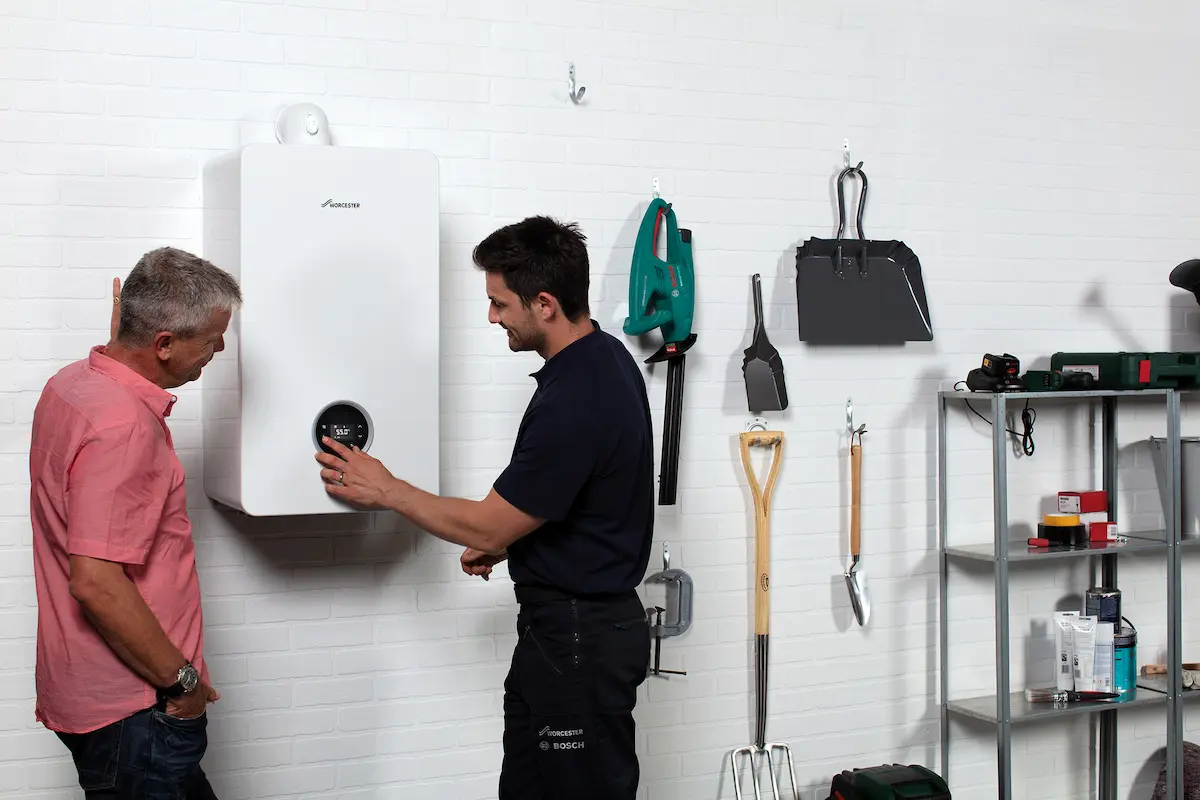
Combustion products must discharge safely outside.
Modern concentric flues also supply combustion air.
Length and bends can restrict the boiler position.
A white vapour cloud is often normal in cold air.
Do not alter, cover or dismantle a boiler flue.
Most modern gas and LPG boilers are room sealed. Their combustion circuit is separated from the room, and a fan moves air and combustion products through the approved flue system.
A typical concentric flue is a pipe within a pipe:
That arrangement is often called a balanced or concentric flue. Older appliances can have very different open-flue or chimney arrangements, while oil appliances use systems designed for their own boiler and fuel. The safe rule is simple: identify the exact appliance and use its approved instructions, not the diameter of a pipe seen on another house.
| Flue route | Where it leaves | What the survey must consider |
|---|---|---|
| Horizontal | Through an outside wall | Openings, boundaries, paths, plume direction and a suitable wall core |
| Vertical | Up through a roof | Equivalent length, supports, fire stopping, terminal position and weatherproof flashing |
| Extended room-sealed flue | Wall or roof after internal sections and bends | Approved parts, bend allowances, inspection access and total permitted length |
| Older open flue | Often via a chimney or dedicated flue | Room ventilation, chimney condition, spillage and appliance-specific safety requirements |
A short horizontal flue is often the simplest route, which is why boilers commonly sit on or near an outside wall. A vertical flue can solve a difficult layout but adds roof work and more components. Neither is automatically better; it depends on the boiler, building and safe termination point.
The terminal needs to discharge without combustion products being drawn back into the property, creating a nuisance or causing danger. The installer considers windows, doors, ventilation openings, corners, gutters, roof features, boundaries, neighbouring property and places where people pass.
Search results often quote one clearance as if it governs every installation. It does not. The correct position depends on the appliance instructions, terminal type, flue route, relevant standard and site conditions. A plume-management terminal can also have different instructions from the main flue terminal.
This is why moving a boiler two cupboards along can change the quotation. The water and heating pipes may be cooperative, but the flue still needs an approved route and length. During a boiler installation survey, I normally weight the boiler position heavily towards the flue route because it is often the largest and most restrictive connection.
Usually. Modern condensing boilers recover more heat from the combustion gases than older boilers, so the gases leave cooler and contain water vapour. In cold or damp outside air that vapour condenses into a visible white plume.
A normal plume can appear more strongly when the boiler is working hard and almost disappear in milder weather. It should not be confused with smoke, although the terminal still releases combustion products and should never be treated as harmless steam that can discharge anywhere.
Position becomes a practical issue if plume repeatedly crosses a window, neighbour's opening, public route or surface where it causes nuisance wetting or icing. An approved plume-management kit may redirect the exhaust, but it must be part of the boiler's approved flue system and included in the length calculation.
Many modern boilers allow approved straight extensions and bends. The manufacturer gives a maximum equivalent flue length, and elbows normally use some of that allowance because they add resistance.
The questions are not just “will the pieces connect?” They are:
Do not mix similar-looking parts from another boiler or buy a random extension online. The wrong seal or joint can turn a neat hidden pipe into a route for combustion products.
Yes. Flue diameter alone does not define compatibility. Gas, LPG and oil boilers can use different materials, temperatures, terminal arrangements, condensate provisions and installation standards. Even two gas boilers from the same manufacturer may use different adapters or maximum lengths.
That is why I have removed the tempting “gas is this size, oil is that size” shortcut from this guide. It may describe common products, but it is not a safe way to identify or design the flue on a real property.
Stop using the appliance and seek urgent help if a carbon-monoxide alarm sounds, anyone has possible CO symptoms, or you suspect combustion products are entering the home. Move to fresh air and follow the alarm/emergency guidance.
Arrange a Gas Safe inspection if you notice:
Do not remove the boiler case or dismantle the flue to investigate. If the boiler is simply showing an unrelated fault, our boiler repair service explains the local diagnostic route.
Concealed room-sealed gas flues became common in some flats and apartments where boilers were positioned away from an outside wall. HSE warns that an engineer must be able to check the flue's continuity, joints and support. A dangerous defect can otherwise remain hidden in the void.
Inspection hatches or an accepted safety arrangement may be required along the route. Do not cut your own hatch without understanding fire, acoustic and structural requirements. Ask a Gas Safe registered engineer to identify whether the notice applies and what access is needed.
Usually the installation includes the correct new flue terminal and any required extensions for the new appliance. Existing flue components should not be assumed compatible just because the new boiler fits the same wall.
A replacement survey should confirm the complete route before the boiler is ordered. That includes safe termination, maximum equivalent length, inspection access, weathering, condensate handling and any scaffolding or roof access. It is considerably cheaper to find an impossible terminal position while holding a tape measure than while holding a new boiler.
A boiler flue takes combustion products safely to outside. A modern room-sealed concentric flue also brings combustion air into the boiler through the outer passage while exhaust leaves through the inner passage.
A visible white plume is normally water vapour condensing in cool outside air and is common with modern condensing boilers. Have unusual smells, staining, damage, fumes entering the property or a changed plume assessed rather than assuming they are normal.
Yes. Many boilers have an approved vertical flue system, provided the route, terminal, supports, weathering and total equivalent length follow the exact manufacturer's instructions and relevant standards.
Approved extensions and bends can be used on many boilers, but every fitting affects the permitted equivalent length. Only use the correct system for the exact appliance and have it designed and installed by a suitably qualified engineer.
There is no safe universal answer for every boiler and terminal arrangement. The installer must use the current appliance instructions, flue standard, building requirements and site conditions, including openings, boundaries and public areas.
Do not cover, alter or enclose a flue without competent assessment. A flue in a void may need inspection access so its continuity, joints and supports can be checked. HSE specifically warns about concealed gas flues that cannot be inspected.
No. Flue material, diameter, terminal, clearances, condensate handling and permitted lengths depend on the appliance, fuel and approved flue system. Similar-looking components are not automatically interchangeable.
Use a Gas Safe registered engineer who is qualified for the appliance and work involved. Do not dismantle, extend or reseal a gas flue yourself, because a defect can allow combustion products and carbon monoxide into the property.
Vector Heat can survey the flue route before work starts, explain any vertical-flue or plume-management requirements and design the boiler position around the real building.
Plan a boiler installation