
Heat Pumps
Air Source Heat Pump Disadvantages
Compared with what? The drawbacks I discuss before recommending a heat pump.
Published
I'm a heat-pump installer writing about air source heat pump disadvantages. Not my most obvious sales tactic.
The real drawbacks are finding space, a more involved installation, slower warm-up and specialist servicing. The financial benefit also depends on what you're replacing. Swapping a working combi is a different decision from replacing an old oil boiler.
Here I'm talking about an air-to-water heat pump supplying radiators or underfloor heating and hot water. These are the compromises I want customers to understand before we agree a job, not after we've taken the boiler out.
The disadvantages, in brief
| Potential drawback | What I check |
|---|---|
| Space outside | Airflow, sound, access and the pipe route, not just whether the unit fits. |
| Space for hot water | A suitable cylinder or compact alternative, especially when replacing a combi. |
| More installation work | Radiators, pipework, electrics and the disruption involved. |
| Slower warm-up | Your routine, room temperatures and how quickly the house cools down. |
| Specialist aftercare | Who services it, who repairs it and what backup you have. |
| The financial return | The actual saving in pounds, alongside installation and ongoing costs. |
1. The outdoor unit needs a suitable position
A narrow passageway between houses often rules itself out. The heat pump needs room to move air, space for servicing and a sensible route back to the heating system. The airflow requirements are there for a reason, even if it's inconvenient.
I check the particular model's clearances. There isn't one distance that applies to every heat pump, and fitting the cabinet into a gap doesn't mean the position works.
Noise can rule out a position
I've ruled out proposed locations near a neighbour's window after doing the sound calculation. That hasn't necessarily stopped the installation. We've looked for a better position.
Modern units are much quieter, and customers are often pleasantly surprised when they hear one. I encourage people to listen to a working installation. They make a noise, but that doesn't necessarily make them noisy. My heat-pump noise guide explains the difference.
A quiet model still needs proper siting. Putting it somewhere awkward and promising nobody will hear it isn't a design.
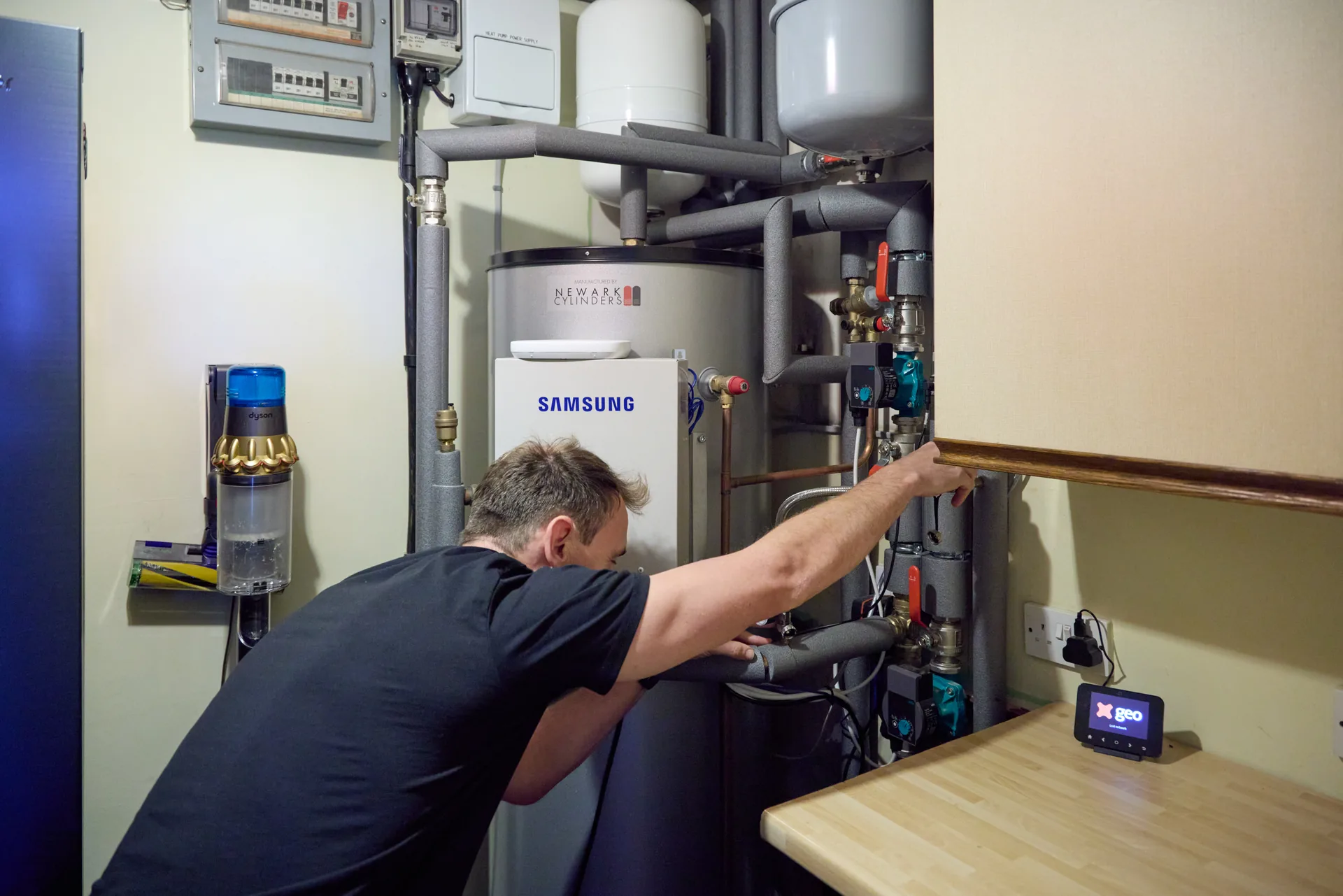
2. Replacing a combi means planning hot-water storage
A combi heats water as you use it. A conventional heat-pump installation heats stored water, so I need somewhere for that storage to go. In a small terrace, this can be the hardest part of the survey.
I've fitted Mini Stores where the boiler used to be and under a utility-room worktop. We've also used purpose-built insulated external cylinder cupboards. I usually find an option, but I can't promise every property has a practical one.
These aren't interchangeable boxes. I need to match the storage and reheating arrangement to your baths, showers and household routine. A compact option that fits beautifully but doesn't meet your hot-water demand isn't the right choice.
Energy Saving Trust's heat-pump guide also identifies hot-water storage as a key change from a combi. My heat-pump hot-water guide covers the options I use.
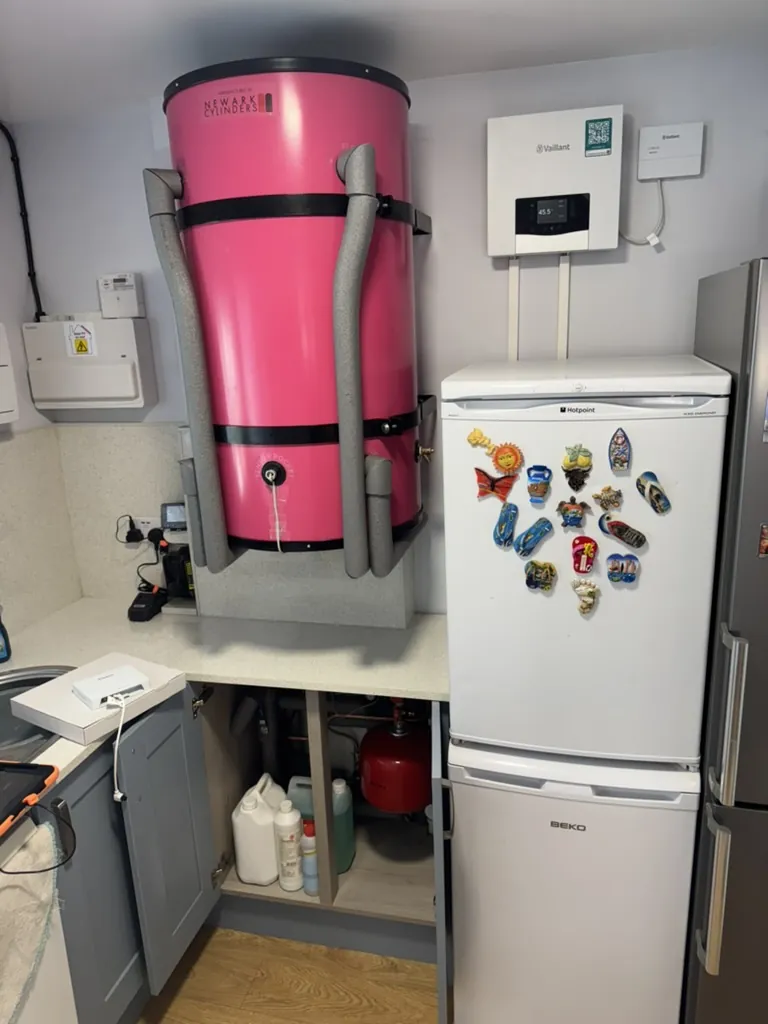
3. Installation is more involved than a boiler swap
Our heat-pump installations normally take three to four days. A straightforward boiler replacement can often be completed in one. Converting from a combi generally adds more work because we're introducing hot-water storage as well.
There can be new pipe routes, electrical work and radiator changes. Long pipe runs add time and cost. Ask which rooms we'll need access to and what needs lifting or drilling. Hot water is normally back on the same day, ready for the evening. Heating is normally off for one or two nights.
Radiator changes should have a reason
You might need several radiators changing, one or two, or none. I calculate what each room needs and check the radiator output at the proposed flow temperature: the temperature of the water going to the radiators.
I want the quotation to explain which radiators need changing and why. You shouldn't have to accept a houseful of replacements simply because someone has said “heat pumps need bigger radiators”.
Our heat-pump installation guide takes you through the work from survey to handover.
4. You need to allow more time for heating
Lower flow temperatures are more efficient, but a system designed to run steadily at those temperatures has less spare output for a sudden warm-up. Often the adjustment is simple: start the heating earlier instead of expecting a short, very hot burst.
In colder weather, I generally advise steadier temperatures and a smaller setback, often around 2°C below the comfort setting. I agree that with the customer for their home. It isn't an instruction to heat every empty house at the same temperature all day.
I ask when you're home, which rooms you use and how quickly the property loses heat. Energy Saving Trust's operating guidance explains why flow temperature and allowing enough heating time matter.
If you've always had a combi, a hot-water schedule is new too. We plan cylinder reheating around when you need water, rather than waiting for the shower to provide feedback.
Heating just one small room needs thought
If you work from home and only want to heat a small office, tell me. A heat pump has a minimum output and needs enough water moving through it. I've used larger volumisers, which hold extra heating-system water, to manage small zones. They need space too.
Not every installation needs one. Your routine isn't automatically a reason to reject a heat pump, but it has to be part of the design.
5. Servicing and repairs need specialist knowledge
Heat-pump servicing costs more than a straightforward gas-boiler service in our business. Finding someone who can diagnose a fault can also be harder. I would ask about both before choosing an installer, not just who is available to fit it.
Manufacturer backup matters to me. I've had good experiences getting Vaillant and Bosch support around Lincoln. That is my experience, not a promised response time for every breakdown.
- Servicing: who will do it, what does it cover and what does it cost?
- Repairs: does your installer diagnose faults, and how is manufacturer support arranged?
- Backup: what will provide heating or hot water while a fault is being resolved?
Where the cylinder has an immersion heater, we check that it works and replace a failed one when needed. That gives hot-water backup, not central heating. We can also lend temporary heaters when needed.
Don't assume every compact hot-water option has an immersion heater. Ask what backup your particular installation includes, and keep to its servicing and warranty requirements.
6. Lower fuel costs aren't the whole calculation
In my experience, our systems generally cost less in fuel than gas. That doesn't mean I can promise the same saving to every household, or ignore servicing and the cost of changing the system.
Removing gas completely can remove its standing charge. Keeping a gas hob or fire can mean that charge stays. Compare the full annual cost, using your tariff and a realistic estimate of system performance. I've set out the workings in our heat-pump running-cost comparison.
A small bill leaves less money to save. If your heating costs £600 a year, an illustrative 20% reduction is £120 a year. That isn't a saving forecast. It shows why I wouldn't talk only in percentages when asking someone to give up cupboard space and change a working system.
The upfront quote also needs to include the cylinder, radiator work, pipe routes and electrics it actually requires. Any grant or tax treatment must be confirmed for the job, not assumed from an old headline.
7. Sometimes the compromise isn't worth it
I would be cautious about a high-heat-loss home with no space for larger radiators, decorative radiators the owner wants to keep, or building restrictions that prevent the changes we need.
If the design still needs 70–80°C water to keep the rooms warm, I wouldn't recommend an all-heat-pump approach. Some equipment can reach those temperatures; that doesn't make it the system I'd choose for efficient everyday heating. A hybrid system may be worth assessing instead.
An old house isn't automatically unsuitable. I look at practical insulation and draught improvements alongside the heating design. We don't need new-build insulation levels, and I won't prescribe a complete renovation by default.
The RICS consumer guide makes a useful distinction: considering the whole building doesn't mean doing every improvement at once. Any work needs to suit the building and preserve necessary ventilation.
What I'd ask before accepting a quote
- Where will the heat pump, cylinder and any extra equipment go?
- What flow temperature is the system designed for?
- Which radiators need changing, and why?
- What work is included, and what disruption should I expect?
- How will the heating and hot-water routine change?
- Who deals with servicing and breakdowns afterwards?
Those answers tell you far more than a model name and a price.
Heat pump disadvantages: common questions
What is the biggest disadvantage of a heat pump?
It depends on the house. When replacing a combi in a small property, finding room for hot-water storage can be the biggest difficulty. Elsewhere it is outdoor siting, installation work or whether the likely saving justifies the change.
Do I have to replace all my radiators?
No. I check their output against each room's heat loss at the proposed flow temperature. Some installations need several changes, others only one or two, and some none.
Can I have a heat pump without a large cylinder?
Compact hot-water options can work, and I've fitted Mini Stores on walls and under worktops. They still need to meet your household's demand. I need to check capacity and recovery, not just whether the unit fits.
Do heat pumps struggle in winter?
They can keep a home warm through winter when sized and designed for the conditions. Efficiency changes with outdoor temperature, and recovery from a deep setback takes longer. A cold house shouldn't be dismissed as something you simply have to accept.
Are old houses unsuitable for heat pumps?
No. Age alone doesn't decide it. I need to know the room-by-room heat loss, radiator capacity and practical options for reducing heat loss. Difficult restrictions can make a particular installation unattractive, but an old house is not an automatic rejection.
Can a heat pump increase my bills?
Yes, depending on the previous system, tariffs, performance and heating habits. Your electricity bill will rise when electricity replaces gas or oil; compare the combined energy costs, not electricity alone. Servicing and standing charges belong in the wider comparison too.
Tell me what you'd be giving up
Cupboard space, a particular radiator, a quiet patio or a heating routine that works for you. I'd rather discuss those things during the survey than discover a problem once you've agreed the job.
We design heat-pump installations across Lincolnshire. I need to know we can heat your home comfortably and efficiently before I recommend one.
Discuss your home with usWritten from my surveys and installations, with further guidance from Energy Saving Trust and RICS linked above.